46 resultsfor “health risks from hantavirus ship Tenerife”
hantavirus outbreak since it departed from Argentina a month ago. Spanish authorities have given permission for the ship to dock in the Canary Islands, despite concerns from local officials. [About 150 people are still aboard
hantavirus is endemic, on April 1 for a cruise across the Atlantic Ocean to Cape Verde. The World Health Organization believes the first infection occurred before the start of the voyage, followed by transmission between
hantavirus on board the MV Hondius cruise ship, it is finally approaching Tenerife in the Canary Islands. Intensive preparations have been under way to receive the ship in the port of Granadilla and help more
risk from hantavirus remains low. My colleagues and I have said this unequivocally, and I will say it again to you now,” Tedros Adhanom Ghebreyesus, the director general of the World Health Organization (WHO), [said
Tenerife or the port of Las Palmas — if it can't evacuate passengers in Cape Verde. WHO said it was working with local authorities and Oceanwide on a "full public health risk assessment." "Detailed investigations
Tenerife. 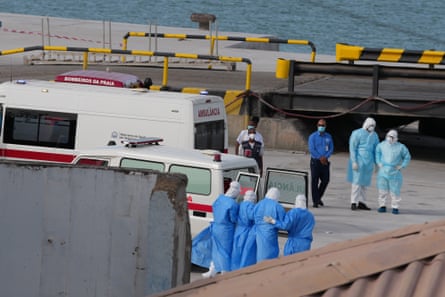 Health workers in protective gear evacuate patients from the MV Hondius cruise ship. Photograph: Misper Apawu/AP The ship
hantavirus after a case was detected among a Dutch crew member of the ship at the centre of the outbreak. Tedros Adhanom Ghebreyesus, the WHO chief, told a news conference in Geneva on Friday that
hantavirus](/news/2026/5/4/what-is-hantavirus-suspected-in-deaths-of-three-people-on-cruise-ship) outbreak linked to a cruise ship, with a new suspected case identified among a British national on the remote South Atlantic island of Tristan da Cunha. The UK Health Security Agency confirmed
hantavirus](https://www.theguardian.com/world/hantavirus)-stricken cruise ship M/V Hondius were being repatriated to the United States on Sunday after the vessel docked in Tenerife and all the passengers were evacuated. Upon their arrival in [Spain
hantavirus-stricken MV Hondius remain asymptomatic after the vessel arrived in Tenerife on Sunday, almost a month after the first passenger died of the rodent-borne disease on board the ship. “The anchoring has been
Tenerife airport, after disembarking from the hantavirus-stricken cruise ship MV Hondius, Spain, 10 May, 2026. Photograph: AP The two outbreaks “are just the latest crises in our troubled world”, WHO chief Tedros Adhanom Ghebreyesus
Tenerife and another to the Netherlands will take 18 passengers. Both flights are to also carry passengers from other countries that did not send their own repatriation flights, officials said. Hantaviruses can cause severe respiratory
Health and Human Services said all 17 US citizens on the flight will "will undergo clinical assessment" at a medical facility in Nebraska. Seven other US passengers had already returned and are being monitored
Hantaviruses are usually carried by rodents, but human transmission of the Andes strain - which the WHO believes some of the ship's passengers contracted in South America - is possible. Symptoms can include fever, extreme fatigue
ship at the centre of a hantavirus outbreak](https://www.theguardian.com/news/ng-interactive/2026/may/09/how-hantavirus-turned-hondius-dream-cruise-into-tragedy). Dfat said it is not aware of any of the travellers who are displaying symptoms of the virus, but will help coordinate response efforts
hantavirus outbreak](/news/2026/5/4/what-is-hantavirus-suspected-in-deaths-of-three-people-on-cruise-ship) and anchored off the coast of Cape Verde to sail to the Canary Islands. Spain’s Ministry of Health said in a statement late on Tuesday that the World Health Organization
Tenerife island on Monday and is sailing to the Dutch port of Rotterdam. Two flights with the final group of 28 passengers landed in nearby Eindhoven on Tuesday. Three people have died after travelling
Tenerife, off the coast of West Africa, on Saturday or Sunday. [
risk to the broader public is low. People are usually infected by hantavirus through contact with infected rodents or their urine, their droppings or their saliva. Human-to-human transmission is rare. But a limited