
Soft toys, memes and a movie villain: Labor tries to simplify the message but selling a budget isn’t child’s play
Labor faces challenges in explaining its federal budget amid public skepticism.
The Guardian World1 min read
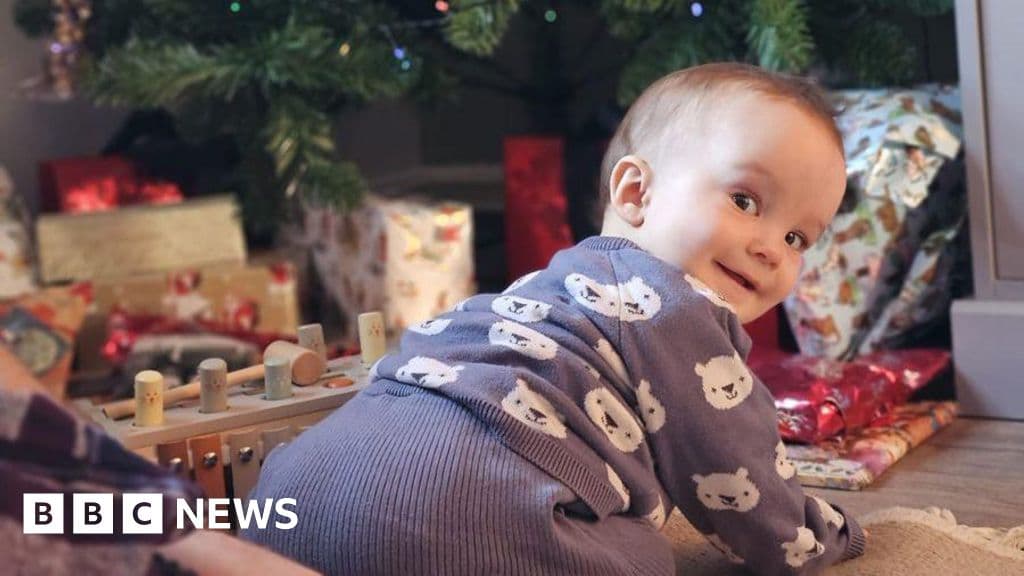
A baby named Arthur, believed to be the youngest in the UK to receive a rare intrauterine blood transfusion, is now thriving after battling severe anemia caused by parvovirus. His mother, Maisie, reported that the procedure was successful and Arthur is a cheerful little boy.
Mentioned in this story
A baby who contracted a virus when he was still in the womb is thought to be the youngest in the UK to receive a life-saving, rare blood transfusion procedure.
Doctors discovered Arthur had caught parvovirus, which led to severe anaemia, a build-up of fluid and heart failure.
Specialists at St George's Hospital in London gave the infant what is known as an intrauterine transfusion (IUT) when he was about the size of an avocado and his mother was 16 weeks pregnant.
His mother, Maisie, a 30-year-old primary school teacher from Cranleigh in Surrey, said it was 50/50 whether her son would survive, but the procedure was successful and he was now a "really chirpy little boy".
Medics believe Arthur is the youngest patient in the UK to have had the procedure.
Parvovirus, also known as slapped cheek syndrome, is usually harmless to children but Arthur was extremely unwell because of his immature immune system.
Maisie described the procedure in 2024 as "absolutely terrifying".
"He was so small the doctors were working within millimetres," she said.
Arthur, born in January 2025, was "doing great" and "reaching all the milestones", she said.
"To have the life I am now living, with my family, there's no words to express the gratitude I feel and how fortunate I was to be able to access that care and blood promptly," she added.
She said she often wondered who the donor was, adding: "I would love to tell them that their decision to give blood gave my boy the chance to be here."
About 180 IUT units are issued each year by NHS Blood and Transplant (NHSBT), using blood from donors who must meet strict criteria.
Paul Bickley, 45, from Richmond, one of eight donors whose blood has been used most often, said: "I just realised life is very precious and that kept me donating. Hearing my blood was used in this way almost made me cry."
David Smith, 64, a donor from Westminster, said: "If you can help babies, you have to. It's always a pleasure."
Dr Anne Kelly, paediatric transfusion and components clinical expert for NHSBT, said IUTs were very rare, donors were carefully selected and extra safety measures were applied, because patients were "particularly vulnerable".
Consultant paediatrician and chief medical officer at St George's, Dr Luci Etheridge, added: "A blood transfusion while still in the womb can mean the difference between life and loss.
"We are proud to provide this highly-specialised, lifesaving care."
Additional reporting by PA Media
An intrauterine transfusion (IUT) is a medical procedure that involves transfusing blood into a fetus while still in the womb to treat conditions like severe anemia.
Arthur contracted parvovirus while still in the womb, which led to severe anemia and complications like fluid build-up and heart failure.
Intrauterine blood transfusions carry risks such as infection, premature labor, and complications for both the mother and the fetus, but they can be life-saving in critical cases.
Labor faces challenges in explaining its federal budget amid public skepticism.

New NDIS rules will cut 240,000 participants in four years, documents reveal.

Experience the rich sounds of samba, jazz, and morna in Cape Verde!

Republicans rally behind Ken Paxton following his Texas primary victory over John Cornyn.

Senior Labour party figures criticize Tony Blair's recent advice, stating it overlooks issues of inequality and austerity. Andy Burnham plans to respond, emphasizing that understanding inequality is crucial for addressing Britain's political challenges.

WHO chief urges ceasefire in DRC to combat Ebola outbreak
See every story in News — including breaking news and analysis.