

Me, worry? For US small businesses, Trump’s tariffs are now a non-issue
US small businesses have moved past concerns about Trump's tariffs, adapting to new economic realities.
The Guardian World1 min read

Fans are boycotting the upcoming World Cup in North America, raising concerns about its success. The tournament is set to begin in mid-June, co-hosted by the U.S., Mexico, and Canada.
Mentioned in this story

Ty Malugani posing at St. James Park, the stadium of Premier League team Newcastle United in Newcastle upon Tyne, England. Ty Malugani/Ty Malugani
Ty Malugani/Ty Malugani
When Ty Malugani in Alabama heard the World Cup was coming to North America, he was thrilled.
This was finally his chance to go to a World Cup right in the U.S and take his four little ones to experience the game he loves. The U.S. is co-hosting the tournament with Mexico and Canada starting in mid-June.
"We always talked about going to a World Cup," Malugani says. "And so we were like, oh, there's one in America! Just perfect, perfect timing."
Soon enough, that excitement turned into disappointment. First, there were the eye-watering ticket prices. The cheapest match for the U.S. team would cost his family almost $1,600 — for nosebleed seats. If his family wanted to go to the U.S. opening game, it would cost them over $6,700 for seats.
Fans are boycotting the World Cup due to various concerns, including issues related to the event's organization and social implications.
The boycott could significantly affect attendance and overall enthusiasm for the tournament, potentially leading to a less successful event.
The World Cup starts in mid-June and is co-hosted by the United States, Mexico, and Canada.
Ty Malugani is a fan from Alabama who was excited about the World Cup coming to North America, as it offers him a chance to share the experience with his children.
US small businesses have moved past concerns about Trump's tariffs, adapting to new economic realities.
Record super PAC funding in 2024 primaries raises concerns over donor secrecy.

US government restricts foreign access to Anthropic's AI models over security concerns.
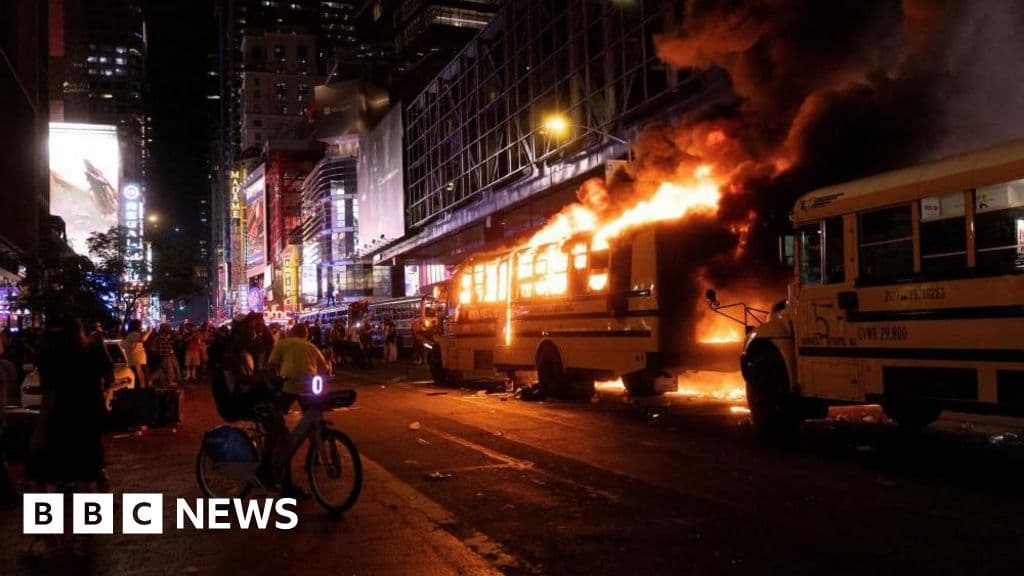
A teenager was shot and buses were set on fire in Manhattan during celebrations for the Knicks' first NBA championship win in over 50 years. The chaotic scenes unfolded as fans celebrated the team's victory over the Spurs.

Democrats face a challenging Senate race in Maine after backing Janet Mills over Graham Platner, who won the primary. Platner's controversial past complicates the party's strategy as they prepare for a tough general election against Republican Susan Collins.

A 94-year-old mother from Cambridgeshire seeks justice for her daughter, Lindsay de Feliz, whose murder retrial begins this week in the Dominican Republic. Lindsay's body was discovered in December 2019, and her mother hopes new evidence will lead to a conviction.
See every story in News — including breaking news and analysis.
Then there was the confusing way FIFA is selling the World Cup tickets, from using lotteries to its hard-to-understand array of seating categories.
The last straw for Malugani came when the organization awarded President Trump the FIFA Peace Prize, a new recognition given to those who "have helped unite people all over the world in peace."
For Malugani, it felt as if FIFA was more focused on cuddling up to the president than on soccer fans like himself.
"It felt very much like we're not going to care about the fans, or the event itself," he says. "We're not going to care about anything other than trying to appease this one person in order in the hopes that they may benefit FIFA in some way."
With less than two months left before the start of the World Cup, Malugani is one of many fans from the U.S. and from overseas who told NPR they've grown so frustrated with the World Cup — and some of the policies from the Trump administration — that they are deciding not to attend the tournament at all.
FIFA, for its part, says it's seeing "unprecedented" demand for tickets to the World Cup, which will bring star athletes such as Lionel Messi from Argentina or Cristiano Ronaldo from Portugal to North America.
But there are signs that demand for the World Cup is running below expectations, at least so far — and it's raising questions about whether the tournament might not be quite the resounding success many had anticipated.
Jan Freitag, who analyzes the hospitality industry as National Director for CoStar Group, a real estate and hospitality data provider, says he still feels demand will pick up in the second half of the tournament, when the knockouts and the final take place in July.
But demand in the first half of the World Cup has been softer than expected, he adds.
"It's a confluence of, oh, there's a war going on. Oh, airfares are high. Oh, ticket prices are high. You know, and in the first round stages, maybe those matches aren't super interesting. So, you know, maybe it's sort of a little bit of everything," Freitag says.
In another sign of potential trouble, hotels are reporting bookings are not running as high as the industry had expected.
One reason is that FIFA canceled a large number of hotel rooms across some of the host cities, according to Rosanna Maietta, who leads the American Hotel & Lodging Association. Although it's common for FIFA to overbook hotel rooms before tournaments, the number of cancellations caught the industry by surprise.

Saudi Arabia supporters hold a replica of the FIFA World Cup trophy ahead of a match between Saudi Arabia and Mexico in Lusail Stadium in Qatar during the 2022 World Cup. Khaled Desouki/AFP via Getty Images
Khaled Desouki/AFP via Getty Images
But another major reason is that the industry is not yet seeing the number of bookings from overseas travelers it had expected.
"That makes us take a deep breath," Maietta says. "It remains to be seen where we'll end up by the time the games are here."
Maietta, however, said she was hopeful bookings will pick up as the tournament approaches.
But don't count on Kieran Maguire to be one of them.
Maguire is a professor of soccer finance in Liverpool, England, who hosts a popular podcast on the subject. But he is also a fan, having attended several World Cups before.
Not this one, though. Maguire says he no longer feels welcome in the United States, a country he says he loves and where he has felt comfortable visiting before.
But lately, he's wary. Maguire cites recent rules that allow immigration officers to scrutinize the social media history for a variety of visitors, which could be expanded to also include those from countries with visa waiver agreements with the U.S.
The White House has also imposed bans or travel restrictions on around three dozen countries, including on four teams that are actually taking part in the World Cup.
Another reason, Maguire says, are the recent cases of violence involving ICE in cities such as Minneapolis where several people have been killed.
"We've seen what's happened in Minnesota. We've seen what's happened in other cities as a whole," he says. "I think some of the measures … which are seen as being draconian, which are seen as being quite repressive, have had a negative impact upon those willing to attend the World Cup."
Like FIFA, the White House is adamant the tournament will be a success — and pushed back against those who criticize the administration.
"The FIFA 2026 World Cup will no doubt be one of the greatest and most spectacular events in the history of mankind," says White House spokesman Davis Ingle in a statement. "President Trump is focused on ensuring that this is not only an incredible experience for all fans and visitors, but also the safest and most secure in history."
But Malugani in Alabama won't be one of the people attending. His biggest regret still remains that his four kids also won't be able to watch them in person. He had been hopeful they could go to the World Cup so that they could also grow up loving soccer, just as he did.
But he now feels it's a tournament that's no longer meant for people like them.
"That to me is the worst. Because I love the sport and I want future generations to love the sport," he says. "Hopefully things can turn around and things can maybe, maybe work out. But as of right now, it just feels like it's a missed opportunity."


