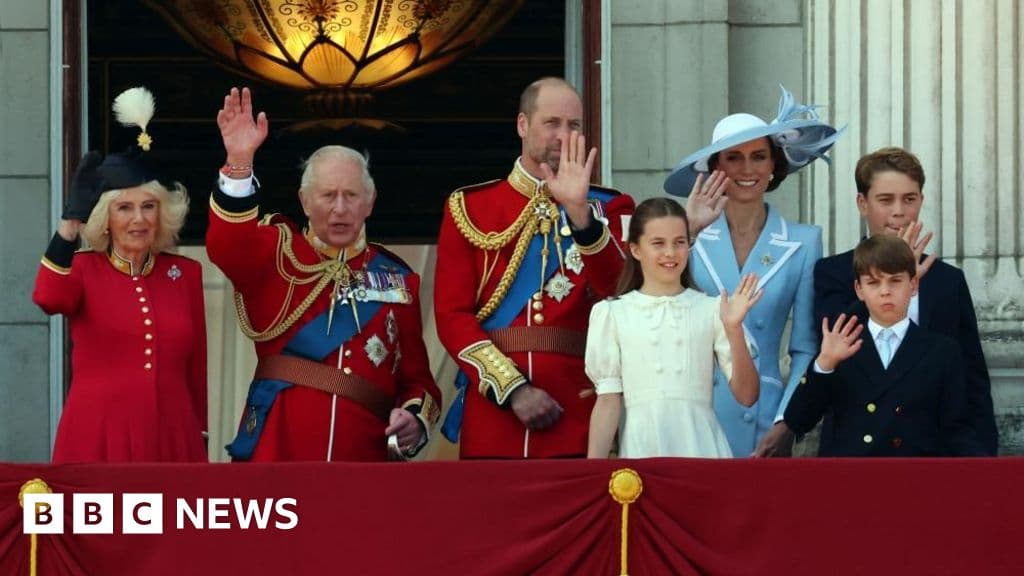
Royal Family watch Red Arrows flypast on Buckingham Palace balcony
The Royal Family gathers at Buckingham Palace for the Red Arrows flypast during Trooping the Colour.
BBC News1 min read

The Supreme Court is considering President Trump's bid to end Temporary Protected Status for Haitians and Syrians, which could lead to mass deportations of individuals who have lived legally in the U.S. for over a decade.
Mentioned in this story

The Supreme Court Andrew Harnik/Getty Images
Andrew Harnik/Getty Images
President Trump could move forward with mass deportations of people who have been living legally in the U.S., many of them for more than a decade, if he prevails in two cases before the Supreme Court Wednesday.
At issue is the Temporary Protected Status program, which permits eligible individuals to live and work in the United States if they cannot return to their home countries because of natural disasters, armed conflicts, and other "extraordinary or temporary conditions." Congress enacted the TPS program in 1990 to establish criteria for selecting, processing, and registering people fleeing such turmoil.
Since then, every president, Republican and Democrat, has embraced the program, except Trump. He is trying to get rid of it.
The vehicle is the temporary status extended previously to eligible individuals from two countries: Haiti, where a devastating earthquake killed more than 300,000 people in 2010 and left the country with roving gangs, cholera epidemics, and without a functioning government — conditions that persist today — and Syria, where a relatively small group of 7,000 individuals has been granted protected status, as a civil war and Israeli bombing attacks continue in parts of the country.
Trump has never made any secret of his views on these countries. As he said to a crowd last year, "Why is it we only take people from shithole countries? Right? Why can't we have some people from Norway, Sweden. Just a few."
TPS doesn't work like most other immigration benefits. It applies only to people who have continuously lived in the U.S. legally since the most recent TPS country designation. They are eligible to remain here, but under strict criteria.
"They have to go through a vetting process which involves biometrics, background check, running them against all the government's databases," says Ahilan Arulanantham, who represents the Syrians in Wednesday's case. "Two misdemeanors, you're out."
In addition, people with TPS have to renew every 18 months and go through the process all over again.
The Trump administration, however, contends that none of this matters because, under the 1990 TPS statute, none of these judgments is subject to review by the courts at all. As the administration put it in its briefs, the statute "covers the waterfront," barring judicial review of all the provisions of the law.
Temporary Protected Status (TPS) allows individuals from certain countries to live and work in the U.S. if they cannot safely return due to disasters or conflicts.
If the Supreme Court rules in favor of Trump, it could lead to mass deportations of TPS recipients who have been living legally in the U.S. for many years.
Many TPS recipients have been living legally in the U.S. for over a decade, having been granted status due to conditions in their home countries.
TPS is granted based on extraordinary conditions such as natural disasters, armed conflicts, or other temporary situations that prevent safe return to the home country.
The Royal Family gathers at Buckingham Palace for the Red Arrows flypast during Trooping the Colour.

Bangkok mourners line streets for Princess Bajrakitiyabha's funeral procession.

Discover how Footy Addicts is building friendships through football in London!

Could Scotland's coach Steve Clarke surprise fans with a midfield change against Haiti?

Thousands gather for anti-racism rally in Belfast after recent violence targeting homes and businesses.

Anthropic to disable advanced AI models following US order limiting foreign access.
See every story in News — including breaking news and analysis.
Twenty-one Republican attorneys general are supporting the administration — among them, Kansas Attorney General Kris Kobach. He notes that under TPS some of the 17 countries that have been designated as too dangerous to go back to, have been on the protected status list for more than a decade.
"Temporary protective status was never intended to be a de facto amnesty," says Kobach. "That status, as its name suggests, is temporary."
Lawyers for the Haitians and Syrians counter that the provision barring court review applies to only to one section of the law, not the rest. And they assert that the Trump administration has failed to comply with the procedures mandated in the TPS program and the Administrative Procedure Act.
The APA , as it's known, was enacted 80 years ago, and sets the rules of the road for how federal agencies develop, issue, and enforce regulations. It requires agencies to follow specific, transparent procedures and, importantly, it provides a framework for judicial review of agency actions in order to prevent arbitrary decisions.
Specifically, in the case of the Haitian nationals, then-Secretary of Homeland Security Kristi Noem terminated Haiti's TPS status in response to a Trump executive order.She gave two reasons: First, that there are no extraordinary conditions in Haiti that prevent Haitians with TPS status from returning home in safety. And, second, that even if Haiti were unsafe, termination of TPS protection is still required because, "it is contrary to the national interest."
Noem made similar findings for Syria, citing problems with vetting Syrian nationals, and pointing to two Syrians under criminal investigation, neither of whom had TPS.
Regardless, the administration notes that, traditionally, the Supreme Court has been highly deferential to executive branch claims in the area of immigration because they involve "critically important" matters of "national security and public safety."
Lawyers for the TPS recipients will tell the court, however, that the findings in both cases were entirely "pretextual," meaning a sham. They contend that rather than conduct the required extensive consultation with the U.S. State Department about conditions in those countries—a consultation that is mandated by law—the State Department rubber-stamped the DHS secretary's findings with a two-sentence statement.
The Haitians do have one claim that does not fall under the umbrella of immigration. They contend that the Trump administration has discriminated against them based on their race. And they cite in particular some of Trump's more inflammatory language, for instance, claiming falsely in a presidential debate in September 2024, that Haitians in Springfield, Ohio, "are eating the dogs. The people that came in, they're eating the cats. They're eating the pets of the people that live there."
The Supreme Court, however, has refused to consider such language in previous cases, calling it "political."
In the lower courts, both the Haitians and Syrians did prevail on TPS, on a preliminary basis. But the Supreme Court has been critical of lower court judges in other immigration cases for stepping outside of their lane. And prior to this case, the court's conservative majority has largely deferred to the administration.