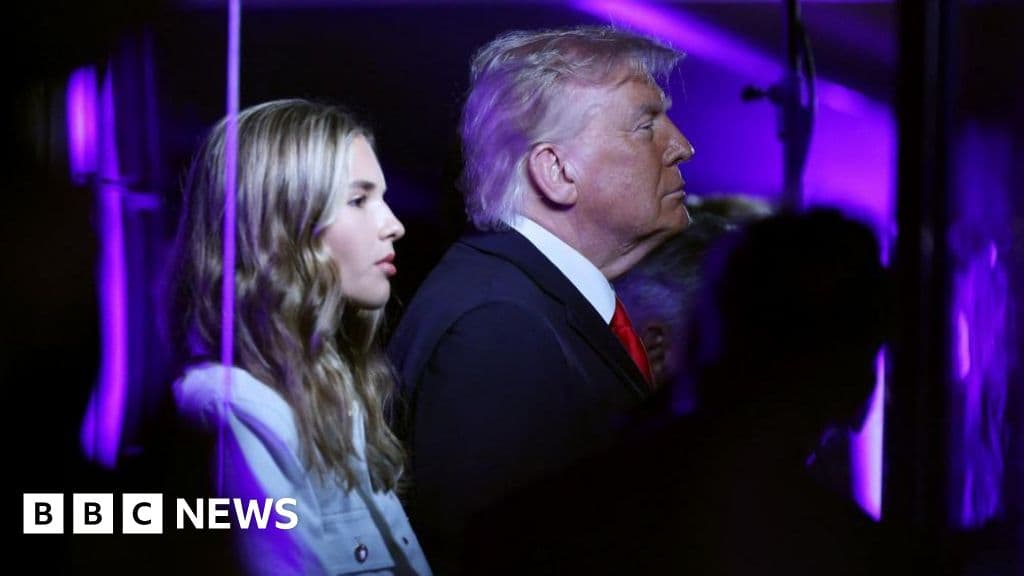
Trump booed in New York as he becomes first US president to attend NBA Finals
Trump becomes first sitting president to attend NBA Finals, booed by crowd
BBC News1 min read

Keir Starmer rejects claims of Labour's complacency on defence funding, asserting that spending is increasing. He faced questions regarding comments from former Labour defence secretary George Robertson about the government's approach to defence and social security.
Mentioned in this story
Keir Starmer has said he does not agree with George Robertson’s comments about the government’s “corrosive complacency” on defence funding, as the prime minister faced sustained pressure on the issue.
Questioned in the Commons about the warnings by Robertson, the former Labour defence secretary and Nato chief who co-authored a defence review for the government, Starmer insisted that defence spending was increasing rapidly.
Pressed by Kemi Badenoch about whether he agreed with Robertson, now a Labour peer, that social security should be cut to boost defence, Starmer said his government was tackling both areas – and argued that previous Conservative governments neglected them.
Government sources have not denied that Rachel Reeves has proposed increasing the budget by less than £10bn over the next four years amid concerns that any more would be unaffordable.
While the government has committed to reach 2.5% of GDP on defence from April next year, then 3% in the next parliament, military leaders believe there is still a £28bn shortfall after years of the armed forces being hollowed out by successive administrations.
With defence spending discussions due this week, military leaders are understood to have been asked to find £3.5bn in savings this year, even as the armed forces are being readied for conflict.
Asked by Badenoch whether he agreed with Robertson, Starmer said: “I respect Lord Robertson, and I thank him again for carrying out the strategic [defence] review. My responsibility is to keep the British people safe, and that is a duty I take seriously. That is why I do not agree with his comments last February.”
Questioned about when a promised defence investment plan would materialise, Starmer said it was important to get this right, and that it would be “published as soon as possible”.
He defended Reeves’ record on defence spending, saying that the promised increases to the defence budget were possible “because of the decisions of this chancellor”.
Robertson publicly aired his frustration at the government’s failure to come forward with its 10-year spending plans for defence in a speech on Tuesday night, warning: “We cannot defend Britain with an ever-expanding welfare budget.”
Speaking earlier on Wednesday, James Murray, the chancellor’s deputy, argued that balancing welfare and defence spending “is not a zero-sum game”.
“We’ve decided to have the biggest sustained increase in defence investments since the cold war,” Murray told Times Radio. “At the same time, we’ve begun our work to reform the welfare system, changing universal credit, reducing fraud and error, reforming motability. There’s more work to do.”
Keir Starmer stated that he disagrees with George Robertson's comments about complacency and emphasized that defence spending is increasing rapidly.
George Robertson is a former Labour defence secretary and Nato chief who criticized the government for its 'corrosive complacency' on defence funding.
Rachel Reeves has proposed increasing the defence budget by less than £10 billion over the next four years.
The government has committed to reaching 2.5% of GDP on defence from April next year, increasing to 3% in the next parliament.
Trump becomes first sitting president to attend NBA Finals, booed by crowd

ABC managing director Hugh Marks secretly searches for new news director, replacing Justin Stevens.

Trump warns Netanyahu: ‘You’ll be on your own’ if attacks on Iran continue

Jacinta Allan criticized a billboard in Melbourne depicting her with the phrase 'Ditch the witch,' calling it sexist and hateful. Pauline Hanson defended the billboard, stating she has faced similar insults for years.

US designates Alibaba, BYD, and Baidu as military companies, straining US-China relations.

Botswana's diamond mining slump leaves workers like Motshwegwa Rakhudu struggling to survive.
See every story in News — including breaking news and analysis.
He added: “It’s not a zero-sum game because we are increasing the investment in defence as a result of our decisions to record levels … It’s worth also saying that the welfare system isn’t some kind of amorphous blob. It includes things like our decision to remove the two-child benefit cap, which helps hundreds of thousands of children out of poverty.”
John Healey, the defence secretary, is understood to be pushing the Treasury for more money for defence. However, the suggestion that public spending cuts may be necessary to fund defence has prompted an angry reaction on the left of Labour.
John Hutton, another Labour peer who was a defence secretary under Tony Blair, said Starmer needed to “knock heads together here” and ensure the Treasury released more funding without first seeking guarantees on procurement systems.
He told the Guardian: “I think the Treasury rightly feel that the MoD wastes a lot of money at the moment, as they do – the procurement process is notoriously inefficient – and you could really save significant money, which you could then reinvest.
“But I don’t think it’s reasonable for the Treasury to say at the moment that, until you come up with a credible plan [for efficiencies] – I think they want six or seven billion from the MoD – until you come up with that plan, we won’t allow you to spend. That is completely wrong. Because that just simply does not take into account the geopolitical situation we’re in.”