
Fisa spy powers almost certain to expire after Congress fails to act – US politics live
Fisa spy powers on the brink of expiration after Congress inaction
The Guardian World1 min read
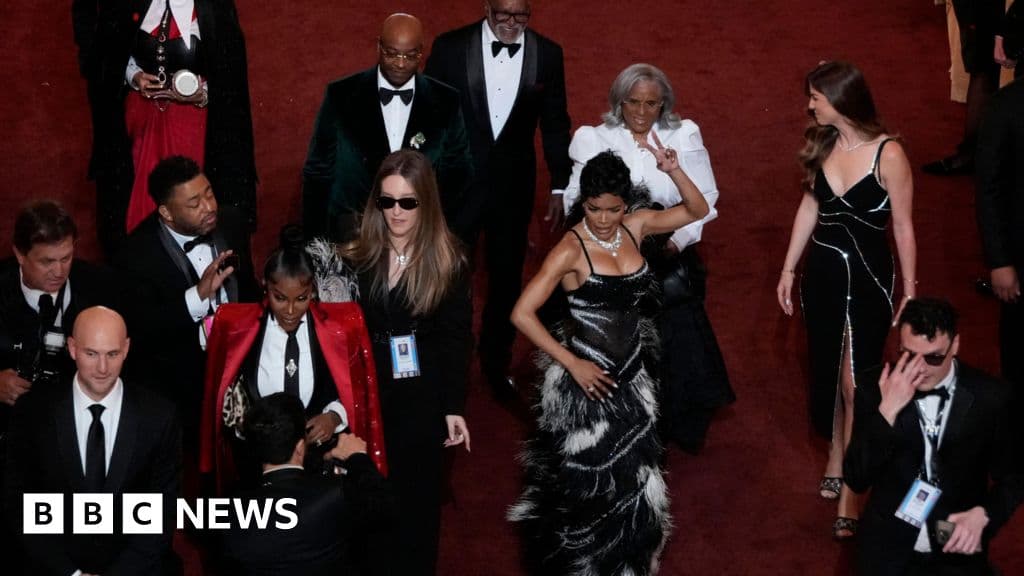
The Academy of Motion Picture Arts and Sciences has announced that only human actors and writers are eligible for Oscars, clarifying that AI-generated performances and scripts will not be considered. This marks a significant change in the eligibility rules for the prestigious awards.
The Academy of Motion Picture Arts and Sciences has clarified that only acting and writing for films done by humans will be considered eligible to win an Oscar.
The academy, which controls the US film industry's most prestigious award, on Friday issued updated rules for what kind of work in movies and documentaries would be considered eligible for an Oscar as the use of artificial intelligence (AI) technology grows.
In updated eligibility requirements, the Academy specified that only acting "demonstrably performed by humans" and that writing "must be human-authored" in order to be nominated for an award.
The Academy called the requirements a "substantive" change to the rules for the Oscars.
The need to specify awards can only go to acting and writing done by "humans" is new for the academy.
In recent months, there have been notable examples of expansive use of AI tools and technology to replace or recreate human work.
The actor Val Kilmer, who died in 2025, is set to be recreated with AI technology in order to be a lead role in an upcoming movie. Last year, London-based actor and comedian Eline van der Velden said she had created an entirely fake AI actor to "become a global superstar".
When the union representing Hollywood writers went on strike two years ago, a key issue in the fight was film and TV studios using AI to write scripts.
Meanwhile, the basis of all AI tools are large language models (LLMs), which have been trained on text, images and video created by humans over the decades in order to produce their outputs.
Hollywood studios, actors and authors have pursued lawsuits claiming copyright infringement against a number of AI companies.
However, the academy did not issue a ban on AI use in films more broadly.
Outside of acting and writing, if a filmmaker used AI tools in their work, such "tools neither help nor harm the chances of achieving a nomination", the academy wrote.
"The Academy and each branch will judge the achievement, taking into account the degree to which a human was at the heart of the creative authorship when choosing which movie to award," the group added.
"If questions arise regarding the aforementioned use of generative artificial intelligence, the Academy reserves the right to request more information about the nature of the use and human authorship."
Technology has been part of filmmaking for many years, with the use of computer-generated imagery (CGI) being used widely since the 1990s.
The new rules state that only acting performed by humans and writing that is human-authored can be nominated for an Oscar.
The Academy made this specification due to the growing use of artificial intelligence in film, aiming to maintain the integrity of the awards.
This change may limit the role of AI in film production, as it explicitly excludes AI-generated performances and scripts from award consideration.
Fisa spy powers on the brink of expiration after Congress inaction

Belfast faces anti-immigrant riots following a violent knife attack.

Trump cancels planned strikes on Iran, hints at peace deal.

Barclays is buying GoHenry, a kids' debit card app, to target young users.

Key FISA provision set to expire as Trump faces backlash over DNI appointment

Watford legend Kenny Jackett passes away at 64
See every story in News — including breaking news and analysis.
While CGI is largely considered to be a manual process, something done and perfected by humans to create elements of a film, AI tools are generally designed to automate the work entirely through the use of simple prompts.