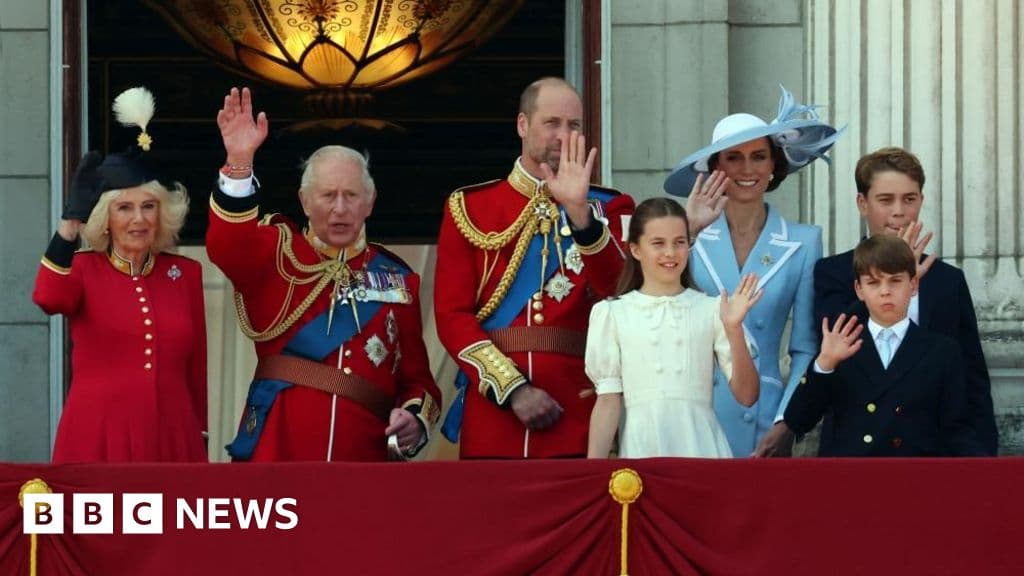
Royal Family watch Red Arrows flypast on Buckingham Palace balcony
The Royal Family gathers at Buckingham Palace for the Red Arrows flypast during Trooping the Colour.
BBC News1 min read

India's investment in Iran's Chabahar Port faces uncertainty after the US waiver on sanctions expired, jeopardizing a key trade corridor to Afghanistan and Central Asia.
Mentioned in this story
New Delhi, India — Relations between the United States and India are at a crossroads yet again: this time, over New Delhi’s decade-long investment in Iran’s Chabahar Port.
India’s most ambitious connectivity project in its extended neighbourhood now potentially faces a dead end after a US waiver on sanctions imposed on the project expired on Sunday, with no signs of its revival from Washington. The port has been the centrepiece of India’s hopes of building a trade and transit corridor with landlocked Afghanistan and Central Asia.
The US has been pressuring Iran’s economy towards collapse through an aggressive sanctions regime aimed at choking off its revenue streams, under its “maximum pressure” campaign.
The latest is the naval blockade against Iran’s ports, while Tehran claims control over the Strait of Hormuz. India is heavily dependent on the narrow sea route for energy supply, and has been negotiating with Iran to secure passage.
So is India’s Chabahar dream dead now?

A security person looks on at oil docks at the port of Kalantari in Chabahar, 300km (186 miles) east of the Strait of Hormuz, January 17, 2012 [Raheb Homavandi/Reuters]
In southeastern Iran, perched on the Gulf of Oman, the Chabahar port comprises two terminals: Shahid Kalantari and Shahid Beheshti. India has been involved in the Shahid Beheshti and has invested at least $120m in equipping it.
The port has been hailed as a cornerstone of India’s economic and strategic ambitions over the last two decades, because of its geography.
At the moment, Pakistan — India’s archrival and nuclear-armed neighbour — stands between India and landlocked Afghanistan and Central Asia. Because of persistent tensions with Pakistan, a land route to Afghanistan and the Central Asian nations is not an option for India.
The Chabahar port allows India to circumvent that problem using a maritime route – shipping between the Iranian port and Iran’s west coast, and then road and rail transit through Iran to Afghanistan and Central Asia. It is a method India has used repeatedly over the past decade.
There is a second, strategic reason why the port matters to India.
In November 2016, Pakistan inaugurated the China-funded deep-sea port of Gwadar at the mouth of the Gulf of Oman. It is a commercial port, but China’s influence there has meant that India has long feared it could be used to either economically or militarily challenge India through maritime naval operations.
India's Chabahar Port project is at risk after the US waiver on sanctions expired, limiting India's ability to proceed.
The US imposed sanctions on Iran's Chabahar Port as part of its 'maximum pressure' campaign to weaken Iran's economy.
Chabahar Port is crucial for India to establish a trade and transit corridor with landlocked Afghanistan, enhancing connectivity.
The US sanctions complicate India's energy supply, as it relies on the Strait of Hormuz for energy imports and has been negotiating with Iran for secure passage.
The Royal Family gathers at Buckingham Palace for the Red Arrows flypast during Trooping the Colour.

Discover how Footy Addicts is building friendships through football in London!

Anthropic to disable advanced AI models following US order limiting foreign access.

Ben Stokes returns to Durham training after missing England's Test due to curfew breach.

FDA approves a new sunscreen ingredient that blocks UVA and UVB rays, the first in nearly 30 years!

Is John Healey's resignation the start of a crisis for Downing Street?
See every story in News — including breaking news and analysis.
Chabahar offers an escape: it is located about 140km (87 miles) west of Gwadar and is also a deep-water port on the Gulf of Oman. It gives India a strategic presence that mitigates the risks posed by Gwadar by outflanking it.
The Chabahar port is also the southern node of the International North-South Transport Corridor (INSTC) — a 7,200km (4,474-mile) network of railroads, highways and maritime routes that connects Russia and India through Iran.
“Chabahar is important for India’s connectivity endeavours in Central Asia, a region not easily accessible for New Delhi,” said Kabir Taneja, a fellow at the India-based Observer Research Foundation think tank.
“The Iranian port, and the attached INSTC corridor, offers both a core investment with Iran and access to geographies, including Afghanistan, that are looking to diversify their access to coastlines and ports,” Taneja told Al Jazeera.
While India and Iran first agreed to develop the port in 2003, the waves of US sanctions on Iran that followed halted any progress. The talks were revived after Washington eased sanctions under the 2015 Iran nuclear deal.
In 2016, India’s Prime Minister Narendra Modi visited Tehran, announced a plan to build and operate the key Chabahar port after meeting then-President Hassan Rouhani, and pledged to invest $500m to develop the strategically important port.
It became minimally operational before US President Donald Trump withdrew from the nuclear deal in 2018 during his first term, and sanctioned Iran again. But India soon secured a sanctions exemption from Trump to continue developing Chabahar. Afghanistan was at the time ruled by a US-backed government that needed Indian aid shipped through Chabahar.
Since the Taliban came to power in Kabul in 2021, bilateral relations between Afghanistan and Pakistan have hit rock bottom, often spilling into fighting along the border.

Despite Trump’s “maximum pressure” policy to choke Iranian revenue streams, the US Treasury Department had initially exempted Chabahar from sanctions in 2018. This was during Trump’s first term.
But in September 2025, the second Trump administration announced that it was revoking all exemptions to Iran-related sanctions, including for Chabahar. India lobbied and got the Chabahar exemption extended until April 26, 2026, after reportedly promising to wind down operations there.
India also paid $120m in promised investments in February this year, raising criticism from opposition parties that accused Modi’s government of buckling under US pressure to abandon a vital strategic project.
“To now hear that India has unceremoniously retreated from Chabahar at the first hint of pressure from the United States represents a new low in this government’s conduct of foreign policy,” Pawan Khera, a spokesperson for the Indian National Congress, India’s main opposition party, had said then.
“For how long will the Government of India allow Washington to dictate our national interests?”
After the waiver expired on Sunday, Randhir Jaiswal, a spokesperson for India’s Ministry of External Affairs, told reporters in the national capital that New Delhi is discussing the issue with Tehran and Washington.
“Obviously, the current conflict is also a complicating factor,” Jaiswal added, referring to the ongoing war.

Indian Prime Minister Narendra Modi and US President Donald Trump hold a joint news conference at the White House in Washington, DC, on February 13, 2025 [Andrew Caballero-Reynolds/AFP]
Last year, a day before the US sanctions were to kick in — before the waiver was extended — the New Delhi-appointed officials of India Ports Global Ltd (IPGL), which manages the Chabahar port, resigned, and its website was taken down.
In February this year, the Indian government did not allocate any money for Chabahar in its annual budget, in the first such omission in nearly a decade.
Rajan Kumar, a professor of international studies at New Delhi’s Jawaharlal Nehru University, told Al Jazeera that India has no other option but to wait for the hostilities to end in the Middle East.
“Until the time conflict ends and Iran remains under heavy sanctions, India does not have much of a choice,” said Kumar.
New Delhi has reportedly been looking to transfer the stake of government-owned IPGL Chabahar Free Zone to an Iranian entity for operations. However, no deal has been reached yet. Such a transfer could allow India to return to its role in managing port operations whenever sanctions are lifted on Iran in the future, analysts say.
“Chabahar has really become a losing bet over the last few years. In that sense, it’s really a damaged asset,” said Michael Kugelman, a resident senior fellow for South Asia at the Atlantic Council.
“There could be scenarios later when India could pick an opportunity, but with the war in Iran, and the likely possibility of continued tensions with the US, the ties will remain extremely fraught,” he told Al Jazeera.
So, India would face a difficult sanctions challenge with the Chabahar port if it were to move forward with it, said Kugelman. “It would be increasingly difficult for it to avoid the risk of the US sanctions.”
At best, Kugelman said, India will play a long game and look to return to the Chabahar port later. At worst, he added, “New Delhi would conclude that it needs to swallow its losses and back out.”
However, Anwar Alam, a senior fellow at the Policy Perspective Foundation, a think tank in New Delhi, said India’s ultimate decision on Chabahar would hinge on its priorities.
India can manage sanctions and strike a deal with both the US and Iran without necessarily exiting Chabahar, he said.
“But if keeping Trump and [Israeli PM Benjamin] Netanyahu in good mood is of greater priority for the Indian government, more so than retaining control of Chabahar, then an exit is the only option,” Alam told Al Jazeera.