
‘I was actually depressed’: France tries to deport immigrant students
In France, immigrant students like Mariem face deportation orders instead of job offers after graduation.
Al Jazeera English1 min read

In West Texas, residents are uniting against the proposed extension of the border wall, displaying anti-wall signs and messages throughout the Big Bend region. This movement highlights the community's deep-rooted connection to the land and its history.

Across the Big Bend, anti-wall signs, flyers and messages have popped up in homes and businesses, like this liquor store in Marfa, Texas. Carlos Morales
Carlos Morales
REDFORD, Texas — On a quiet spring morning, Joe Pineda drives across his land near the Rio Grande, pointing out where he runs cattle and grows alfalfa and the family cemetery that dates back to the late 1800s.
As he reaches the edge of the river, the 52-year-old slows his hulking pickup truck to a crawl. He then talks about his family's deep history in the Big Bend area of West Texas and the days he spent here as a child and the times he brought his own children.
"It's things like that that I'm going to miss," said Pineda as a gentle wind ran through the overgrown reeds and mesquite trees crowding the river. "It's the time that you can enjoy with your kids, and enjoy (the) heritage of your land, where your great-grandparents and everybody else before you lived – and it's going to be taken."
Pineda and his family have received a letter from the federal government warning of eminent domain proceedings if they don't agree to sell the land or voluntarily give access for border wall construction.
It's a scene playing out across the Big Bend as the government looks to build roughly 175 miles of "border barrier." This area, one of the last pockets of untouched frontier country, is set for 30-foot-tall steel fences, patrol roads, flood lighting and surveillance systems.
The community is largely against the extension of the border wall, as evidenced by numerous anti-wall signs and messages in the area.
Anti-border wall signs are popping up across the Big Bend region, including homes and businesses in towns like Marfa.
Joe Pineda is a local resident who emphasizes his family's long history in the Big Bend area and expresses opposition to the border wall extension.
The land holds historical significance for local residents, with family ties dating back to the late 1800s, as highlighted by Joe Pineda's family cemetery.
In France, immigrant students like Mariem face deportation orders instead of job offers after graduation.
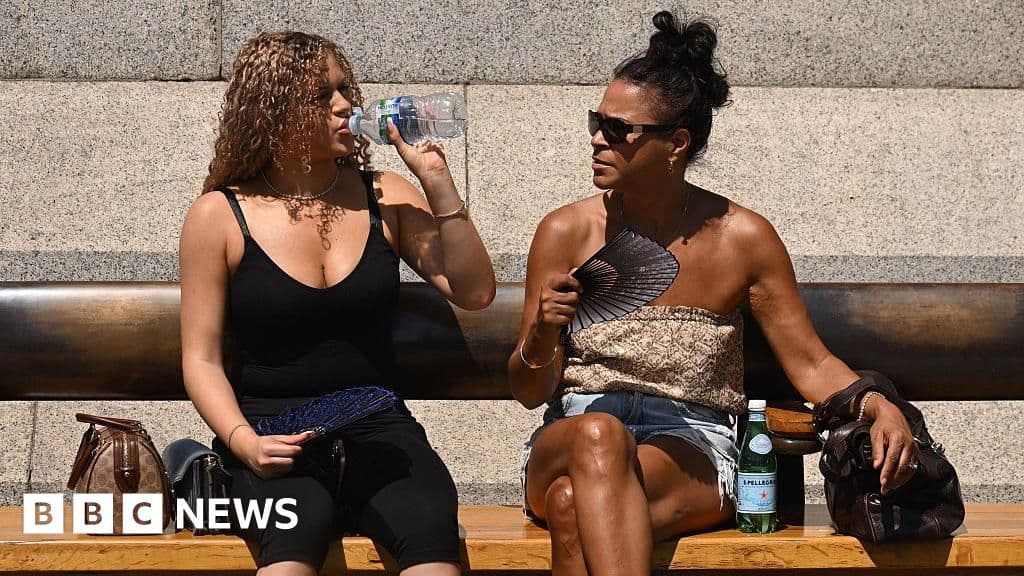
Learn about high UV levels in the UK and how to protect yourself.

Pakistan and China reach new consensus to boost economic ties and security.

Iran and the US are in negotiations, but military tensions persist as the rial gains value.

Texas GOP primary: Paxton takes on Cornyn with Trump's backing

Carol Vorderman calls for apology from Reform UK candidate over offensive comments.
See every story in News — including breaking news and analysis.

Joe Pineda, 52, sits by the banks of the Rio Grande. He pulls in water from the river to grow alfalfa, pecan trees and other crops. He also runs cattle on his family land, but he says he isn't doing that this year because he's worried about the wall. Carlos Morales
Carlos Morales
The federal government plans have united an unusual coalition of people across the political spectrum who say a wall is not needed here. They worry about threats to the environment and Indigenous sites, to impact on the region's famously dark skies and on wild animals, like Black bears, bobcats and bighorn sheep.
It's all part of a $56-million dollar tourism industry that Pineda says is now in jeopardy.
"They're killing our economy with this wall," Pineda said, standing by the Rio Grande. "This area gets a lot of money from tourism. It's going to make everything change, it's gonna be sad."
U.S. Customs and Border Protection tells NPR the agency will try to "avoid or minimize impacts to the environment to the greatest extent possible" in the areas where they plan to build walls.
Historically, the area's rugged and unforgiving terrain has meant fewer people attempting to cross into the U.S. through this region. And since the beginning of President Trump's second term in office, that number has fallen even further. In the first three months of this year, Customs and Border Protection's Big Bend Sector – a vast and seemingly boundless area covering nearly 500 miles of the Rio Grande – saw 498 apprehensions, which is just over a tenth of the apprehensions made in Texas' busiest sector.
"We're not the number one crossing spot," said Brewster County Sheriff Ronny Dodson, who grew up in the region and has been the county's top law enforcement officer for the last 26 years.

A group kayaks down the Rio Grande as it courses through the Big Bend. River guides and local outfitters worry a wall would cut off their access to the Rio Grande and devastate their livelihoods. Carlos Morales
Carlos Morales
In recent months, Dodson, along with four other border sheriffs, wrote federal and state officials to say a border wall in the Big Bend area isn't the "most practical or strategic approach to border security in this area."
"We agree with border security," Dodson said in an interview. "We agree there needs to be walls (in) places. There's no ifs, ands or buts about that, but not here. We just need to be monitored, we need the manpower and I think we'd be very fine."
Dodson's county, the largest by land area in the state, is home to Big Bend National Park.
At one point the beloved destination for hikers and river enthusiasts was set for a border wall too, but CBP now says it's no longer planning to construct 30-foot-tall steel fencing. Instead, the agency will build vehicle barriers and patrol roads along the border in the national park, which archaeologists say will still have an impact and would dig into environmentally and culturally sensitive land.

Landowners, river guides and residents throughout the Big Bend hold a rally against the proposed border wall in Presidio, Texas on March 21, 2026. Carlos Morales
Carlos Morales
For Dodson, who has written his own letters to President Trump and Texas Gov. Greg Abbott imploring them to visit the region, the money being poured into border barriers could be better spent. The price tag for a single mile of border barrier in the region: over $17 million dollars.
"These numbers are mind boggling," said Hudspeth County Judge Joanna Mackenzie. "That type of money is generational changing."
In a joint-letter, Mackenzie and all of the top elected local officials on the Texas-Mexico border wrote the government, asking for a say in how border security takes shape in the places they know best. "Tell us is this gonna happen and we don't have a say in it. What can we do, what can we do?" Mackenzie asked. "That's it, what can we do?"
Some private land owners in the Big Bend say they're willing to do whatever it takes, including filing their own lawsuits against the government, to stop the build-up at the border.

A replica of the 30-foot-tall steel wall stands outside a café in Terlingua, Texas. Carlos Morales
Carlos Morales
"This fight is one we did not ask for," said Raymond Skiles, a longtime wildlife biologist in the region and a landowner himself.
Sitting in his home in Alpine, Texas, Skiles looks at a map Customs and Border Protection sent him.
"If this were to come to pass, it would be a rip in the treasured landscape of the Big Bend," said Skiles, holding back tears. "It'd be like taking a knife to the Mona Lisa, and just cutting it in two and leaving that rent scar across it."
For Skiles, an imposing barrier through the Big Bend would be a painful reminder of what once was, an unwanted memorial to the place he calls home.

Raymond Skiles holds the letter with a map he received from U.S. Customs and Border Protection earlier this year. It shows the proposed path the border wall would take through his family land in Langtry, Texas. Carlos Morales
Carlos Morales