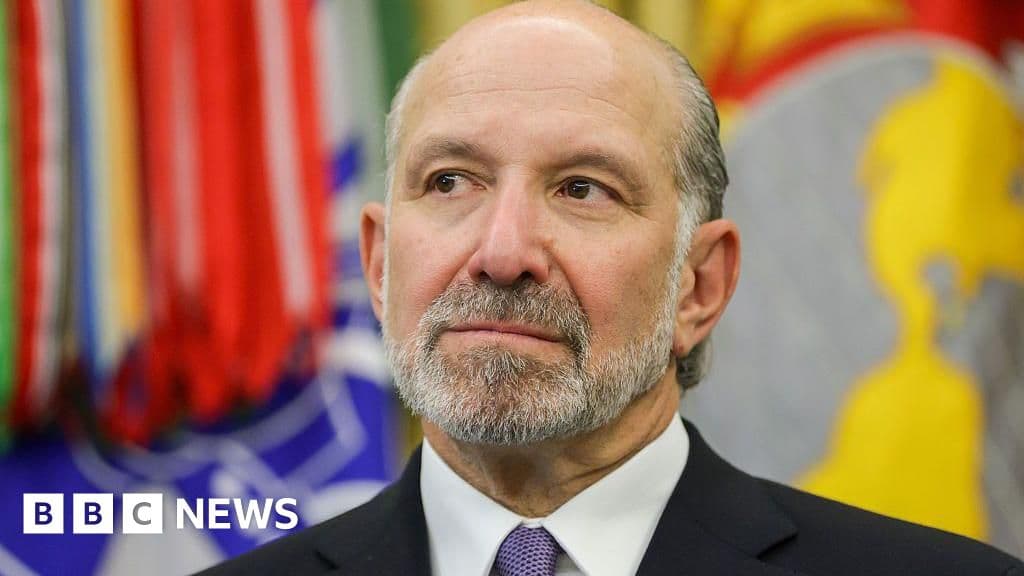
US commerce secretary details 'off-putting' interaction with Epstein in testimony
Commerce Secretary Lutnick details Epstein interactions in testimony
BBC News1 min read

The housing market in England and Wales is weakening due to fears of higher mortgage rates and inflation linked to the Iran war, leading to decreased demand from buyers. Estate agents report a cautious sentiment among clients, resulting in slower sales and price-sensitive buyers.
Fears of higher mortgage rates and rising inflation as a result of the Middle East conflict are leading to a subdued and downbeat housing market, according to estate agents.
Demand from potential homebuyers across England and Wales has shown a “noticeable softening” recently, according to a monthly survey of estate agents by the Royal Institution of Chartered Surveyors (RICS).
Members have told the professional body that buyers and sellers are becoming more cautious, and many agents have cited clients who are worried about whether inflation and interest rates will rise in the coming months, leading to slower sales, fewer homes on the market, and more price-sensitive buyers.
The Bank of England warned last month that interest rates may have to increase in the coming months as “higher inflation is unavoidable” because of the war in the Middle East and resulting jump in oil and gas prices.
At the same time, mortgage rates are likely to be affected by the current sharp rise in government borrowing costs, as swap rates – which lenders use to price their fixed-rate mortgages – tend to move in tandem with government bond yields.
Tarrant Parsons, head of market research and analysis at the RICS, said: “Until there is a clearer path for inflation and borrowing costs, activity and sentiment look set to remain subdued, particularly across southern England and London where affordability pressures are most acute.”
The RICS said a net balance of 34% of its members said inquiries from new buyers in April had fallen since the previous month. This is a slight improvement on the net balance of 40% who said inquiries had fallen in March, but still “indicative of weak market momentum”. The index measures the difference between the share of agents reporting rising and falling new buyer inquiries.
The volume of agreed sales deteriorated in April, with a net balance of 36% of members reporting a fall, versus 35% a month earlier. Estate agents are pessimistic about this improving much over the next three months.
The Iran war is causing fears of higher mortgage rates and inflation, leading to a subdued housing market with decreased buyer demand.
Estate agents have reported a noticeable softening in demand from potential homebuyers and increased caution among buyers and sellers.
The Bank of England warned that interest rates may need to increase due to unavoidable higher inflation resulting from the Middle East conflict.
Mortgage rates are likely to be affected by rising government borrowing costs, as they typically move in tandem with government bond yields.
Commerce Secretary Lutnick details Epstein interactions in testimony

Denise Powell secures victory in Nebraska's 2nd district Democratic primary

Prince Harry highlights alarming rise in antisemitism in the UK

Australian government cuts $760m research program, angering researchers

Cindy Burbank won the Nebraska Democratic primary but plans to drop out to support independent candidate Dan Osborn in the general election against Republican Pete Ricketts.

Coles misled Australian shoppers with fake discounts, court rules.
See every story in News — including breaking news and analysis.
The report added that the flow of new properties being put up for sale was “largely stagnant” over April, while 34% more members reported decreases in house prices over the past three months than increases, marking a “further deterioration” from the -25% reading seen last month.
However, there is a widening regional divide in house price growth, with stronger price falls being reported in London, the south-east, East Anglia and the south-west, while the north-west and north of England continued to post marginally positive readings.
In the rental market, demand is outpacing supply, as a rising number of landlords leave the sector in face of increasing regulation and higher taxes. RICS members said the level of demand from new tenants has been increasing, with a net balance of 14% reporting a rise over the past three months, while there was a drop in new instructions from landlords to put their properties up for rent. A net balance of 25% of respondents expect rents to rise over the coming months.
The RICS report ties in with results from Savills, the estate agent, which said that it had seen “greater caution” among buyers and sellers in its UK residential business since the onset of the Middle East conflict. The company, which was giving an update to shareholders before its annual general meeting, said this caution has resulted in longer completion timeframes, and transactions overall for the first quarter increased by just 1% year on year.