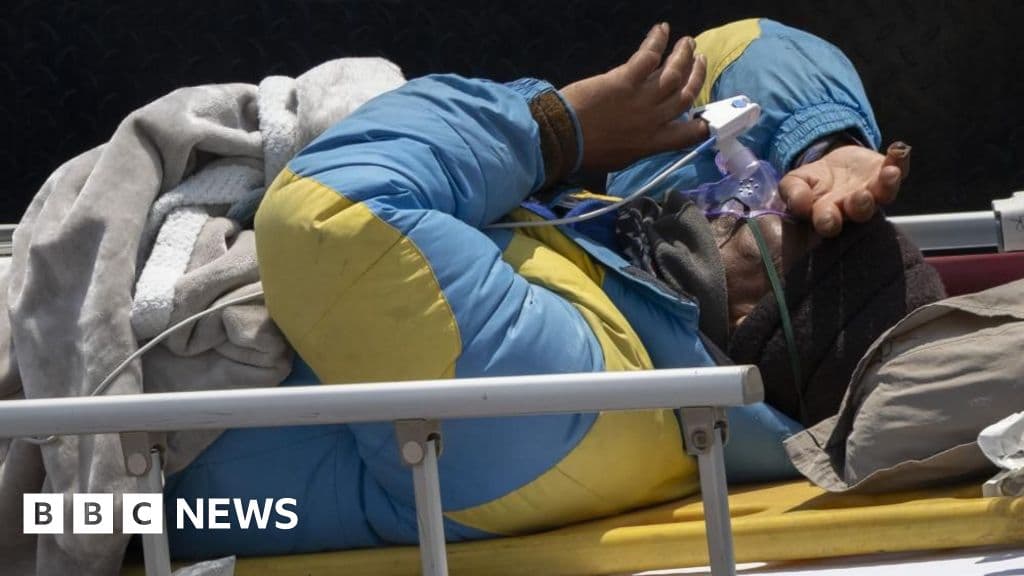
Mount Everest climber recounts moment he lost guide who survived six days alone
Climber Chris Thrall shares his emotional story of losing guide Dawa Sherpa on Everest, who survived six days alone.
BBC News1 min read

Lebanon's migrant workers are uniting to feed around 200 displaced individuals daily at Tres Marias, a community kitchen in Beirut. They use traditional recipes to provide support amid the ongoing crisis.
Mentioned in this story
Beirut, Lebanon – Myra Aragon tosses chicken wings into a large cooking pot. She stirs them and then adds garnishes and spices.
“These are bay leaves,” she says, pouring in a handful. “These are anise stars and this is black pepper.”
Today, she’s making chicken afritada, a classic chicken stew from her home country of the Philippines. Her kitchen and community centre, called Tres Marias, in a suburb just north of Beirut, feeds about 200 people every day. Most of them are migrant workers.
Amid the war and a massive displacement crisis, some migrant workers have stepped up to serve their community.
Migrants “face so many different restrictions,” says Abdel Halim Abdallah, a Doctors Without Borders (MSF) project coordinator in Lebanon, speaking to Al Jazeera. “They show love and affection and solidarity through food. It is a unifying thing.”
On March 2, Hezbollah fired rockets at Israel for the first time in at least a year. The group claimed it was in response to the killing of Iran’s Supreme Leader Ayatollah Ali Khamenei on February 28 and 15 months of unanswered Israeli aggression, which included more than 10,000 ceasefire violations.
Israel responded by forcing the displacement of at least one million people across Lebanon, including from the entirety of the south and Beirut’s southern suburbs. Israeli forces have in recent weeks also invaded southern Lebanon and occupied several towns and villages. Many Lebanese have fled their homes for refuge with friends or relatives. Those who couldn’t ended up in shelters or on the street.
Migrants have also been victims of Israeli attacks. Two Sudanese nationals were killed by an attack on April 5 in Jnah, in Beirut’s southern suburbs. An Ethiopian national was killed when Israel demolished a building in Beirut’s Tallet el Khayat neighbourhood on April 8.
Thousands of others are displaced. More than 200,000 migrant workers are living in Lebanon today, according to figures compiled by the American University of Beirut. According to a 2023 report by the International Organization for Migration (IOM), a high concentration of migrants live in Beirut’s southern suburbs, an area devastated by Israeli attacks in 2024 and again in 2026. The IOM also estimates 48,000 have been displaced since March.
Many migrants work as cleaners or nannies and are beholden to the country’s kafala labour system, which binds a foreign worker to a local sponsor and sometimes results in the labourer being abused. In 2024, many ended up on the . Some have found refuge in community housing or have support from their embassy.
Lebanon's migrants are operating community kitchens like Tres Marias to provide meals for war-displaced individuals, showcasing solidarity through food.
Tres Marias is a community center in Beirut that serves around 200 meals daily, primarily featuring traditional dishes from the migrants' home countries.
Myra Aragon is a migrant worker from the Philippines who cooks traditional dishes like chicken afritada at the Tres Marias community kitchen.
Migrant workers in Lebanon face various restrictions and hardships, but they express solidarity and support for their community through food.
Climber Chris Thrall shares his emotional story of losing guide Dawa Sherpa on Everest, who survived six days alone.

Mogadishu clashes intensify as Somalia faces a political crisis over election tensions.

US officials tackle flesh-eating screwworm outbreak using flies and sniffer dogs.

Barnaby Joyce has retracted his statement about One Nation's housing policy, clarifying that permanent residents will not be forced to leave their homes. Instead, the policy targets foreign owners, requiring them to sell properties within two years.

In a second break with Trump, the House passes a bill to aid Ukraine and sanction Russia.

NSW officials seize over 100,000 exotic cockroaches worth $200,000 in record bust
See every story in News — including breaking news and analysis.
Displaced by Israeli bombs, some migrants also face discrimination. Shelters are officially supposed to accept all displaced people — irrespective of their nationality — but on the ground, that is not always the case.
Abdallah says that he has seen some migrant families in shelters, though many are turned away and Lebanese are often given priority. And even if migrant workers are accepted into shelters, they often also face discrimination inside.
“We hear stories that they are put in the basement or into an open area,” Abdallah says. In such circumstances, many will decide to leave the shelters. Many rely on community houses, with MSF mapping more than 100 such houses.
Faced with these systemic challenges, migrant communities frequently end up organising themselves — and helping each other.
With the systemic challenges in mind, Aragon opened Tres Marias. It is among at least three food kitchens run by migrant workers in Lebanon amid the chaos of war and displacement.
“I’ve been in Lebanon for 22 years. I know the difficulties of the kafala system,” Aragon says from her shop, as she takes a break from stirring chicken. In those years, she’s witnessed — and survived — the 2006 war, uprisings in 2015 and 2019, the 2020 port blast, Lebanon’s economic collapse and the 2023-2024 war with Israel.
As she speaks, a team of volunteers chops peppers outside the modest kitchen where the chicken is boiling. The cooked food will be packaged and distributed. Tres Marias also collects, packages and distributes raw ingredients to people who can cook for themselves.
They feed migrants mostly but occasionally Lebanese families come to them, too. They feed whoever is in need. And she said that solidarity builds out of their efforts.
“Some people will ask me to cook their cuisines,” she said. She gave the example of Bangladeshis requesting biryani, which she made and got positive reviews on, even though she found it too “har”, using the Arabic word for spicy.
Most of the families are migrants in Beirut’s southern suburbs, Aragon said. They are based in areas like Laylake, Haret Hreik and Ghobeiri. All of these areas have received repeated evacuation warnings by the Israeli military. There have been no strikes on Beirut or the suburbs in the last few days, after a bloody April 8 when more than 350 people were killed in Israeli attacks across the country.
Distributing the meals is still too dangerous, so another migrant worker picks them up on his motorbike and meets families inside the southern suburbs.
In 2024, at the height of intense Israeli attacks on Lebanon, Aragon and her team also worked to feed migrants. But she says there is a difference this time.
“This war is a lot worse than the last one,” she says. The 2024 war also included mass killing and displacement. But this time, the attacks are hitting new areas, and social tensions are brewing.
That difference plays out in her head when Israeli drones fly over Beirut at night.
“Sometimes I look up and feel like it is following me,” she says about the incessant buzzing noise that has filled Beirut’s skies in recent years.
But as the war carries on, Aragon will continue to cook and distribute food to those who need it. She says that a lot of her work centres on listening to other migrants and their communities about what they need. Food is one way that makes people feel cared for and seen.
It is also a way for people to learn about food from the Philippines, she said.