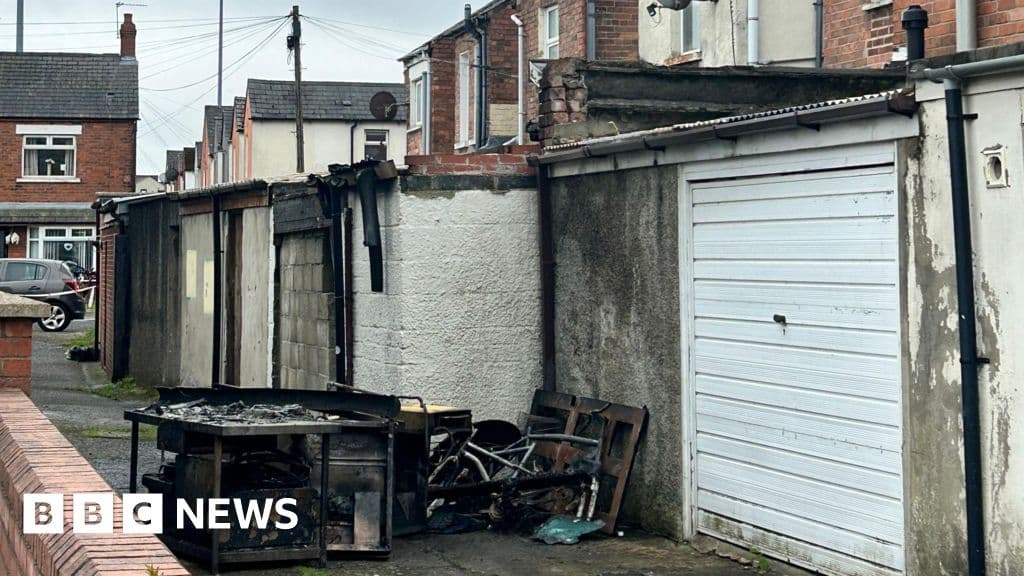
Nineteen now arrested over disorder with house targeted in arson
Nineteen people arrested, including a teen, after violence in Northern Ireland and an arson attack.
BBC News1 min read

Europe's smaller airports face an existential threat due to potential jet fuel shortages linked to the Middle East crisis, which could lead to widespread flight cancellations. The Airports Council of Europe warns that these airports, already struggling post-Covid, may not survive if airlines cut capacity and raise fares.
Mentioned in this story
Europe’s smaller airports may not survive if jet fuel shortages triggered by the Middle East crisis lead to widespread route cancellations, the industry’s trade body has warned.
Although airlines insist that there are currently no supply issues within the normal four- to six-week horizon, the US-Israel war on Iran and the effective closure of the strait of Hormuz have doubled the price of jet fuel, prompting some carriers to cancel flights.
The Airports Council of Europe said regional airports were the most exposed and faced an “existential threat” if airlines cut capacity and raised fares, as demand on their routes was generally more price-sensitive – demonstrated when Lufthansa axed 20,000 summer flights operated by its regional subsidiary, CityLine.
Olivier Jankovec, the director general of ACI Europe, said that smaller regional airports had still not recovered since the Covid pandemic, with traffic still 30% below 2019 levels, while larger ones had bounced back to growth.
He said: “The current levels of jet fuel prices and the prospect of a new cost of living crisis mean that many regional airports across our continent are likely to face both a supply and demand shock. For them, this is nothing short of an existential threat.”
The body said that troubles risked being exacerbated by the full implementation of the EU’s entry-exit system, EES, which in theory should demand that all applicable non-citizens must now submit biometric information on arrival at the border. It reiterated calls to allow the system to be suspended at any point should long queues develop.
The airports’ warning came as the head of the global airlines body, Iata, Willie Walsh, said the current crisis was not yet dampening demand for flying. He added that any jet fuel shortage would affect Asia first, then Europe, and that rationing “could lead to some flight cancellations”.
Airline groups have lobbied for measures including slot alleviation, granted in the UK, which makes it easier to cancel flights without the risk of losing the rights to operate at the same time from a busy airport in future.
The jet fuel shortages are triggered by the US-Israel war on Iran and the closure of the strait of Hormuz, which have doubled jet fuel prices.
Smaller regional airports in Europe have not fully recovered from the Covid pandemic, with traffic still 30% below 2019 levels.
If airlines cancel flights, smaller airports may face significant financial challenges, leading to possible closures as they are more vulnerable to price-sensitive demand.
Nineteen people arrested, including a teen, after violence in Northern Ireland and an arson attack.

Exploring the Historical Roots of Torture Against Palestinians

USA faces Paraguay in World Cup 2026 opener at SoFi Stadium!

Israel's new buffer zone in Lebanon could be an attempt to seize gas reserves.

China detains American researcher accused of spying amid Myanmar tensions

At 93, Moira Brown will attend her fourth World Cup, celebrating Scotland's qualification for the tournament after nearly 30 years. She'll cheer for her team during their group stage matches in the U.S.
See every story in News — including breaking news and analysis.
József Váradi, the chief executive of Wizz Air, the biggest airline in central and eastern Europe, said the slot demands were protecting the interests of legacy carriers such as Lufthansa and British Airways, rather than all airlines.
Describing the conflict as a “nonsense war” and a “complete mess”, he said he did not expect government involvement in managing fuel supply to be needed or helpful, adding: “Maybe they should stop Donald Trump and send him home, if they want to play a constructive role.”
Váradi said he did not expect jet fuel shortages because the high kerosene prices were “creating a lot of room to become creative – that kind of a marketplace mobilises forces”, with tankers now going to the US.
He said summer bookings were holding up but European airlines would face a crunch moment in the autumn: “Airlines go bust two times a year, in September and February. Airlines with weak liquidity positions will come under immense pressure in September time.”