
UK-China ‘ice age’ thaws: Why the West needs Beijing
UK government seeks to thaw relations with China amid global challenges.
Al Jazeera English1 min read

On April 8, Israel launched over 100 airstrikes across Lebanon, causing significant destruction and civilian casualties. Ahmad Hamdi, a resident of Beirut, narrowly escaped injury as rockets struck his neighborhood.
Mentioned in this story
Beirut, Lebanon – On April 8, Ahmad Hamdi, 22, was sitting on his couch at home in Beirut’s Tallet el Khayat neighbourhood, hours after Israel had launched more than 100 attacks in under 10 minutes across Lebanon.
Then he heard the “indescribable sound” of a rocket. Ahmad jumped off the couch as the glass in his building shattered around him before more rockets hit.
Clouds of dust obscured the view from his apartment on the fourth floor. When they dispersed, he saw the building directly facing his had been reduced to a pile of rubble.
He looked back at the couch he had been sitting on. At some point between the second and fourth explosion, shards of shrapnel had hit the couch exactly where his chest had been when the first rocket struck.
“When you think of Tallet el Khayat, you feel it is safe and secure,” Ahmad told Al Jazeera. “No one would expect something like that would happen.”
April 8 has become known in Lebanon as Black Wednesday. Israel’s attacks on that day killed at least 357 people across the country. Israel claimed it killed 250 Hezbollah operatives. The exact breakdown of civilians and combatants is still not known, but numerous sources looking into the day’s casualties told Al Jazeera that the attacks appeared to be indiscriminate at best and in some cases may have amounted to the direct targeting of civilians. United Nations experts have described Israel’s attacks on April 8 as “indiscriminate”.
“The method in which the attacks happened in the middle of the day with dozens of strikes all at one time without warning and when civilians were present shows recklessness in Israeli military conduct,” Ramzi Kaiss, Lebanon researcher at Human Rights Watch, told Al Jazeera.
On March 2, Israel intensified its war on Lebanon for the second time in under two years. Earlier that day, Hezbollah had responded to near-daily Israeli attacks on Lebanon for the first time since December 2024 in response to the United States and Israel’s assassination of Iran’s Ayatollah Ali Khamenei.
Israel also invaded southern Lebanon, where it has gone about systematically destroying towns and villages in what experts – and Israeli officials – said is an effort to create an uninhabitable “buffer zone” along its border.
“Part of [Israel’s] military strategy is to create a buffer zone and no man’s land,” Bassel Doueik, the Lebanon researcher for the Armed Conflict Location & Event Data (ACLED) conflict monitor, told Al Jazeera. “What Israel is doing in southern Lebanon is creating a multilayered buffer zone inside Lebanese territory and that is why they are demolishing houses in towns along the border.”
Israel conducted over 100 airstrikes across Lebanon in under 10 minutes, resulting in widespread destruction and civilian casualties.
Ahmad Hamdi, a 22-year-old resident of Beirut, experienced the airstrikes firsthand, narrowly escaping injury as shrapnel hit the couch he had been sitting on.
The airstrikes primarily affected Beirut, specifically the Tallet el Khayat neighborhood, where significant damage occurred.
Civilians, like Ahmad Hamdi, expressed shock and disbelief at the sudden violence in areas they considered safe, highlighting the unexpected nature of the attacks.
UK government seeks to thaw relations with China amid global challenges.

Ukrainian drones hit St Petersburg as key economic forum begins, embarrassing the Kremlin.
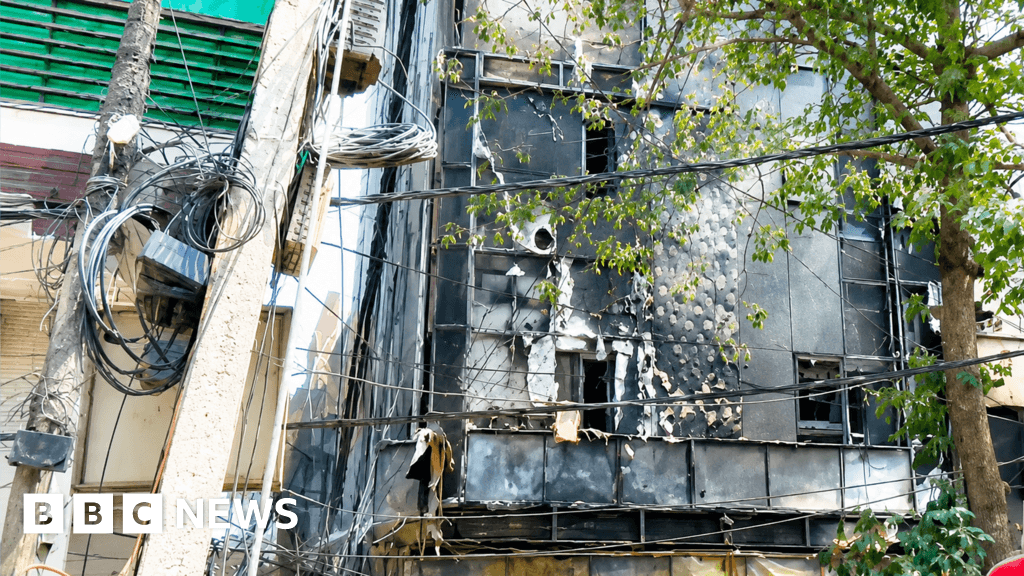
Tragic fire in Delhi claims 21 lives, including foreign nationals seeking medical care.

David Cameron offered Boris Johnson a senior Cabinet role to support the UK's EU remain campaign in 2016. Johnson later chose to back Brexit instead, changing the debate's direction.

Steve Hilton and Xavier Becerra lead in California's governor primary race ahead of November election.

Reza Pahlavi is criticized as far-right supporters praise the Savak, complicating his pro-democracy image.
See every story in News — including breaking news and analysis.
Israel has not stopped attacking Lebanon since October 2023 and has violated a November 2024 ceasefire more than 10,000 times, according to the UN. Most of its attacks have been in southern Lebanon and the Bekaa Valley in the east.
Israel conducted 100 air strikes and dropped more than 160 bombs across Lebanon on April 8, according to ACLED.
Israel claimed the attacks targeted Hezbollah headquarters, command-and-control sites, military formations and assets of its air force unit and elite Radwan Force.
Hezbollah discontinued the practice of providing the circumstances of its fighters’ deaths in September 2024. The Lebanese group does conduct some public funerals for fighters killed during the battles in southern Lebanon, but it is difficult to ascertain the exact number of those killed, making it hard to prove or disprove Israel’s claims.
But groups investigating the April 8 attacks said the available information casts doubt on the Israeli narrative. Analysts with ACLED said they are still confirming casualties but early indications showed that only a few victims were known Hezbollah members.
“One hundred one women and children were killed on April 8,” Ghida Frangieh, a Lebanese lawyer and researcher with Legal Agenda, a Beirut-based nonprofit research and advocacy organisation, told Al Jazeera. “For this number of 250 to be correct, it means every man killed must have been a Hezbollah combatant. This is not true as we were able to document several civilian men killed during these attacks.”
Lebanese media reported on a number of those killed by Israel on April 8, including employees of local restaurants, teachers, a poet, journalists, Lebanese soldiers and a member of a Druze-majority political party.
In some cases, Israeli attacks wiped out several members of the same family. Seven members of the Nasreddine family were reportedly killed on April 8 in Hermel in northeastern Lebanon. And three generations of the displaced Hawi family, including three children, were killed in the Jnah neighbourhood bordering Beirut.
Even if Hezbollah targets were present at all of the sites struck during the April 8 attacks, researchers said the attacks should still be considered indiscriminate. And while there still may be a discrepancy over the exact numbers of Hezbollah members vs civilians killed, international humanitarian law places the burden of proof on the attacking army.
“International humanitarian law is clear: Armed forces must distinguish at all times between civilians and military objectives,” Reina Wehbi, Amnesty International’s Lebanon campaigner, told Al Jazeera. “Even when there is a legitimate military target and in order to avoid indiscriminate, disproportionate or other unlawful attacks, parties must respect the principle of precaution and do everything feasible to verify that targets are military objectives, to assess the proportionality of attacks and to halt attacks if it becomes apparent they are wrongly directed or disproportionate.”
Over the past two and a half years, Israel has regularly violated the laws of war in Lebanon and in Gaza by indiscriminately attacking civilians, targeting paramedics and journalists, and using white phosphorus. Still, experts said there is little chance Israel will be held accountable.
“For the Israeli military, there is no deterrence to committing violations in Lebanon,” Kaiss of Human Rights Watch said. “After the crimes of humanity against Gaza, countries could have immediately suspended arms sales, the transit of arms through airports, placed targeted sanctions on officials, and the US and others could have suspended arms sales, but none of that happened.”
Kaiss said Lebanon could also give jurisdiction to the International Criminal Court (ICC), of which it is not currently a member, to investigate and prosecute Israel’s crimes in Lebanon. The ICC has already issued arrest warrants for Israeli Prime Minister Benjamin Netanyahu and former Defence Minister Yoav Gallant on charges of war crimes and crimes against humanity in Gaza.
Attacks on Beirut have temporarily halted since US President Donald Trump announced a ceasefire in Lebanon on April 16. But the war rages on in southern Lebanon with Israel continuing to kill civilians, including rescue workers. Israel and Lebanon have started to engage in direct negotiations despite Hezbollah’s objections in what the Lebanese state hopes will bring an end to Israel’s attacks and occupation of southern Lebanon.
But on the ground, there has been little deterrence or accountability for Israel’s crimes against civilians.
“This hasn’t happened in the last two years, so the Israeli military on the ground feels emboldened to continue,” Kaiss said.