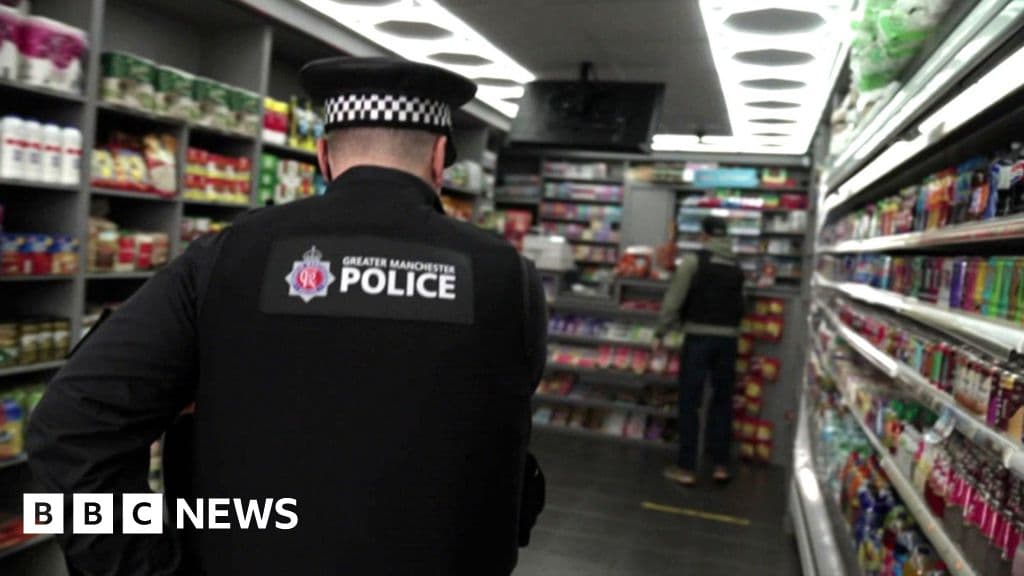
New High Street crime unit to target gangs fronting shops after BBC investigation
New £30m High Street crime unit to tackle gangs after BBC probe
BBC News1 min read

Idaho's 2026 primary elections are crucial for the Republican Party, with winners likely to dominate the November general election. The state has not elected a Democrat to federal office since 2008.
Mentioned in this story
Among the six states holding primaries on Tuesday is the solidly red enclave of Idaho, nestled in the northwest, close to the United States border with Canada.
The state’s Republican bona fides are well established. Not since 1974 has it sent a Democrat to the US Senate.
The last Democrat elected to federal office was in 2008 — and that politician, US Representative Walt Minnick, only served a single term.
But its deep-red streak makes Tuesday’s primary races all the more important for the state. The winners on the Republican side are likely to sail to victory in November’s general election.
Still, the vote is expected to serve as a bellwether for the future of the Republican Party under President Donald Trump’s leadership.
Many of the state’s Republican primaries are contests between moderates and more hardline conservatives. Here’s what to know about Tuesday’s vote:
The polls will be open from 8am to 8pm local time (14:00 GMT on May 19 to 02:00 GMT on May 20).
Idaho is a largely agricultural state, with a modest population of more than 2 million.
That means it only has two members in the US House of Representatives, which divides its 435 seats among the states according to the number of residents.
Both of Idaho’s House seats will be up for grabs, as well as one of Idaho’s spots in the US Senate.
At the state level, quite a few positions will be on the ballot, most notably the governor’s office.

Idaho Governor Brad Little sits between his Nebraska counterpart, Pete Ricketts, and US President Donald Trump at a White House meeting on December 16, 2019 [Kevin Lamarque/Reuters]
Idaho's 2026 primary elections are significant as they will likely determine the Republican candidates who can win in the November general election.
The last Democrat elected in Idaho was Walt Minnick, who served a single term in Congress after being elected in 2008.
Idaho's solidly Republican political landscape makes the primary races critical, serving as a bellwether for the party's direction under Donald Trump's leadership.
The 2026 primary elections in Idaho are expected to reflect the future dynamics of the Republican Party and its alignment with Trump's policies.
New £30m High Street crime unit to tackle gangs after BBC probe

Tuesday is a major primary election day; here's what you need to know!

Massie primary breaks spending records as pro-Israel groups target him

NY Times files lawsuit against Pentagon for press access restrictions

Trump administration plans to lift limits on toxic 'forever chemicals' in drinking water.

Trump postpones attack on Iran, citing serious negotiations with regional leaders.
See every story in News — including breaking news and analysis.
Many of Idaho’s primary races are shaping up to be contests between incumbents and challengers seeking to push the state’s politics further to the right.
That is the case for Governor Brad Little, a 72-year-old rancher who is campaigning for a third term as Idaho’s chief executive.
In Tuesday’s Republican primary, Little faces seven other candidates, although none are particularly well known and only one – Ron James, a county commissioner – is an elected official.
Mark Fitzpatrick, a retired police officer, business owner and self-described “bold culture warrior”, appears to be Little’s most active opposition. He has out-fundraised the other Republican challengers and angled to secure county-level endorsements in a bid to unseat the governor.
Fitzpatrick’s platform is seen as more hardline than Little’s. He has accused the governor of being a “traitor” for allowing an “illegal immigrant invasion” on his watch, and last year, he organised a “Hetero Awesomeness Fest” in response to LGBTQ Pride events.
In the Democratic primary, four candidates are vying for the party nomination. Of the group, former public defender Terri Pickens is the best funded, having out-raised her competitors by a double-digit factor.

US Representative Russ Fulcher is considered the frontrunner to retain his seat in Idaho’s Republican primaries [File: Bonnie Cash/Reuters, pool]
Idaho has two congressional districts: one that runs from the Canadian border down the western portion of the state, and another that hugs the southeastern corner, including the capital, Boise.
The western area is known as Idaho’s first congressional district, and it is currently represented by Republican Russ Fulcher, a businessman.
He is facing two challengers this primary season, although neither reported significant campaign contributions to the Federal Election Commission (FEC) as of April 29.
Kaylee Peterson, meanwhile, had a vast fundraising edge heading into May’s Democratic primary for the same district.
In Idaho’s second congressional district, incumbent Mike Simpson, a former dentist, is seeking his 15th term as a US representative. The 75-year-old has held the office since 1999.
Simpson has spent more than $600,000 on the campaign so far, according to the Idaho Capital Sun.
Only one of his challengers, Perry Shumway, raised enough money to report his fundraising to the FEC. He had $5,291.98 by the end of April.
In the second district’s Democratic primary, Ellie Gilbreath is running unopposed as her only competition has withdrawn from the race, according to her website.

Representative Mike Simpson is seeking a 15th term in the US Congress [John McDonnell/AP Photo]
A former Idaho governor, Jim Risch, is seeking a fourth term in the Senate during the midterms.
In January, Risch received an endorsement from Trump, who called the Idaho politician one of his “strongest allies” in the Senate.
Risch faces a challenge, though. The Republican primary for his seat has seen more spending than many of the state’s other races.
But as with the other races, the incumbent’s campaign chest has dwarfed those of his three challengers. His political action committee (PAC) has spent more than $1m, a sum far greater than his closest rival, Josh Roy, who documented roughly $23,500 in expenses, according to the latest FEC numbers.
Of the three candidates jockeying for the Democratic nomination, only David Roth reported more than $5,000 in contributions to the FEC during the last reporting period.
Roth, a nonprofit worker, identifies as the first openly gay candidate to receive a statewide nomination in Idaho.
In recent years, Idaho’s primary contests have revealed fractures within the Republican Party, between traditional conservatives and far-right challengers.
Trump has injected himself into some of the races, making the primaries a test of his hold over the party.
For example, during Idaho’s last gubernatorial primaries in 2022, Governor Little faced down a feisty challenge from his Trump-endorsed lieutenant governor, Janice McGeachin.
At the time, Little had angered Trump’s Make America Great Again (MAGA) movement by accommodating some COVID-19 restrictions.
McGeachen had opposed those guardrails, and while Little was out of the state in 2021, she used her position as lieutenant governor to sign an executive order banning mask mandates.
Little repealed the order upon his return, setting off the primary showdown.
Despite Trump’s endorsement of McGeachin, Little won the 2022 contest, but the governor has done little to challenge Trump in the years since.
In 2025, he even signed into law a bill, passed by Idaho’s legislature, banning mask mandates. The move was one of several policy pivots that helped the incumbent win Trump’s endorsement this time around.
The incumbents for Idaho’s US House and Senate seats have all also received Trump’s endorsement.
That may mean there are few surprises on primary day. As Kevin Richert, writing for Idaho Education News, put it: “Idaho’s statewide primary elections could be dull.”

Governor Brad Little lost Trump’s endorsement in 2022, only to regain it in 2026 after signing a bill against mask mandates [File: Evan Vucci/AP Photo]
Not since 1995 has Idaho seen a Democratic governor. But that does not necessarily mean the Republican primary winner has a clear shot at victory in November’s midterms.
Once the primaries are settled, the Democratic and Republican nominees for governor will also face John Stegner in the general election.
The former Idaho Supreme Court judge is running as an independent candidate and, therefore, will not appear on any primary ballots.
His campaign appears to show momentum. Stegner raised eyebrows in March by raising more in three months than the top Democratic candidate had in two years.
But that is not the only race being affected by an independent bid. Incumbent Senator Jim Risch will likely go head-to-head with another independent candidate, former State Representative Todd Achilles, on November’s ballot.
Achilles has been actively raising funds. He even released a poll indicating he could defeat Risch, although the merit of that poll has been called into question as it was sponsored by Achilles’s own campaign.