
Some Minneapolis donors have moved on. The immigrants waiting for help haven't
Minneapolis mutual aid group Juntos Podemos continues its vital work for immigrants despite losing some donors.
NPR Topics: News1 min read
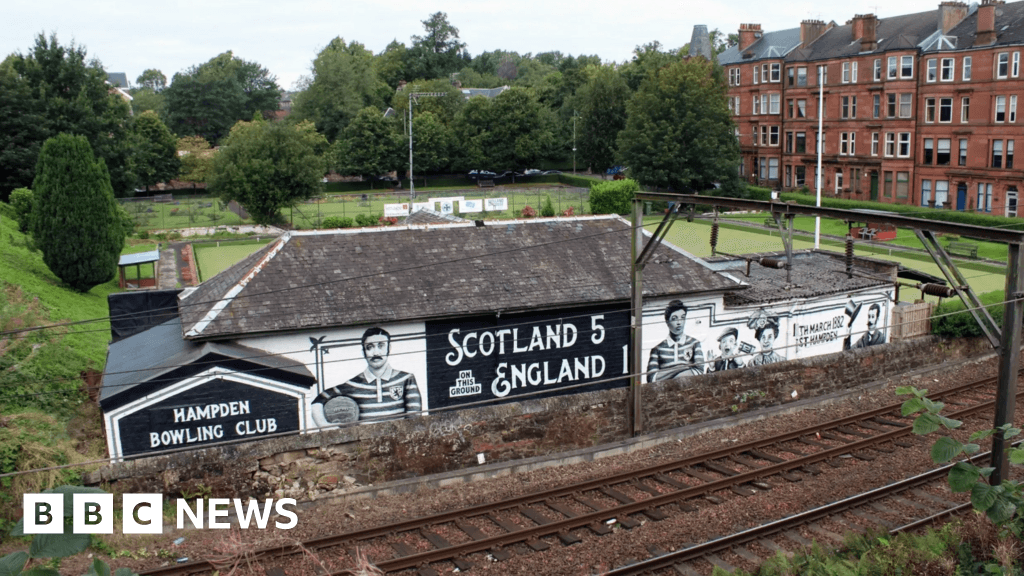
Hampden Park, the world's first international football stadium, has received protected status from Historic Environment Scotland. This designation aims to preserve its historical significance amid redevelopment fears.
Mentioned in this story
The site of the original Hampden Park, considered to be the world's first international football stadium, has earned protected status from Historic Environment Scotland.
Fears were raised last year that the grounds on Kingsley Avenue in Glasgow's southside could eventually be turned into flats because of the closure of the bowling club which was based on the land.
This meant the area could become available for commercial use or redevelopment, to the dismay of campaigners. They argued that the original Hampden - which hosted internationals and Scottish Cup finals from 1873-1883 - should be celebrated.
HES has now designated it a scheduled monument in recognition of its place in football history.
The aim of a scheduled monument is to preserve significant sites in Scotland as much as possible in the form they have been passed down to people today.
Remains of the original football stadium - where Scotland famously routed England 5-1 in 1882 - were discovered following an archaeological excavation at the site in 2021.
When Queen's Park built the stadium, Scottish teams usually played on converted cricket pitches, such as the West of Scotland ground in Partick where Scotland and England played the world's first international in 1872.
The Hampden ground has long been considered the first stadium where many of the aspects now common to a football stadium - such as grandstands, turnstiles and season tickets for entry - originated.
Dara Parsons, head of designations at HES, said: "It feels timely to recognise the central role that Scotland played in the development of the sport, and the place of First Hampden within that story.
"The remains of the pavilion at the first Hampden are a link to the earliest days of football in Scotland, and its importance to, and impact on, communities. It is a monument to our national game and to the origins of the modern football stadium."
The decision followed a public consultation which showed support for the designation.
Parsons added: "We'd like to thank everyone who took time to take part in our consultation and share their valuable contributions.
"We had a great response, and we are looking to continue that engagement over the summer where we will be asking people to suggest important football heritage sites from across the whole of Scotland for us to investigate."
The original ground was replaced by the second Hampden Park in 1884, which was followed by the third version of the stadium - in Mount Florida - in 1903.
Hampden Park is recognized as the world's first international football stadium, hosting matches from 1873 to 1883.
Concerns arose that the site could be redeveloped into flats after the closure of a local bowling club, threatening its historical status.
Protected status as a scheduled monument means that Hampden Park will be preserved in its current form to honor its historical significance.
Minneapolis mutual aid group Juntos Podemos continues its vital work for immigrants despite losing some donors.

Jho Low, linked to the 1MDB scandal, requests a pardon from Trump.

Neuty the viral pet nutria has passed away from cancer, leaving his family and fans devastated.

Lee Lai makes history as the first non-binary winner of the Stella Prize with 'Cannon', a graphic novel.

Unions funding Labour call for Starmer to resign before next election.

At least eight killed in Israeli drone strikes on highway south of Beirut
See every story in News — including breaking news and analysis.
Hampden Bowling Club took over the original stadium's land in 1905 but closed earlier this year.
More than 8,000 scheduled monuments are currently spread across Scotland.
Among the most recent scheduled monuments are gun emplacements and anti-invasion defences from World War Two.
The monuments are of all types, including prehistoric burial mounds, Roman forts, early Christian carved stones and industrial mills.