
Scientists warn Trump plan to axe US ocean monitoring system will leave world ‘flying blind’
Scientists warn Trump's plan to cut ocean monitoring will leave us 'flying blind' on climate and weather.
The Guardian World1 min read

Ellie Kildunne, the England rugby star, opens up about her struggle with body dysmorphia and disordered eating during the COVID-19 lockdown. She aims to inspire others by sharing her experience.
Mentioned in this story
Media caption,
"It's time for me to speak up about my body dysmorphia to give other people the courage"
Warning: This article contains reference to eating disorders
England rugby star Ellie Kildunne says she slipped into disordered eating and unhealthy weight loss during the coronavirus lockdown as her competitive instincts and isolation from her team left her feeling vulnerable.
The 26-year-old was a figurehead for the Red Roses' World Cup win last year, scoring five tries including a superb solo effort in front of an 82,000-strong sell-out crowd at Allianz Stadium in the final against Canada.
However, away from the big stage, clear goals and obvious opposition, Kildunne says she was prey to self-destructive behaviour. Now she wants to speak out to help others in a similar situation.
"Our lives as athletes are surrounded by control - you've got to reach certain metrics on your GPS, you're chasing weights in the gym, you're trying to score the try, the goal, whatever it is," she told BBC Sport.
"Once that's taken away from you, I think I just tried to find that sense of control in other places."
During lockdown, Kildunne was part of Great Britain's sevens squad, training for an Olympic Games which was subsequently postponed until 2021.
Without access to a gym and team sessions, and with uncertainty over her playing future, Kildunne focused on running, searching out faster courses to try and improve her times over certain distances.
But, at the same time, she was eating less.
When she couldn't control what she was eating, Kildunne would exercise to compensate, nipping out for runs to 'earn' the meal friends were about to serve her.
"I could probably see myself getting a little bit smaller, but then was still trying to chase being smaller on top of that," Kildunne added.
"I wasn't in that team environment with physios all the time, or my team-mates.
"And body dysmorphia is such a funny thing, because I would have been small but I would see myself as bigger in the mirror.
"It seems really stupid now, and I look back on it - I don't know why I did it. But I just ended up having a terrible relationship with food.
"In the rugby world, I'm considered small, but in my world outside rugby, I was considered big - so I never really had that place where I felt comfortable, that I fit in.
"Maybe I was rebelling against everything, but not knowing what I was trying to aim for at the same time."
The skipped meals and scarce calories soon showed when Kildunne returned to organised rugby.
She suffered a stress fracture in her knee.
"That was probably just because I didn't have the muscle to take the force of running and the intensity we train at," Kildunne reflected.
Ellie Kildunne revealed that she struggled with body dysmorphia and disordered eating during the COVID-19 lockdown.
The isolation from her team and her competitive instincts led Kildunne to feel vulnerable, resulting in unhealthy weight loss.
Ellie Kildunne is known for being a key player in the England women's rugby team's World Cup victory, scoring five tries in the tournament.
Kildunne is speaking out to give others the courage to address their own issues with body image and mental health.
Scientists warn Trump's plan to cut ocean monitoring will leave us 'flying blind' on climate and weather.

Kanya King, founder of the Mobo Awards, has passed away at 57 after battling colon cancer.

US visa rejections and war on Iran keep fans away from World Cup.
Actor James Handy, known for Jumanji, stabbed to death; girlfriend's son arrested.

Tragedy in the Sahara: 49 die of thirst after truck breaks down

FIFA World Cup 2026: Exciting Features and Key Talking Points!
See every story in News — including breaking news and analysis.
As she attempted to lift weights in the gym, involuntary tremors would set her limbs shaking.
"It was just because I had no energy. I had nothing in me to fuel," she added.
As she switched into fifteens from sevens, her lack of power and confidence in contact was exposed.
"Every time I touched the ball, the ball got ripped off of me or I got absolutely smashed. I couldn't make the tackles and I didn't have the confidence to. So I started wearing shoulder pads, so I felt a bit bigger and stronger."
More effective than extra padding was an additional question, though.
Kildunne, who now plays at Harlequins, was having a physiotherapy session at previous club Wasps.
Emily Ross, who had also worked with Kildunne during her time in Sevens, assessed her physically, but also asked if she was OK in other areas.
"I broke down in tears, probably because I've been waiting for someone to say that," said Kildunne.
"I knew I had a problem, but it was something that I wasn't even trying to stop.
"But as soon as you say something out loud to somebody, that creates accountability. If I'm not stopping for me at this point, I'm stopping because I've told you and I don't want you to worry.
"So we had a really honest conversation, and from that point on Emily became a real support for me."
Kildunne was diagnosed with ADHD (attention deficit hyperactivity disorder) - a neurodevelopmental condition that can lead to hyperactivity, hyperfocus and impulsiveness - at the start of 2025.
She says that the condition can mean she can become distracted and fail to prioritise eating as she should.
But a combination of understanding food as fuel for her sport and proactive steps, such as eating free from distractions and alerting team nutritionists to pay her special attention, has helped keep her on track.
"I think it's ongoing," she said.
"I wouldn't say I've got a bad relationship with food now, but it's something that you've always got to be conscious of, because I've got those habits somewhere."
Kildunne is not the first women's rugby player to highlight Issues of body image and food.
Ilona Maher, the United States centre and social media phenomenon, told the BBC in August that her relationship with food is a "never-ending battle" to balance the pressures of societal ideals and the bonds and comfort that food brings., external
Sarah Bern, who played alongside Maher at Bristol Bears last season and is an England team-mate of Kildunne's, has spoken regularly about how she has struggled with body image, particularly as a teenager.
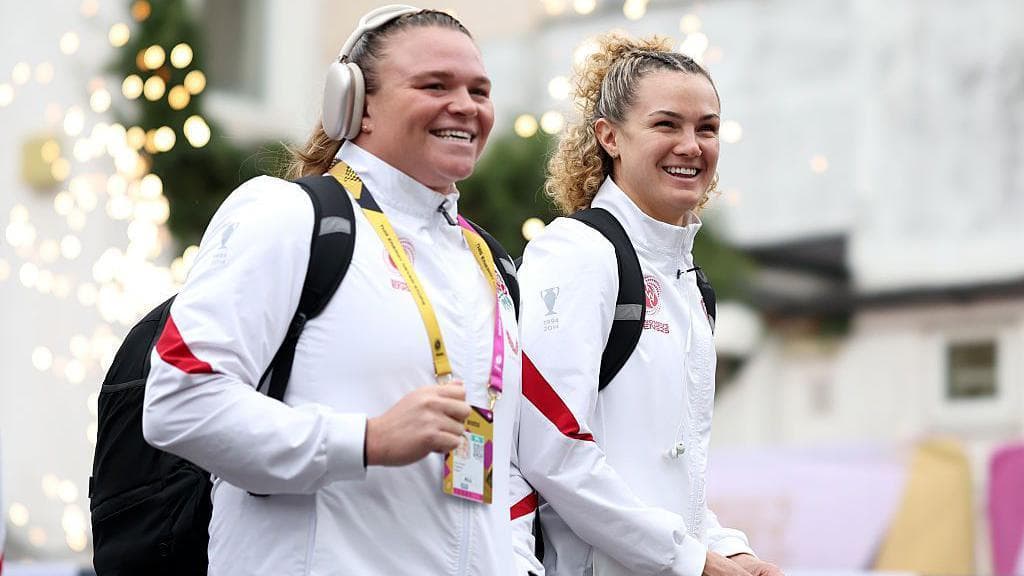
Image caption,
Bern and Kildunne were both part of England's run to the Women's Rugby World Cup on home soil in 2025
Bern has said she is "totally blown away" by the responses she gets from girls and women to her story.
"I don't want a younger version of me or any young girl growing up thinking that they have to restrict themselves, or be controlling or obsessive in what they're doing to think of themselves as beautiful," she said.
"When I share it, I get a lot of women coming up saying: 'If I had a role model like you, like you would have saved me so many of these years where I really struggled, or maybe I would be more confident now.'
"Or I have young people saying: 'You've literally saved my life.'"
Kildunne, whose book was released last week, says she wants to help people in the same way.
"I feel like I'm in control now, that I can talk about something and it not trigger me," she said.
"I have finally started to realise the influence that I can have on other people, and I want to do more than I have been doing, because I really think that can help people.
"From the outside it all looks perfect, and I want to show people that no one's perfect.
"Just because I'm a rugby player for England doesn't make me this superhero. And I want to relate to people that maybe are going through similar things and give them that friend and that support that I probably needed."
If you or anyone you know have been affected by any of the themes raised in this article, help and support is available at BBC Action Line.