Why temperature records are being not only broken but smashed
TL;DR
Western Europe is experiencing unprecedented heat, with UK temperatures exceeding 35C, breaking the previous May record by over 2C. Experts describe the situation as astonishing and mind-boggling.
Key points
- Western Europe is experiencing extreme heat.
- UK temperatures exceeded 35C this May.
- This is over 2C above the previous May record.
- Experts describe the situation as astonishing and mind-boggling.
- Such heat is unusual for spring.
If you take a look across western Europe at the moment, you'll struggle to find many places escaping the heat.
In the UK, temperatures passed 35C on Tuesday – more than 2C above the previous record for May.
This heat would be exceptional even in the middle of summer, let alone spring, the Met Office says.
"Absolutely astonishing," says Friederike Otto, professor of climate science at Imperial College London.
"Mind-bogglingly crazy," adds Peter Thorne, director of the Icarus Climate Research Centre at Maynooth University in Ireland.
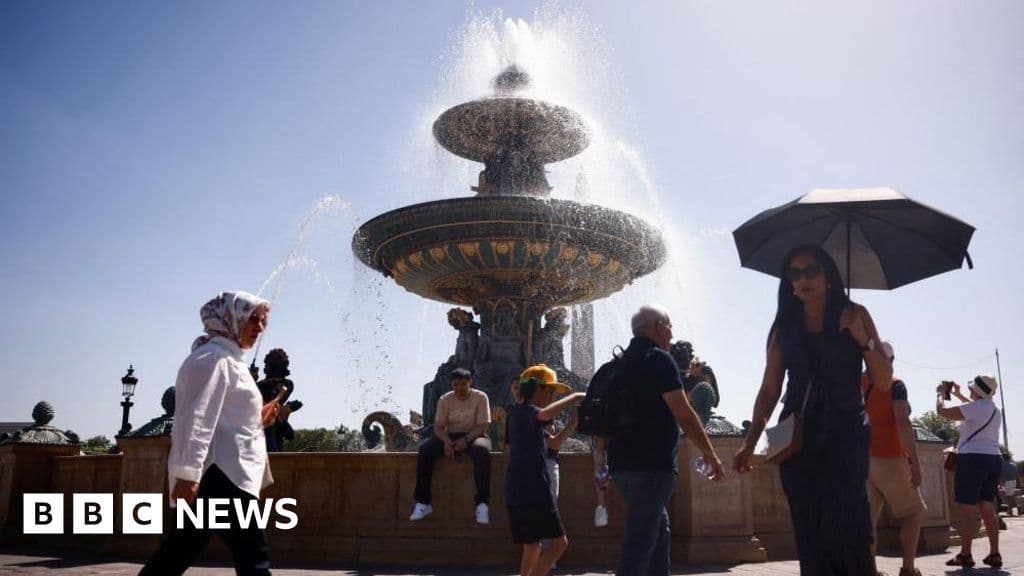
France is also in the midst of an unprecedented early-season heatwave, according to its weather service, Météo-France. Hundreds of heat records have been broken around the country.
Ireland's May temperature record has been surpassed by more than 1C, while Germany, Italy, Spain and Switzerland have all faced unusually hot conditions for spring too.
The immediate cause of the heatwave is a "heat dome" – where an area of high pressure gets "stuck" over Europe, trapping warm air underneath.
But scientists have little doubt that human-caused climate change - largely the result of the burning of coal, oil and gas - has supercharged the heat.
Over the last 30 years, Europe has been warming by 0.56C per decade – more than twice the global average, according to the Copernicus climate service.
That might not sound like much, but it is a seismic change in climate terms and enough to make heat extremes significantly more intense.
"When we have a heatwave it's happening more severely, because it's on top of a warming climate," Richard Betts, head of climate impacts research at the Met Office and a professor at the University of Exeter, told BBC News.
"I've been a climate scientist for 33 years and we're seeing exactly the kinds of things that we were warning back then... [although] these records are perhaps more extreme and coming sooner than we had expected," he added.
And the heat isn't limited to Europe, with temperatures reaching 45C in Delhi in India.
As scientists collect year after year of temperature data, records should in fact become rarer over time – at least in a stable climate.
The simple logic is that you're much more likely to see a new record after 10 years of data than after 100 years.
"If someone beats a world record in high jump, you would expect them to beat it by one centimetre and not suddenly by 20, 30 centimetres and the same holds for the weather," Erich Fischer, professor at the Institute for Atmospheric and Climate Science at ETH Zurich in Switzerland, told BBC News.
"If the record is broken after 100 or 150 years of measurements, you would have probably expected it to be broken by a tenth of a degree and not suddenly by two degrees or three degrees," he added.
But when a relatively rare weather system such as this week's heat dome comes around in a warming climate, the margin of record can be huge.
"We're going through a period of very rapid warming, particularly western Europe… so if the same weather events we had in, say, the 1970s [happened again], it will not only be slightly warmer, but it will simply smash the record," said Prof Fischer.
Even in 2026, this week's European heatwave is not an isolated case.
Back in March, about 30% of active US weather stations set new temperature records for the time of year, according to Berkeley Earth, an independent US climate research group.
The margin of records across the western US was "utterly absurd", its chief scientist Robert Rohde said.
These record-smashing heatwaves have come in a world about 1.4C warmer on average than during the late 19th Century, because of human activities such as the burning of fossil fuels.
But global warming could reach close to 3C by the end of the century, based on the current climate policies of governments around the globe.
This will inevitably mean further temperature records – posing particular challenges for countries such as the UK and Switzerland, which are not built for extreme heat.
And as the past few days have shown, this challenge is no longer confined to the summer months.
"The climate we are living in today is simply not the one we grew up with, and our buildings and infrastructure are woefully unprepared for what's next," warned Prof Otto.
Until 1990, the UK's temperature record across all months stood at 36.7C, set in 1911.
It has since been broken several times and now stands at 40.3C, set in July 2022.
With further climate change, even higher temperatures will soon be a serious possibility, warned Prof Betts.
"Until we reduce global carbon emissions to net zero, we'll continue to heat the planet and temperature records will continue to be broken," he said.
Sign up for our Future Earth newsletter to keep up with the latest climate and environment stories with the BBC's Justin Rowlatt. Outside the UK? Sign up to our international newsletter here.
Q&A
What temperature records were broken in the UK this May?
UK temperatures surpassed 35C, exceeding the previous May record by more than 2C.
Why are temperatures in western Europe so high this spring?
The current heatwave is attributed to exceptional weather patterns that are causing temperatures to rise significantly.
What do climate scientists say about the recent heat records?
Experts like Friederike Otto and Peter Thorne describe the heat as astonishing and mind-boggling, indicating a concerning trend in climate patterns.
How does the current heat compare to typical summer temperatures?
The temperatures being recorded are exceptional even for summer, highlighting the severity of the current heatwave.