Why India has never played in the World Cup despite a population of 1.4 billion
TL;DR
India has never qualified for the FIFA World Cup despite its large population of 1.4 billion. The Indian men's national football team has not progressed beyond the preliminary rounds of Asian qualifiers.
Key points
- India has a population of 1.4 billion.
- The Indian men's national football team is called the Blue Tigers.
- India has never progressed beyond preliminary rounds of qualifiers.
- Football is celebrated in states like West Bengal, Kerala, and Goa.
- Indian journalists cover the World Cup despite India's non-participation.
Will India ever play at the Fifa World Cup?
The familiar lament that Indian football fans have learnt to live with is back after the "greatest show on earth" kicked off last week.
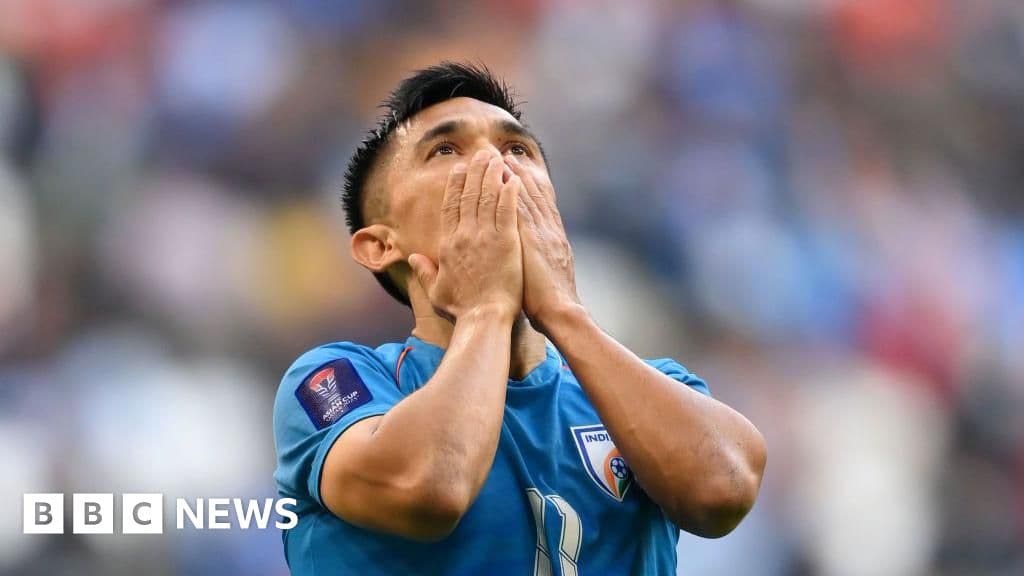
For those tracking the fortunes of the Blue Tigers - as the Indian men's national football team is called - over the years, the question is one of the biggest clichés as the country has never progressed beyond the preliminary rounds of Asian zone qualifiers.
The irony, however, lies in the manner in which the World Cup is celebrated in a number of football-crazy Indian states such as West Bengal, Kerala and Goa - or in the growing number of accredited Indian journalists covering the event on the ground despite the country having no stakes in the competition.
"We have faced frequent questions in the press box as to whether India plays football. Most of them know us as a cricket-playing nation," joked a senior Indian football writer who has covered four World Cups.
It's not just India - neighbour China, the world's second-most populous country, has also not qualified for the World Cup again. Fifa, however, is well aware of the importance of these markets, prompting it to dispatch a high-powered media rights team to India to secure a last-minute broadcasting deal for live coverage of the matches.
So will a place in the World Cup continue to be a bridge too far for India?
Baichung Bhutia, former national team captain and arguably one of the biggest names in Indian football, thinks it's not impossible - though there are no shortcuts.
"Yes, India can definitely play [in the World Cup] as nothing is impossible. The quota of Asian teams have gone up to eight [along with a ninth team in Iraq which came through from confederation play-offs this time] in the bigger 48-team format, where teams like Uzbekistan and Jordan are playing. However, it will require a lot of hard work," he said.
Bhutia added that there was no dearth of talent in a big country like India.
"What is lacking is the right ecosystem as we don't have a serious grassroots programme with a long-term vision. It's the most popular team sport in the world and we will need time for the results to show,'' said Bhutia.
Shyam Thapa, 78, who helped India win bronze at the 1970 Asian Games - the country's last major continental success - also emphasised the need for a sustained grassroots programme, saying the key was to bring more children into the game.
The trace of irritation in his voice was unmistakable. Thapa, a canny striker famed for his bicycle-kick goals, lamented that middle-class and upper-middle-class parents were increasingly steering their children away from football and towards cricket.
''I have run a youth academy myself for years and can vouch for the fact that the more young children take to the game, the more the chances of finding brighter talents. However, what has the All India Football Federation (AIFF) done to set such a system in motion?''
He added that many Indian parents were taking their children to cricket coaching camps, hoping they would get a "lucrative Indian Premier League (IPL cricket tournament) contract".
"They need to understand that there can be good money if they can make a career in football too,'' he said.
A closer look at the nine teams from the Asian continent which made the cut for the World Cup this year shows the enormity of the task that lies ahead of India.
They are Australia, Iran, Japan, Jordan, South Korea, Uzbekistan, Qatar, Saudi Arabia and Iraq (via inter-confederation play-offs) - with Jordan and Uzbekistan making their long-awaited debut.
Both debutants are, incidentally, ranked well above India in the current Fifa standings.
Uzbekistan are 52nd in the world and Jordan 63rd, while India have slipped to 136th after a sharp decline over the past 18 months.
The rankings underscore the scale of the challenge facing Indian football. As Kalyan Chaubey, the first former footballer to become AIFF president, said after taking office in 2022: "I will not sell dreams like India will play in the World Cup in eight years. Instead, I will say we will take Indian football forward from its current condition."
Nearly four years on, the question is whether his administration has succeeded in that.
Far from fast-tracking Indian football, many believe the past three years have turned the AIFF into an object of ridicule.
In 2014, the federation had launched a domestic club-based tournament, the Indian Super League (ISL), with much fanfare, pulling in big names from business, Bollywood and cricket. It was professionally run and attracted good foreign players. But now its future is uncertain.
The latest season of ISL was severely delayed after the AIFF failed to attract any bidders for commercial partnership, leaving hundreds of footballers facing anxious futures and generating a torrent of negative publicity.
Finally, the federation was forced to run a curtailed version without any commercial partners and has now gone back to the drawing board for the next season.
Against this backdrop, Chaubey's Vision 2047 - an ambitious roadmap that promised to bring 35 million children into football - increasingly resembles a forgotten campaign pledge. And the disconnect between lofty targets and on-field results has only grown starker.
A brief resurgence in 2023 saw the senior men's team climb back into Fifa's top 100 after winning an invitational tournament and the SAFF (South Asian Football Federation) Championship. Since then, however, the gains have largely unravelled.
After raising hopes of reaching the third round of the AFC (Asian Football Confederation) qualifiers for the 2026 World Cup for the first time, the team fell short and then failed dismally to qualify for next year's AFC Asian Cup.
In the near term, a ticket to the Asian Cup - which has 24 top teams from the continent in the fray - is the immediate priority.
In an informal chat with media a few years back, former captain Sunil Chettri, who came back from retirement in 2025, said that one has to set realistic goals.
''We need to take one step at a time and right now, our goal should be to qualify for all Asian Cups as it will help us play against stronger opposition. Once we can establish ourselves among the top 15-20 Asian countries, then only can we think of raising the bar for the World Cup,'' he said.
For the moment, the outlook remains bleak, though the AIFF leadership has been pushing hard for a policy change that would allow overseas citizens of India - also known as an OCI cardholders - to play for India.
At present, players of Indian origin holding foreign passports must renounce that to represent the country. Australia-born Ryan Williams did exactly that and quickly demonstrated his value with an impressive start in Indian colours.
If such a policy change is implemented, it could make a significant difference.
At this World Cup alone, four players of Indian origin are representing other countries: Tahsin Mohammed for Qatar, Nishan Velupillay for Australia, Sarpreet Singh for New Zealand and Samuel Moutoussamy for Congo.
For now, however, all that is still in the realm of possibility.
Until then, Indian fans will once again watch from afar, cheering the Messis, Ronaldos and Neymars of the world, while marvelling at the achievement of nations such as Curaçao, the smallest country ever to reach the World Cup.
The inevitable question will linger: if Curaçao can do it, why can't India?
Q&A
Why has India never qualified for the FIFA World Cup?
India has never qualified for the FIFA World Cup because the men's national football team has not advanced beyond the preliminary rounds of Asian zone qualifiers.
What is the significance of football in Indian states like West Bengal and Kerala?
Football is celebrated passionately in states like West Bengal and Kerala, where fans actively engage with the sport despite India's lack of participation in the World Cup.
How do Indian journalists cover the FIFA World Cup?
Indian journalists cover the FIFA World Cup extensively, often facing questions about India's football status, highlighting the country's cricket-centric reputation.
What are the challenges faced by Indian football?
Indian football faces challenges such as lack of investment, infrastructure, and consistent performance in international competitions, hindering its progress.