TL;DR
White-tailed eagles, the UK's largest bird of prey, will be released in Exmoor National Park after government approval. Up to 20 birds will be introduced over three years, raising concerns among local farmers about potential threats to sheep.
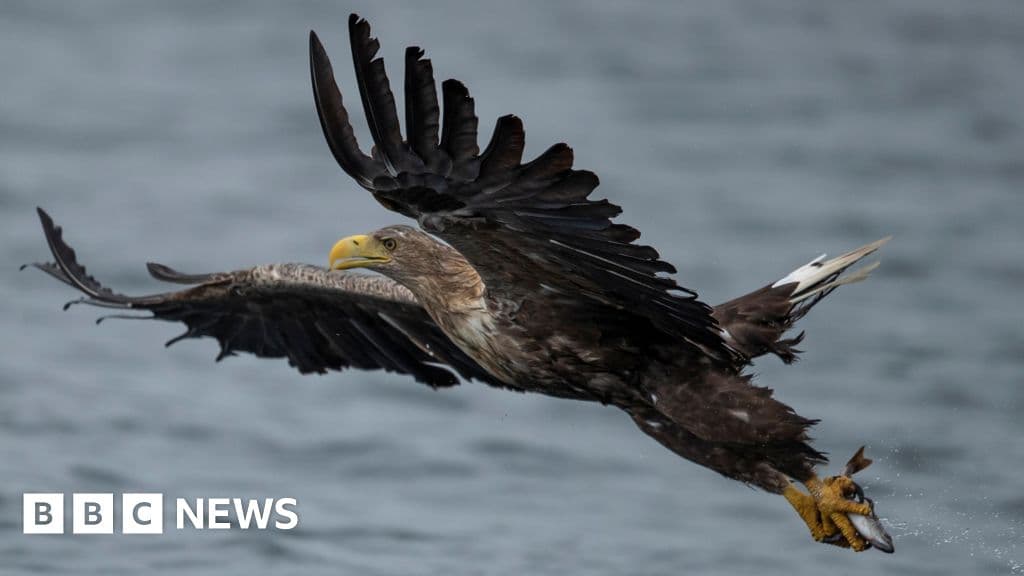
White-tailed eagles - the UK's largest bird of prey - will be released across Exmoor National Park after the government approved the latest stage in a controversial national reintroduction scheme.
Up to 20 birds, which are also known as sea eagles and were once extinct in the UK, will be released over three years from this summer.
But there are concerns the predators could threaten sheep in the area. One farmer in Scotland, where the eagles were reintroduced in 1975, said those in Exmoor should fight plans "tooth and nail" or risk losing lambs to the birds.
Natural England, which approved the plans on Wednesday, said the reintroduction would be "carefully planned" alongside local landowners.
The eagles, which have a wingspan of up to 2.4m (8ft), are already known to have visited Exmoor since the birds were released on the Isle of Wight seven years ago. They have since expanded their territories along the south coast.
All of the birds to be released in Exmoor will be fitted with satellite tags so a project team, led by Forestry England and the Roy Dennis Wildlife Foundation, will be able to track their locations and study their progress.
Steve Egerton-Read, white-tailed eagle project manager at Forestry England, said it was hoped their release would help to boost numbers "and continue their spread across southern England".
Ali Hawkins, senior ecologist with Exmoor National Park Authority, said the project's backers were "committed to continuing to work with farmers and other stakeholders, to support them in adapting to this species fledging on Exmoor once again".
White-tailed eagles were once widespread throughout Britain and Ireland but habitat loss and human persecution saw them disappear by 1918.
The first successful reintroduction of the birds began in 1975 on the Isle of Rum, in Scotland's Inner Hebrides. As more schemes have been launched over the years, however, their return has not always been welcomed.
Some Scottish farmers say they are losing tens of thousands of pounds of livestock each year as the eagles take vulnerable lambs.
Ricky Rennie, a fourth-generation farmer on Garvachy Farm, near Minard, Argyll, said he had been dealing with the impact of white-tailed eagles since 2018.
In the worst year, 2024, he estimates he lost two-thirds of his lambs to the eagles and he estimates he has lost up to £30,000 annually.
He said farmers in Exmoor should "fight" to stop the birds being released.
"If they're coming in naturally, there's not much you can do about it, but if they're trying to introduce them, I'd be fighting it tooth and nail - because they will eventually put farms out of business," he said.
Andrew Connon, president of the National Farmers' Union Scotland, said: "Any Exmoor release must learn from Scottish experience and ensure that farmers are supported within their existing farm systems to embed strong safeguards for livestock from the outset."