
Mississippi governor cancels special legislative session to redraw state supreme court maps
Mississippi governor cancels special session to redraw court maps, plans congressional redistricting by 2027.
The Guardian World1 min read
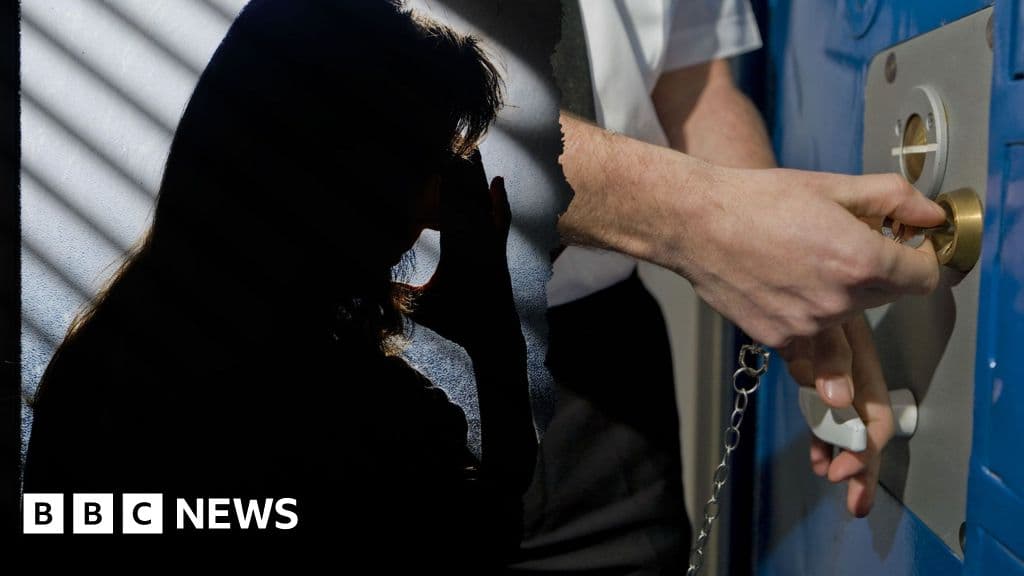
Former prison guards in Northern Ireland face severe PTSD, triggered by everyday sounds like school bells. One guard, Rebecca, shares her struggles with anxiety and lack of support from prison management.
For Rebecca, something as innocuous as the school run can be fraught with anxiety.
The sound of the school bell, she says, "automatically sends me into fight or flight".
The bell at her young children's school is the same as the alarm in the prison where she was physically and verbally attacked as part of an 11-year career as a guard. She has since been diagnosed with complex PTSD.
"I'll flinch, I'll go to run. In my job when that alarm is hit. I'm not running away from the danger, I'm running to the danger. It's completely exhausting."
Rebecca, which is not her real name, is one of two former prison guards who spoke to BBC Radio Ulster's Talkback programme about the long-term issues caused by the job, and how they feel there's been a lack of support from prison management.
She and fellow former prison guard Simon - also not his real name - described dealing with drugs, paramilitary prisoners and some of Northern Ireland's most dangerous criminals.
Simon, who medically retired in 2013, started his career in the now closed Maze prison in 1988.
At that time Northern Ireland prisons, and in particularly the Maze with its H-block wing, were synonymous for housing paramilitary prisoners from the height of the Troubles, the conflict in Northern Ireland which raged across the 1970s, 80s and 90s.
Before starting the job, Simon said he did "not know what I was going into" but found a career of "drug-filled prisons, jail and bays run by terrorists and prisoners".
That threat of violence is something Simon carried with him outside the prison, as he said he was followed by dissident republicans in Belfast city centre.
"It was constantly a fight. You were being attacked, constant threats of violence, drug-taking and loyalist and republican prisoners just doing what they wanted to do and the government not really caring with no support."
The Department of Justice said that claims about prisons being awash with drugs, staff safety being ignored or management not caring about staff wellbeing "are simply not borne out by evidence".
"We will always acknowledge the challenges of prison work - but we will also continue to stand firmly behind our staff, the safeguards in place, and the professionalism with which they carry out their duties," it added.
Simon said he had "seen evil" in his job and that it was "like working with the devil face to face".
Now, he lives with triggers, which include flashbacks. He said the previous night he felt that he was back fighting in a prison block.
"When I wake up in the morning, I've pounding headaches, stomach cramps all the time."
The former prison guard, who is divorced, said life can be "very dark" and it has affected his relationships.
PTSD in Northern Ireland prison guards is often caused by physical and verbal attacks experienced during their careers.
The school bell triggers PTSD for prison guards like Rebecca because it sounds similar to alarms in the prison, evoking memories of danger and trauma.
Many former prison guards feel there is a lack of support from prison management regarding mental health issues like PTSD.
Symptoms of complex PTSD in prison guards can include severe anxiety, flinching at sounds, and a constant state of hyper-vigilance.
Mississippi governor cancels special session to redraw court maps, plans congressional redistricting by 2027.
Elias Calocane feared his brother Valdo would take his own life during inquiry.

Utah mother who wrote a grief book convicted of murdering her husband faces sentencing.

In Gujarat, salt workers brave extreme heat and harsh living conditions.

Sarah Taylor makes history as England's first female fielding coach for men's team

A UK study shows 1 in 7 people prefer AI chatbots for health advice due to long NHS wait times.
See every story in News — including breaking news and analysis.
"I'm only here because of my grandchildren or I wouldn't be here."
For Rebecca, the job changed her as a person. She was never able to switch off.
Rebecca, who predominantly worked with sex offenders, said even reading what they had done to children and adults was "horrific".
"I had to release those people knowing that they were not rehabilitated," she said
She said the attacks she experienced at work became "the norm".
"If I went into my job and I wasn't threatened on a day I would come out and go: 'Oh I mustn't have done my job today.'"
She said her complex PTSD, which leads to panic attacks, means she can still end up in hospital because she believes she's dying.
"I trust nobody. I don't have friends as I would call them.
"I maybe have one or two that I have had since childhood really, that I know that I can trust. But I don't trust even my husband 100%. I trust nobody."
In 2025, it was revealed that Northern Ireland prisons had a "high density" of inmates, with cell sharing at Maghaberry jail on the increase in order to deal with space issues - based on data for 2023-24.
Northern Ireland has a rate of 109 prisoners for every 100,000 people in the population. The equivalent figure for Scotland was 149 and England and Wales was 140.
PTSD, a mental health condition that is attributable to events, can mean that traumatic incidents can come to mind at any time, said Dr Michael Duffy.
"It's triggered by situations and circumstances that remind them of the trauma, and so they get these intrusive memories," he said.
Dr Duffy, director of Queen's University Belfast's Research Centre for Stress, Trauma and Related Conditions (STARC), added that people then "try to suppress it" to keep the memories at bay, often using things like alcohol.
"Because they're constantly frightened of the event happening again, they stay in red alert mode so they're hypervigilant, always looking out for danger, always looking over their shoulder, even when danger isn't there."
When it comes to complex PTSD, Dr Duffy explained that that means three additional symptoms.
"One is that it has an effect on your relationships. Secondly, it can develop a very profound negative sense of yourself. You start to view yourself differently after a while.
"And, then thirdly, it's difficult to regulate emotions sometimes so you get unregulated and you can get angry out of the blue, get sad and it's very hard to see these coming."
In a statement the Department of Justice (DoJ) said prison officers "provide an essential public service", adding that they face "physical and mental demands as part of their job" and "we regret if any former officers are struggling in any way".
The statement said its sickness policy recognises all medical conditions, including PTSD.
It added that there are a number of support services available, including counselling and those from the Police Retraining and Rehabilitation Trust (PRRT).
The trust provides an initial psychological assessment within two weeks of referral and puts in place support, based on need, within three months.
"We would urge these two former officers to seek out that specialist support that is available for them," a spokesman said.
The DoJ added that the Northern Ireland Prison Service is "one of the most closely examined" in the UK, noting positive recent inspection reports for Magilligan Prison and Hydebank Wood.
It said that any assault on a prison officer is "unacceptable" and all incidents are taken seriously, reviewed thoroughly, and met with "firm action", including disciplinary sanctions and referral to the PSNI where appropriate.
You can listen to the interview with both former prison officers on Talkback on BBC Radio Ulster at 12:00 BST and it will be available on BBC Sounds.
If any of the issues raised in this article have affected you, details of help and support are available on the BBC Action Line.