Man City's world falls apart in 24 hours of despair
Manchester City lost the Premier League title to Arsenal after a 1-1 draw with Bournemouth. This followed the shocking news of manager Pep Guardiola's expected departure from the club.

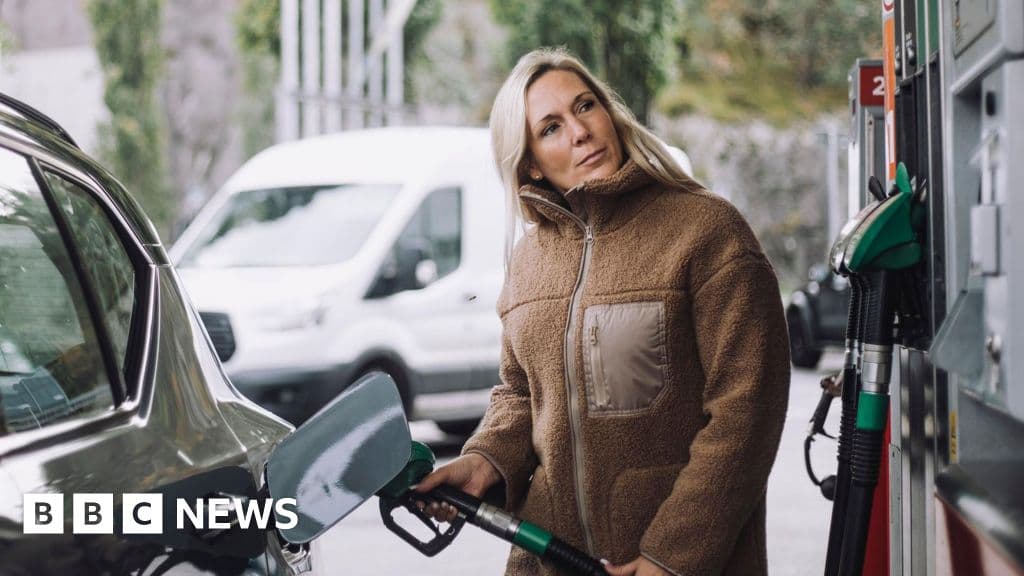
UK petrol and diesel prices have surged due to the US-Israel war with Iran, disrupting energy production and transport. The RAC warns prices may continue to rise without a resolution.
Motorists in the UK have faced higher fuel costs since the US-Israel war with Iran began on 28 February.
The conflict has disrupted the production and transportation of energy across the Middle East, and at some points has stopped it entirely as a result of missile strikes and drone attacks.
The RAC motoring group has warned that prices at the pump could keep rising if there is no resolution to the conflict.
Crude oil is a key ingredient in petrol and diesel, which means that higher wholesale costs make filling up a car more expensive.
Analysts say every $10 (£7.53) increase in the oil price pushes up pump prices by roughly 7p a litre.
Since the war began, the price of a barrel of Brent crude – the global benchmark for wholesale oil prices – has been very volatile, jumping from $73 to $126 a barrel at one point, the highest since Russia's full-scale invasion of Ukraine.
That put the cost of filling a typical family car with petrol up by around £14. A tank of diesel became £27 more expensive.
The price of petrol reached 158.5p a litre on 19 May, the highest since the war began. Diesel was 185.9p a litre.
The previous high was seen in mid-April, after which prices fell for a time before starting to increase again.
The RAC said it expected unleaded petrol to rise to at least 160p a litre in the coming weeks unless there was a "dramatic and sustained drop" in the price of oil. It thought the outlook was a little better for diesel drivers.
However, petrol and diesel prices remain well below the levels reached in summer 2022 following Russia's invasion of Ukraine, when petrol reached 191.5p a litre and diesel hit 199p.
Because transporting oil is a slow process, price movements in the wholesale markets take about a fortnight to show at the pump.
Fuel retailers have denied accusations of price gouging during the conflict. The official markets regulator investigated these claims and said that profit margins were "broadly unchanged" between February and March.
A government scheme called Fuel Finder lets drivers compare the cost of fuel offered by petrol stations across the UK.
For the wholesale markets, the most critical issue remains the status of the Strait of Hormuz.
About 20% of the world's oil and liquefied natural gas normally passes through the strait, but it has been effectively closed since the war began.
A ceasefire between the US/Israel and Iran that started on 8 April has largely held, but efforts to strike a long-term peace agreement between the two sides have not been successful. Control of the strait has been a major sticking point.
The conflict has disrupted energy production and transportation in the Middle East, leading to higher fuel costs in the UK.
Every $10 increase in crude oil prices raises UK pump prices by approximately 7p per litre.
The RAC has warned that UK petrol and diesel prices could continue to rise if the conflict in the Middle East does not resolve.
The increase in UK fuel prices began on 28 February, coinciding with the start of the US-Israel war with Iran.

Manchester City lost the Premier League title to Arsenal after a 1-1 draw with Bournemouth. This followed the shocking news of manager Pep Guardiola's expected departure from the club.

US missionary Peter Stafford contracts Ebola in DRC, now being treated in Germany

Two teenage gunmen carried out a mass shooting at the Islamic Center of San Diego, armed with handguns and rifles. A security guard was killed while trying to protect others, and the shooters later died from self-inflicted wounds.

Yáng Shuāng-zǐ's *Taiwan Travelogue* wins the 2026 International Booker Prize!

Mikel Arteta brings Arsenal back to the top of English football after 22 years.

After 22 years, Arsenal celebrates Premier League title victory!
See every story in News — including breaking news and analysis.
Analysis by BBC Verify showed that only a handful of ships have passed through the Strait since a temporary ceasefire was announced – usually around 138 vessels make the crossing every day.
Oil prices fell following the announcement of ceasefire, but have risen sharply in the weeks since as efforts to reopen the strait have failed.
In addition, the conflict has damaged oil and gas facilities across the Gulf, badly disrupting refining capacity.
The investment bank JP Morgan thinks global oil prices are likely to remain above $100 for the rest of the year, even if the current restrictions on the strait are lifted.
The UK is heavily reliant on oil and gas imports, with the majority coming from the US and Norway.
The price of oil on the global market determines how much the UK pays for it.
Although the UK does get some oil from the North Sea, most of that is exported for refining elsewhere.
In April, Chancellor Rachel Reeves said the UK was not facing an immediate shortage of petrol, diesel, or jet fuel.
Oil makes up 35% of the UK's total energy supply, according to the Department for Energy Security and Net Zero. As a member of the IEA, the UK must hold 90 days' worth of net oil imports, but currently has more than this.
The IEA has suggested a number of measures to reduce energy and fuel use in response to the conflict, including working from home and carpooling.
On 16 April it said Europe had "maybe six weeks of jet fuel left".
The International Air Transport Association (IATA) warned that higher ticket prices for air travellers in Europe were "inevitable" because of the high cost of jet fuel.
On 2 May, the UK government said airlines facing fuel shortages in the summer would be able to cancel flights in advance, without losing valuable take-off and landing slots at busy airports.
In the short term, millions of UK householders' domestic gas and electricity bills are shielded from any impact on wholesale costs paid by suppliers.
People whose energy bills are covered by the price cap saw their unit costs fall in April, and those will not change until the end of June.
However, depending on whether peace talks are successful, bills could rise when the next price cap takes effect at the start of July.
Anyone who already has a fixed energy tariff won't see a price rise for the length of their contract. But some suppliers have been pulling cheaper fixed deals for new customers off the market.
Heating oil is used by many households in Northern Ireland, and in some rural areas. The cost of that fluctuates more directly in response to the oil price, so the latest global uncertainty has pushed up bills for those households refilling their tanks.
The government announced a £53m support package to help those affected.
Additional reporting by Emer Moreau, Kevin Peachey, and Dearbail Jordan