
Police arrest 14 as rival protests take place over Israeli property event in London
14 arrests made during rival protests over an Israeli property event in London.
The Guardian World1 min read
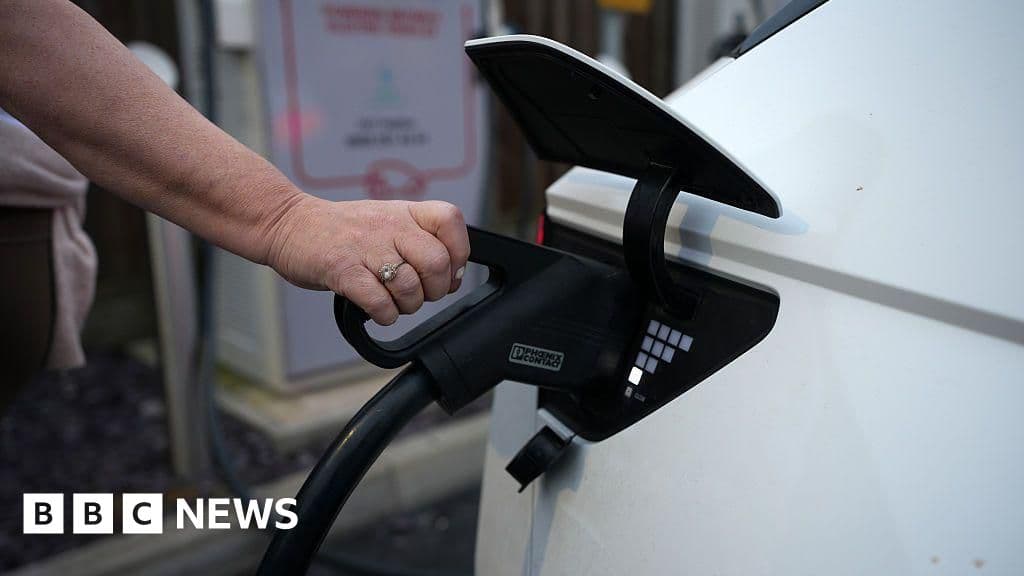
The UK government plans to weaken its target for electric vehicle sales, reducing the requirement from 80% to potentially 50-70% by 2030. This decision follows lobbying from car makers and trade unions concerned about costs and jobs.
The UK government is set to water down its target for how many new cars that are sold need to be electric vehicles (EVs).
Under the current rules, 80% of all new cars sold in the UK need to be EVs by 2030, but car makers and trade unions have been lobbying government for years to reduce the target because of concerns costs and jobs.
Meanwhile, sustainability groups say any weakening of the target will threaten the UK's long-term electrification and climate goals.
The government will hold a consultation on what the new 2030 target should be, meaning it could take months before it is decided, but numbers ranging from 50% to 70% are under consideration.
The policy on EV sales has changed a lot over the years.
A ban on sale of new petrol and diesel vehicles by 2030 was first announced by former prime minister Boris Johnson in 2020 and pushed back to 2035 by Rishi Sunak when he was prime minister.
Alongside this change, Sunak introduced phased targets for EV sales in the UK, known as the Zero Emission Vehicles (ZEV) mandate.
Under the ZEV mandate, the percentage of new car sales that need to be EVs increases each year. The target was 28% for 2025, 33% for 2026, and so on until it reaches 80% by 2030.
Labour has pledged in its manifesto to bring the petrol and diesel ban back to 2030. Meanwhile, a policy review on the separate ZEV mandate had been expected early next year but the industry has pushed for it to happen sooner.
Downing Street is expected to meet with the UK car industry this week to discuss the shift in policy, which was first reported by the Sunday Times. Labour has previously accused the Conservative government of "moving goalposts on phase out dates".
Companies that fail to hit the ZEV mandate face a fine of £15,000 per car. They also have the option of buying credits from rivals who have sold more electric cars than they needed to.
It is understood there are no plans to change that element of the mandate.
To sell their quota of EVs, many car makers use discounts. This has cost the industry more than £10bn over the past two years, according to the Society of Motor Manufacturers and Traders (SMMT).
The SMMT told the BBC that "unless there is urgent relief of the mandate, which is still running well ahead of demand and about to ramp up, then the cost will be in jobs, investments and the viability of some businesses".
The current target requires 80% of all new cars sold in the UK to be electric vehicles by 2030.
The government is responding to lobbying from car makers and trade unions who are concerned about costs and job impacts.
Proposed new targets for electric vehicle sales range from 50% to 70% by 2030.
Sustainability groups warn that weakening the target could jeopardize the UK's long-term electrification and climate objectives.
14 arrests made during rival protests over an Israeli property event in London.

Mourinho returns to Real Madrid, Silva heads to Benfica, and Arbeloa joins Fulham.

India defeats Pakistan by 64 runs in T20 World Cup match!

Police stop Tommy Robinson at Heathrow after his trip to Russia, seizing his phones.

Swiss voters appear to reject a far-right proposal to cap population at 10 million.

Thousands protest in Geneva as Trump and world leaders gather for G7 summit
See every story in News — including breaking news and analysis.
Unite union general secretary Sharon Graham said failure to act on the mandate would be "an act of self-harm to a sector which is a jewel in the crown of UK manufacturing".
Industry sources say drivers are reluctant to buy EVs because of worries about their range and the lack of EV charging points. They say this has also contributed to EVs failing to hold their value when they are sold second hand.
However, the UK Sustainable Investment and Finance Association's (UKSIF) chief executive James Alexander said that watering down the ZEV mandate could slow the rollout of more charging points.
He said the mandate is "vital for driving investment into our charging infrastructure" as it has "given the market confidence to commit vast sums of private capital to building out these networks across the country".
"Any attempt to water down these targets could send warning signals to these investors about the government's long-term commitment to electrifying our transport network," he added.
According to poll by researchers More in Common commissioned by UKSIF, 74% of Britons want their council to maintain or increase support for the rollout of EV charging points.
In total, 2,020,373 new cars were registered in 2025, the third successive year of growth and the highest total since the pandemic.
Electric cars accounted for 473,340 new registrations last year, giving them a market share of 23.4%.
That was a significant increase on 2024, but still below the 2025 ZEV mandate target of 28%.
Of the 9.8 million cars sold in the UK last year the vast majority, some 7.8 million were second-hand and they are not included in the ZEV mandate.