
Taiwan opposition leader says Xi meeting avoided 'reunification' talk
Taiwan's opposition leader Cheng Li-wun meets Xi Jinping, avoids 'reunification' discussion.
NPR Topics: News1 min read

The UK may experience large-scale hacktivist attacks if involved in a conflict, warns the head of the National Cyber Security Centre. These attacks could mirror the effects of recent ransomware incidents without the option to pay ransoms for recovery.
Mentioned in this story
The UK could face “hacktivist attacks at scale” if it becomes embroiled in a conflict and the impact could be similar to recent high-profile ransomware incidents, according to the head of the country’s online security agency.
Richard Horne, chief executive of the National Cyber Security Centre (NCSC), will warn today that nation states now account for the most significant incidents the NCSC deals with.
“Were we to be in, or near, a conflict situation, the UK would likely face hacktivist attacks at scale. With similar effects and sophistication to the ransomware attacks we see today. But … no option to pay a ransom to help recover,” the NCSC chief will say in a speech on Wednesday opening the annual CyberUK conference in Glasgow.
Ransomware gangs – who demand a payment in exchange for unlocking IT systems they have encrypted – have hit a host of British targets in recent years including Marks & Spencer, Jaguar Land Rover (JRL) and Royal Mail. In the case of JLR, the as-yet-unattributed attack slowed growth in the UK economy by hitting car production.
Every public and private sector organisation needs to focus on cybersecurity in the face of such a threat, said Horne, whose agency is part of GCHQ.
“Defending against that means every organisation embedding cybersecurity into their corporate mission,” he said.
“Ensuring they understand the full extent of risk they face, build defence in depth so that initial footholds by an attacker don’t result in catastrophic impact.”
Referring to a typical resolution of ransomware attacks, where organisations pay to unlock encrypted IT systems, Horne said the UK should prepare for a future where “paying their way out just isn’t an option.”
The NCSC chief echoed the warning last year from Blaise Metreweli, the chief of UK spy agency MI6, who said the country was caught in “a space between peace and war” as tensions mount with Russia.
Hacktivist attacks are politically motivated cyberattacks that could disrupt UK infrastructure and services, especially during conflicts.
Recent ransomware incidents have targeted major organizations like Marks & Spencer, Jaguar Land Rover, and Royal Mail, causing significant disruptions.
Richard Horne is the chief executive of the National Cyber Security Centre, and he warns that the UK must enhance its cybersecurity measures in light of potential hacktivist threats during conflicts.
Taiwan's opposition leader Cheng Li-wun meets Xi Jinping, avoids 'reunification' discussion.
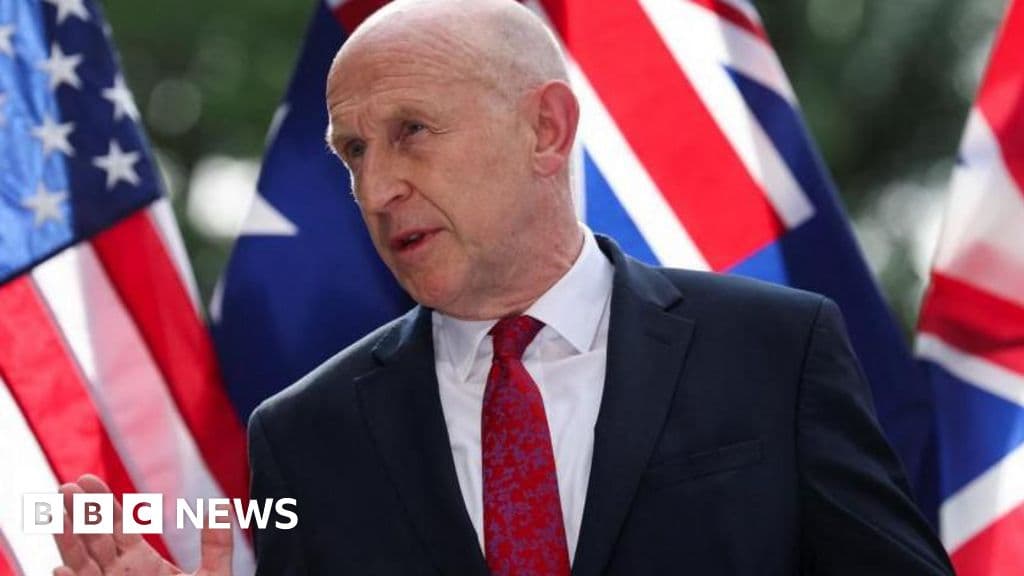
John Healey's resignation highlights frustrations over slow defence funding increases.

Three men sentenced for violence at Henry Nowak protest in Southampton

Vance Boelter pleads guilty to the assassination of Minnesota House Speaker and her husband.

Angler catches rare great white shark off Nantucket, shares safe release video

Chicago officials seek suspect after a cross was burned in Grant Park.
See every story in News — including breaking news and analysis.
“Let’s be clear, cyberspace is part of that contest,” said Horne. “We’re in a perfect storm. With the two forces of rapid technological change and rising geopolitical tensions creating what feels like tumultuous uncertainty.”
Referring to the development of Mythos, a new AI model that can discover hacker-friendly vulnerabilities in systems at speed, Horne said frontier AI – the term for cutting-edge versions of the technology – will expose organisations that are not repairing gaps in their cybersecurity or updating old systems.
Horne said the country was not seeing significant new attacks due to advanced AI systems but it must head off the threat by embracing AI as a means of defending against attackers.