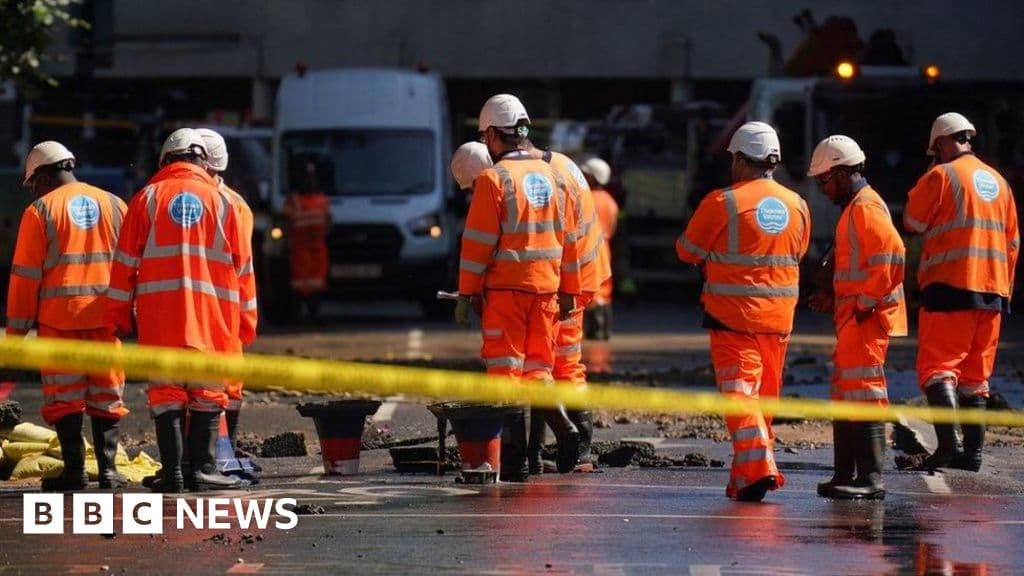
Thames Water moves step closer to nationalisation after government objects to rescue deal
Thames Water moves closer to nationalisation as government objects to rescue deal.
BBC News1 min read

The UAE has officially exited OPEC, a move welcomed by the US for its potential to reduce the cartel's pricing power. This unexpected timing raises questions about future competition and governance in energy markets.
Mentioned in this story
As the United Arab Emirates’s exit from OPEC officially takes effect, experts say the United States government will welcome the move for its potential to curb the oil-producing cartel’s pricing power.
While the UAE’s withdrawal, which went into effect on Friday, has been long rumoured, the timing was unexpected.
“The exit was a surprise in timing (at least to me), but in some ways has been brewing for some time,” wrote Rachel Ziemba, adjunct senior fellow at the Center for a New American Security – a US think tank.
“It prompts the question whether there will be more competition than cooperation in the region and what the governance of the energy markets will look like.”
The UAE has publicly complained about OPEC quotas, which limit the oil production for all member countries. It is one of the few OPEC members that has invested in boosting production over the past few years, but has not been able to get it to market in the volumes it wanted.
The move also comes at a time when the world is clamouring for new supplies of oil. The Strait of Hormuz, through which 20 percent of the world’s oil and gas transits, mostly from Middle East nations to Asia and Europe, continues to be blocked amid the US-Israel war on Iran, sending oil prices soaring.
With oil demand shooting up, the UAE is ready to step in with higher supplies and lower prices.
“This is going to increase oil production once things normalise [in the strait] by about 2 million barrels per day, which will pull down some pricing pressure depending on how demand does compared to global prices,” Adnan Mazarei, nonresident senior fellow at the Peterson Institute for International Economics (PIIE) – a non-partisan think tank in Washington, DC, told Al Jazeera.
“The US would welcome a weakening of the OPEC and OPEC+. They do have some ability to set prices, and a decline in that power will be welcomed by the US,” Mazarei said.
On Thursday, global oil benchmark Brent crude futures LCOc1 rose as high as $126.41 a barrel before settling down $4.02. Also on Thursday, the average price for one gallon of petrol hit $4.33 ($1.13 per litre), close to double from the $2.98 ($0.78 per litre) a day before the US and Israel launched their attack on Iran, which retaliated by closing off the strait and with attacks on energy infrastructure and US bases in the region.
With the war now in its third month, there has been no respite for consumers as prices continue to soar, fueling inflation and stressing wallets, an area of concern for US President Donald Trump with mid-term elections coming up in November and his Republican Party at risk of losing seats.
The UAE left OPEC due to dissatisfaction with production quotas that limited its oil output despite its investments in boosting production.
The UAE's exit may lead to increased competition in the oil market, potentially curbing OPEC's pricing power and affecting global oil prices.
The US government is likely to welcome the UAE's departure as it aligns with American interests in reducing OPEC's influence over oil prices.
The exit raises questions about whether future energy market dynamics will favor competition over cooperation among oil-producing nations.
Thames Water moves closer to nationalisation as government objects to rescue deal.

RFK Jr. faces backlash for 'bullying' letter to journal over vaccine paper removal

Meet Merlin, the duck in Mexico's World Cup jersey who stole the show!

Scotland's camp shows a cultural shift after World Cup victory

Keir Starmer pledges new sanctions on Russia and energy aid for Ukraine at G7 summit.

Alaska election officials rule a second Dan Sullivan can't run against incumbent Dan Sullivan in key Senate race.
See every story in News — including breaking news and analysis.
A new, four-day Reuters/Ipsos poll completed on Monday suggested 34 percent of Americans approve of Trump’s performance in the White House, down from 36 percent in a prior Reuters/Ipsos survey, which was conducted from April 15 to 20.
Trump reiterated his stance that prices will drop with the end of the war.
“The gas will go down. As soon as the war is over, it’ll drop like a rock,” he said on Thursday.
One of the few winners in the current oil squeeze – US oil and gas producers who have enjoyed “unusual profits” since this war began – will likely see some pressure on those profits as and when the UAE supply hits the market, Mazarei added.
Another is the US petrochemical sector, one of the dominant global players, alongside China and Saudi Arabia.
Used in everything from fertilisers, solar panels, clothing, and cosmetics to electric vehicles, electronics, and medicines, petrochemicals are integral to food security, manufacturing, and clean energy and becoming the fastest-growing source of demand for oil, PIIE said in a March report.
The disruption of the oil flows due to the war in Iran has strengthened the US role as it continues to be the largest oil producer.
“The US is in a very advantageous position. The increase in US access to Venezuelan oil will improve the US position further,” Mazarei said.
For now, the UAE’s move is “a future sign and signal – one of openness to trade and interest in helping the world restock,” Ziemba said.
It also comes on the heels of a request for a currency swap line it made to the US last month, which experts have said was a “fundamentally political move”.
“It signals the UAE’s political and economic closeness to the US, and this was a significantly political move,” Mazarei said.
UAE’s exit also opens the door for other OPEC members to follow suit, a scenario that would increase downward pressure on oil prices.
“There is a chance of other countries defecting. But if I had to bet, I’d say OPEC will survive, but in a weaker shape and effectiveness,” Mazarei said.
The one thing Mazarei is keeping an eye on is how the war in Iran will reshape the Gulf Cooperation Council (GCC), the regional alliance comprising Bahrain, Kuwait, Oman, Qatar, Saudi Arabia, and the United Arab Emirates.
“The question is, will the GCC survive?” he said.
Ziemba, too, is watching whether there will be more cooperation or competition in the region after the current conflict.
The UAE’s exit from OPEC “is one of many ways in which countries may be balancing – trying relationships for economic and security arrangements that may suit national interests,” she said, adding that she expects the UAE to be “an important player”, including for their own and regional interests.