
Fake romance to missed deliveries: How to protect yourself from three common scams
Learn about common scams and how to protect yourself from them.
BBC News1 min read
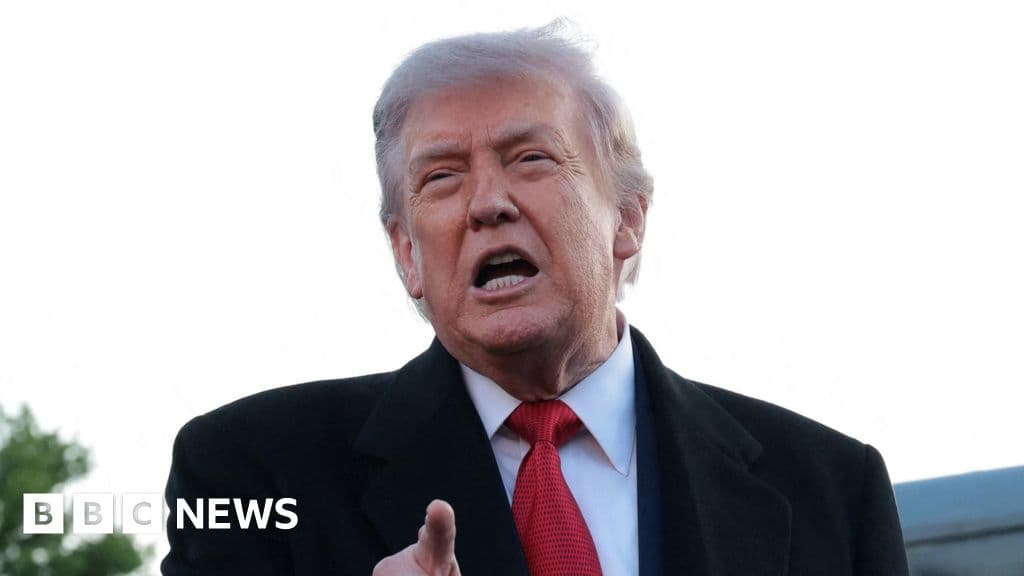
President Trump asserts that a ceasefire between the US and Iran remains intact despite recent exchanges of fire in the Strait of Hormuz. The situation escalated after Iran accused the US of targeting its vessels, while the US claimed it acted in self-defense.
Mentioned in this story
US President Donald Trump says a ceasefire is still in place between the US and Iran after both sides exchanged fire late on Thursday night. It was unclear who fired first.
Iran's top military command alleged the US had targeted an Iranian oil tanker and another vessel approaching the Strait of Hormuz and carried out "aerial attacks" on several coastal areas.
The US, meanwhile, said it responded to Iranian attacks on US Navy guided-missile destroyers in the Strait with "self-defence strikes". Trump said Iran "trifled with us today".
The flare-up comes a day after Iran's foreign ministry had said it was considering a US proposal to end the war.
Iranian state media initially reported "explosions" in the Strait of Hormuz, describing them as an "exchange of fire" with the "enemy". Meanwhile, local media reported explosions were heard in Tehran.
Not long after, a statement from Iran's top military command said US "aerial attacks" struck the coasts of Bandar Khamir, Sirik and Qeshm Island.
It said it responded immediately by attacking US military vessels, inflicting "significant damage", and accused the US of a "violation of the ceasefire".
US Central Command (Centcom) described the Iranian attacks as "unprovoked", saying Iranian forces launched "multiple missiles, drones and small boats" as US Navy guided-missile destroyers transited through the strait.
Centcom said it had "eliminated inbound threats and targeted Iranian military facilities responsible for attacking US forces, including missile and drone launch sites; command and control locations; and intelligence, surveillance and reconnaissance nodes."
"Centcom does not seek escalation but remains positioned and ready to protect American forces," the statement continued.
Posting on Truth Social, Trump said that the US had destroyed multiple small boats that "dropped ever so beautifully down to the Ocean, very much like a butterfly dropping to its grave!"
"Great damage" was "done to the Iranian attackers," he continued.
The US president also reiterated a warning over the peace deal: "Just like we knocked them out again today, we'll knock them out a lot harder, and a lot more violently, in the future, if they don't get their Deal signed, FAST!"
An Israeli source told the BBC there was "no Israeli involvement" in the latest attacks.
The increase in tensions comes despite the US president saying in recent days that the war in Iran will be "over quickly".
US news outlet Axios had said that the White House believes it could be closing in on a 14-point memorandum of understanding with Iran, which could set a framework for more detailed nuclear negotiations.
On Wednesday, an Iranian foreign ministry spokesman said the latest US proposal was being considered and that Tehran would share its views with Pakistani mediators.
The exchange of fire was triggered by Iran's allegations that the US targeted an Iranian oil tanker and other vessels, leading to US self-defense strikes.
President Trump stated that the ceasefire between the US and Iran is still in place despite the recent military exchanges.
Iran's top military command accused the US of conducting aerial attacks and targeting its vessels, describing the incidents as an exchange of fire with the 'enemy.'
Prior to the flare-up, Iran's foreign ministry indicated it was considering a US proposal to end the ongoing war.
Learn about common scams and how to protect yourself from them.

At least seven people were killed and dozens injured in recent shootings in Chicago. Donald Trump has called for military intervention in the city, questioning why Governor JB Pritzker has not sought his help.

Residents in a remote town face banking challenges after the last bank closes.

Survey: 67% of UK Taxpayers Support Increased Levies on Big Tech

Far-right millionaire Abelardo de la Espriella wins Colombia’s presidential runoff against Iván Cepeda.

The decline of the Indian rupee and stricter visa regulations are causing Indian students to reconsider studying abroad. Many, like Pragati Priya, face increased financial burdens as they plan their education overseas.
See every story in News — including breaking news and analysis.
Pakistan's foreign minister said his country was "endeavouring to convert this ceasefire into a permanent end to this war".
But a senior member of Iran's parliament has dismissed the 14-point memorandum of understanding as a "wish list".
Both the US and Iran have threatened an escalation in violence if their respective conditions for a peace deal aren't met.
In a Truth Social post on 6 May, Trump wrote that if Iran did not agree to a deal "the bombing starts, and it will be, sadly, at a much higher level and intensity than it was before".
A short while later, the spokesperson of the Iranian parliament's national security and foreign policy commission, Ebrahim Rezaei, wrote on X that Iran "has its finger on the trigger", warning Iran would "deliver a harsh and regret-inducing response" if the US did not "surrender and grant necessary conditions".
Trump had previously said Operation Epic Fury - the initial US-Israeli offensive in Iran - would come to an end "assuming Iran agrees to give what has been agreed to". Prior to this statement, US Secretary of State Marco Rubio had said the operation was over and had achieved its objectives.
Trump also said, not for the first time, that Iran had agreed to never have a nuclear weapon "among other things" - a claim that has not been confirmed by Tehran. Iran's nuclear programme has been one of the key sticking points between the two sides.