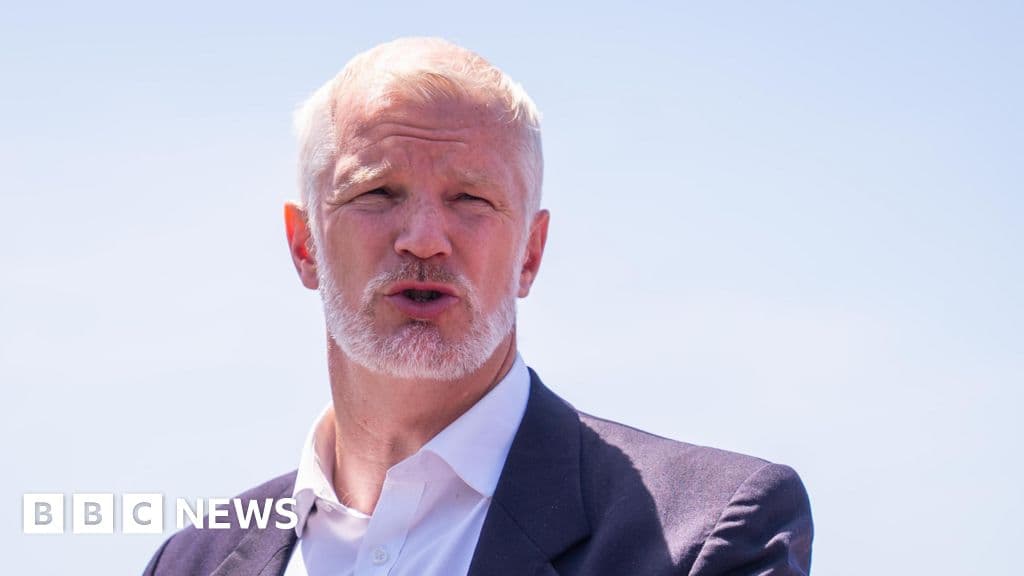
Armed forces minister quits after Healey exit as defence funding row deepens
Armed forces minister Al Carns quits after Healey's exit over military funding issues.
BBC News1 min read

The US has imposed new sanctions on Cuba's state-owned oil company, Union Cuba-Petroleo, citing its role in supporting the country's repressive regime. Secretary of State Marco Rubio criticized the Castro family for profiting from the nation's oil while ordinary Cubans face fuel shortages and blackouts.
Mentioned in this story
The United States has levied additional sanctions against Cuba, this time targeting the Caribbean island’s state-owned oil and gas company, Union Cuba-Petroleo.
On Thursday, US Secretary of State Marco Rubio issued a statement describing the company as a tool for Cuba’s “repressive security apparatus”.
“While the Cuban people have suffered fuel shortages and blackouts because of decades of under-investment in critical infrastructure, Cuba’s Communist leaders have diverted energy resources to line their own pockets,” Rubio wrote.
He then proceeded to denounce the Castro family, whose members governed Cuba for decades, for profiting from the country’s oil.
“As regular Cubans wait for weeks to fill their cars and suffer relentless blackouts, the Castro family flies around on a private jet, the government buses in fake protesters for publicity stunts, and the regime prioritizes keeping the power on in luxury tourist hotels,” Rubio said.
He added that Union Cuba-Petroleo’s assets “were unlawfully expropriated from American owners years ago”, a reference to the Cuban government’s efforts in 1960 to nationalise oil production.
That effort, in turn, was a reaction to a US decision under then-President Dwight Eisenhower to cut off US oil exports to Cuba.
The sanctions are the latest step under US President Donald Trump to apply pressure to the island’s communist government.
Since January, Trump has led a campaign to restrict fuel on the island, first by cutting off energy exports from its regional ally Venezuela, then by threatening tariffs against any country that ships oil to Cuba.
That de facto oil blockade has been coupled with intensifying sanctions that build upon a decades-long trade embargo the US has placed on Cuba.
The island is reliant on oil imports to power its ageing electricity grid, as well as for daily necessities, such as shipping and transportation.
As of 2023, the International Energy Agency estimates that Cuba is only able to produce 40 percent of the oil it uses. In the past, the rest came from abroad.
But that trade has all but stopped. Only a single Russian oil tanker has reached Cuba since late January.
Thursday’s sanctions are expected to heighten Cuba’s energy crisis. The sanctions not only freeze any US-based assets Union Cuba-Petroleo may have, but they also bar any entity with operations in the US from doing business with the company.
While power outages are not unheard of in Cuba, their frequency has increased since the oil blockade began, including two island-wide blackouts in March alone.
This week, Volker Turk, the United Nations high commissioner for human rights, warned that the outages were having dire consequences for everyday Cubans.
The US has targeted Cuba's state-owned oil and gas company, Union Cuba-Petroleo, with new sanctions.
The sanctions were imposed because the company is viewed as a tool for Cuba's repressive security apparatus.
Marco Rubio condemned the Castro family for profiting from Cuba's oil while ordinary citizens suffer from fuel shortages and blackouts.
Ordinary Cubans are facing fuel shortages and blackouts due to the government's mismanagement and diversion of resources.
Armed forces minister Al Carns quits after Healey's exit over military funding issues.

Over 60 US lawmakers are urging Israel to allow cancer patients in Gaza to access treatment in the West Bank and East Jerusalem. The letter, signed by members of both the House and Senate, calls for the evacuation of child patients and their caretakers.

A man pleads guilty to the murder of Minnesota's Democratic House speaker and her husband.

Natural history GCSE will equip teens to plant wildflower gardens and study biodiversity.

Mexico kicks off World Cup with a 2-0 win over South Africa!

Shakira and Burna Boy shine at World Cup 2026 opening ceremony!
See every story in News — including breaking news and analysis.
“The fuel restrictions imposed since early 2026 and recent tightening of extraterritorial sanctions, taken together, are directly harming Cubans, especially the most vulnerable,” Turk said in a statement.
“Children are dying because doctors lack access to essential medical supplies and medicines. This is unacceptable.
The Trump administration, however, has blamed the Cuban government for those blackouts. It has also suggested it is willing to take military action in Cuba to force regime change.
In March, Trump compared his intentions for Cuba to the January 3 military offensive he took against Venezuela, which culminated in the abduction of the South American country’s president, Nicolas Maduro.
“As we achieve a historic transformation in Venezuela, we’re also looking forward to the great change that will soon be coming to Cuba,” Trump said.
“Cuba’s in its last moments of life as it was. It’ll have a great new life, but it’s in its last moments of life the way it is.”
It is unclear how far the US will go to trigger change in Cuba, though. Officials on both sides have been involved in ongoing talks, as Cuba seeks relief from the oil blockade.
In March, The New York Times reported that the Trump administration had proposed the removal of President Miguel Diaz-Canel, the country’s first non-Castro leader since 1959. Cuban officials, however, have publicly rejected that idea.
Last month, the Trump administration also filed a criminal indictment in the US against former Cuban President Raul Castro over the 1996 downing of an activist plane. Diaz-Canel denounced the charges, however, as an effort to “justify the folly of a military aggression”.
Critics also point to the buildup of US military assets in the Caribbean Sea as a signal that the Trump administration is preparing to take aggressive action against Cuba. In May, for instance, an aircraft carrier, the USS Nimitz, arrived in the Caribbean.
Two high-level military leaders have also visited the US naval base at Guantanamo Bay, Cuba, in recent weeks. Last month, it was General Francis Donovan, the leader of the US Southern Command. This week, it was Defence Secretary Pete Hegseth.
On Wednesday, Hegseth again hinted at the possibility of US military action, as he warned Cuba not to make the kind of “wrong decision” that “ creates the kind of threat the United States may have to deal with”.
The Trump administration has long maintained that Cuba represents a national security threat to the US.
In Thursday’s statement, Rubio also underscored that the US would continue to place sanctions on Cuba until a government change occurred.
“President Trump wants a new future for the Cuban people with greater economic and political freedom and opportunity,” he wrote. “Until then, we will continue to target the Communist regime’s ability to leverage its energy trade to further its corrupt agenda and violently repress the Cuban people.”