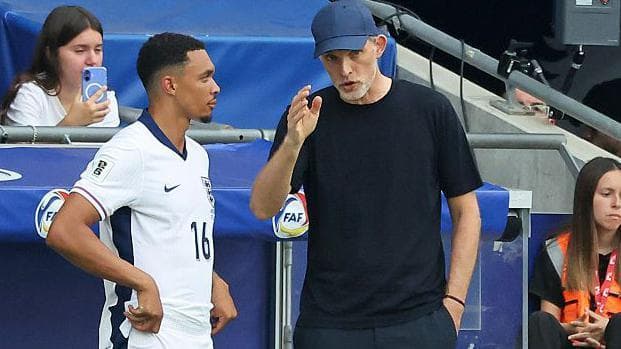
Tuchel's defensive gambles and what do they say about Alexander-Arnold?
Livramento's injury exposes Tuchel's risky defensive choices for England.
BBC News1 min read

Three senior defence figures have accused Keir Starmer of underfunding the military, impacting troop operations. This criticism comes amidst a contentious debate over the defence investment plan, which aims to allocate £13.5bn to the Ministry of Defence over four years.
Mentioned in this story
Keir Starmer is leaving British troops underfunded and unable to carry out the operations he expects from them, according to scathing remarks delivered in parliament on Tuesday by three senior defence figures.
The prime minister came under fire in separate interventions from his former defence secretary John Healey, the former defence minister Al Carns and the country’s current senior military officer, Rich Knighton.
All three accused Starmer of underfunding the military amid a bitter row over the defence investment plan (Dip), which has renewed concerns among Labour MPs about the direction of the government.
Healey and Carns both gave their Commons resignation speeches just days after quitting the government in protest at the Dip, which is expected to provide an additional £13.5bn to the Ministry of Defence (MoD) over four years.
Healey told the Commons: “I took the decision to resign with the very greatest regret and reluctance. I continue to be certain about this decision. In time, I believe it will be seen as necessary in securing the future of our armed forces and of our alliances.”
In comments that highlighted concerns in the Labour party about Starmer’s reluctance to embrace radical policy options, he added: “This is not the moment for calibration or incremental change.
“This means bigger politics, bolder priorities, harder choices, and Britain’s challenge now is the transformation and the rearmament of our armed forces.”
Talking about how much the country spends on defence as a share of GDP, he said: “I see the current defence investment plans falling well short of what is required – a rise of 0.08% from next year to 2030, no date for reaching 3%, no path to 3.5% by 2030.”
Many of Healey’s comments were echoed by Carns, who quit hours after the defence secretary’s resignation on Thursday.
“The reality is, we are spending too much time preparing for last year’s war, not tomorrow’s, and I urge the house to push for transformation, push hard, and push for delivery this side of 2030,” Carns said.
Speaking earlier to parliament’s defence select committee, Knighton, the chief of the defence staff, said Britain would have to “dial back” on military operations in the next few years if the MoD did not get more than what was being offered.
“We’ll have to dial back our activities; our exercise, operational activity, if the level of resource funding that is available to us does not increase,” he said, in effect referring to military activity in Europe, Ukraine and the Middle East.
John Healey criticized Keir Starmer for underfunding the military, stating it affects troops' ability to perform expected operations.
The critics include former defence secretary John Healey, former defence minister Al Carns, and current senior military officer Rich Knighton.
The defence investment plan is expected to provide an additional £13.5bn to the Ministry of Defence over four years.
John Healey resigned in protest against the defence investment plan, believing it was necessary for the future of the armed forces and alliances.
Livramento's injury exposes Tuchel's risky defensive choices for England.
ZDF retracts report on Musk after legal threats over misleading claims

Toronto police reveal a gun-for-hire network linked to multiple shootings, including one at the US consulate.

Keir Starmer faces challenges at the G7 summit as his influence wanes.

Turner prize-winning artist defends Churchill video at NPG after backlash

How Trump's Iran Deal Affects US-Israel Relations
See every story in News — including breaking news and analysis.
All three interventions underlined concerns among Labour MPs about Starmer’s unwillingness to back up his rhetoric with radical policy solutions and his apparent reluctance to overrule his chancellor, Rachel Reeves.
They could have a significant impact on the prime minister’s future, given that the Greater Manchester mayor, Andy Burnham, is hoping to win the Makerfield byelection on Thursday on a promise to challenge the prime minister if elected.
In a separate speech on Tuesday, Wes Streeting, the former health secretary, urged the prime minister to set out a timetable for his departure should Burnham win his seat.
“When the results are in, I hope the prime minister will reflect on his own position and set out a timetable,” he said. “I think that would be a better way forward for everyone and would enable that better culture that we aspire to.”
Starmer insisted he would not accept such demands.
Speaking to Times Radio from the G7 summit at Évians-les-Bains, he said: “I don’t think there should be a contest. If there is a contest I intend to be in it and to fight it.”
He also appeared to reject pressure to increase the defence budget, saying: “I have been responsible for delivering the biggest uplift in defence spending since the 1980s. That’s what we did last year when we increased it from 2.3% to 2.6%.
“The defence investment plan is about the capability for the future so that’s more money even on top of that … What we’re doing now is working with the new defence secretary to look at what capabilities he wants to prioritise.”
Sources say the prime minister has given his new defence secretary, Dan Jarvis, two weeks to learn the detail of the Dip and request any changes before the plan is announced before the Nato summit in early July.