
UK mosques advised to run lockdown drills as fears of anti-Muslim attacks grow
UK mosques urged to conduct lockdown drills as anti-Muslim attacks rise.
The Guardian World1 min read
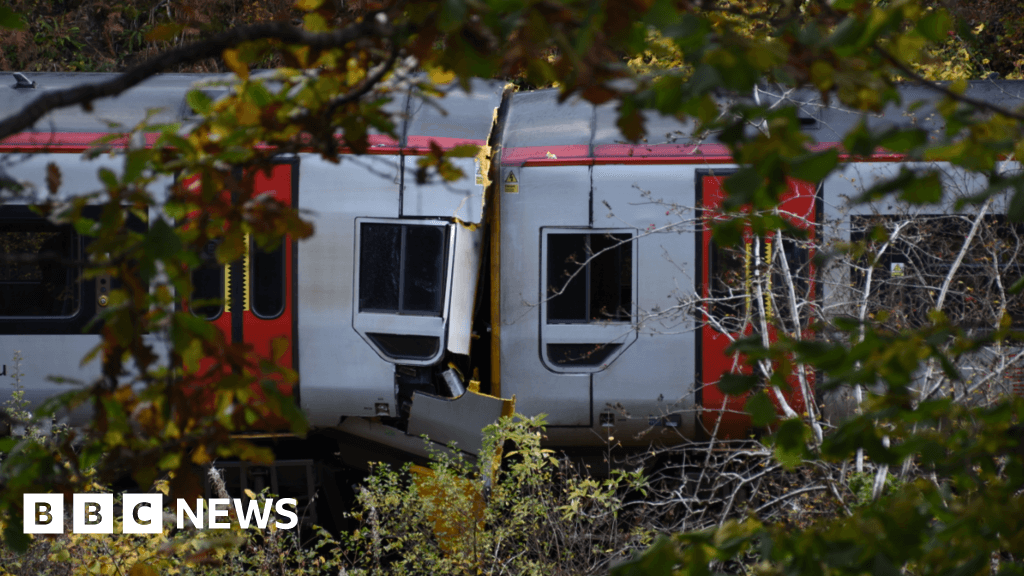
A train crash in Talerddig, Powys, killed one man and injured four others. An investigation revealed that the collision could have been avoided with proper activation of sanding systems.
Mentioned in this story
A head-on fatal collision between two trains in mid Wales could have been avoided, an investigation has found.
One passenger died and four other people were seriously injured when two trains collided in the village of Talerddig, Powys, in October 2024.
An investigation by the Rail Accident Investigation Branch (RAIB) has concluded the crash would not have happened if one or both of the automatic and manual sanding systems - which increase wheel adhesion to the rails - had been activated.
Transport for Wales (TfW) and Network Rail said that while incidents of this nature were "extremely rare", they would consider the report's recommendations to "help prevent a similar incident".
Tudor Evans from Capel Dewi in Aberystwyth was travelling home from a holiday in Italy when he died on the westbound train.
The 66-year-old was a passenger in the rear carriage of the train to Aberystwyth, as were other people who were seriously injured in the crash just before 19:00 on 21 October, 2024.
The driver of the Shrewsbury train was also seriously injured – the RAIB said he was in the process of leaving the cab when the crash happened and became trapped.
The trains, both operated by Transport for Wales, were travelling on the Cambrian Line. Most of the Cambrian Line is single track but there is a section of dual track near to where the crash happened called the Talerddig Loop.
The trains were meant to pass each other in the loop but, on the night of the collision, the train heading towards Aberystwyth was unable to stop despite the brakes being fully applied.
The RAIB said the train slid through the loop and rejoined the single-track section, continuing towards a slope heading for the train coming from the opposite direction.
As it slid down the hill, the train gathered speed and collided head on with the train heading towards Shrewsbury.
The RAIB investigators found that, at the point of impact, the Aberystwyth train was travelling at 24mph, and the Shrewsbury train at just 6mph – the driver of the Shrewsbury train had managed to slow down after being warned by the signaller that the other train had failed to stop in the loop.
However, due to the failed sanding systems and low wheel-rail adhesion, the speed "was such that the deceleration required to slow the train for the loop could not be sustained".
Both trains involved were fitted with two separate sanding systems – an automatic one which is designed to deliver sand when the train is braking, and an emergency sander, which is activated manually to deliver sand to the front wheels.
The report found "the automatic sander did not function, probably due to the presence of electrical faults in its control circuit, while the manually-operated emergency sander was not activated by the driver".
The train crash was caused by a head-on collision between two trains, which could have been avoided if the sanding systems had been activated.
The victim was Tudor Evans from Capel Dewi, who was returning home from a holiday in Italy.
The Rail Accident Investigation Branch recommended activating the automatic and manual sanding systems to prevent similar incidents in the future.
Four other people were seriously injured in the train crash in addition to the one fatality.
UK mosques urged to conduct lockdown drills as anti-Muslim attacks rise.

Get ready for the Great American State Fair on the National Mall! June 25 - July 10.

New poll shows most Americans disapprove of Trump's handling of the economy amid rising gas prices.

Jet fuel prices are falling, but don't expect airfares to follow suit anytime soon.

Join the star-studded dedication of the Obama Presidential Center this Thursday!

U.S. Defense Secretary Hegseth announces a review of forces in Europe and calls for NATO allies to take more responsibility.
See every story in News — including breaking news and analysis.
It also noted the "driver stated that it had not occurred to them to use the emergency sanders", with the author of the report adding the driver was not made aware that the automatic system had not sprayed sand on the train's wheels.
The report also concluded that adverse weather conditions were another crucial factor in causing the collision.
The RAIB recommended that Transport for Wales should review training, development and processes to ensure train drivers are "competent in actions which may be required in abnormal or emergency situations, and that this competency is appropriately maintained".
It added the review should "specifically consider the competencies relating to making emergency calls and the use of emergency sanding systems".
Bethan Evans from Tal-y-bont, Ceredigion, was on the last leg of her train journey to Aberystwyth when the crash happened.
She recalled being knocked unconscious.
"I woke up and the train was at a standstill and I wasn't sure what happened but I had a really bad headache," Bethan said.
"I remember looking around and seeing people in panic, I heard defibrillator noises, I heard people shouting, I saw people on the floor, and broken bones.
"It wasn't until I spoke to fellow passengers that I knew what was going on."
Bethan said she and other passengers were on the train for three hours before being let off and checked over.
"It felt pretty surreal, like it wasn't actually happening," she added.
"From being relaxed and reading a book to not knowing why all of the emergency services were there.
"We had so many casualties, and it took so long for people to be seen, I think there needs to be more staff to come in with first aid before emergency services come."
Peter Lamb, who lives in Talerddig, was in his living room when he heard the trains collide.
He initially thought the crash was a road accident.
"It was just a really loud bang," he said.
"I didn't think much of it, but did have a look out and saw the train had stopped.
"About 10 minutes after, my neighbour phoned. We thought there was a crash at the temporary lights. I looked out and it was just a sea of emergency vehicles.
"Fire service, police, coastguard helicopters were up there, and the air ambulance. Pretty much every service, and Network Rail as well. It was just bizarre - when you live somewhere as quiet as this, and then it's like madness.
"We just feel sorry for the people who were on the train."
The RAIB investigators found it had been raining earlier in the evening and said this was likely to have caused "damp railhead conditions" which could reduce adhesion between the train wheels and the tracks.
Moisture, along with other factors like leaves from nearby trees, can affect adhesion on the rails, according to the RAIB.
It has made nine recommendations, including improving the safety inside passenger carriages, improving the design and safety of sanding systems, improving wheel-rail adhesion conditions and driver training.
It also recommended "all on-train staff, irrespective of role, have the skills and knowledge required to assist in the event of an emergency".
Plaid Cymru Senedd member Elwyn Vaughan lives near to Talerddig and went to the village on the night of the collision.
"It was a big event at the time," he said.
"It's highly unusual, thank goodness, for two trains carrying passengers to go head-on in these islands.
"Therefore, with thoughts obviously with the family of the deceased and those that were injured, it's paramount that these lessons are learned and acted upon."
A joint statement from Transport for Wales and Network Rail said safety remained "our highest priority for both our customers and colleagues".
"Our thoughts continue to be with the family and loved ones of David Tudor Evans and those passengers injured in the incident, and we continue to support our colleagues who were injured or affected," it added.
The firms said they welcomed the publication of the report, adding they had "cooperated fully with the investigation throughout".
"While incidents of this nature are extremely rare on our rail network, we remain committed to working together as an industry to carefully consider the report's recommendations to help prevent a similar incident in the future."
Dave Calfe, general secretary of ASLEF, the train drivers' union, said drivers were "told not to deploy sanders over points" and claimed that "even if the sanders had been deployed, they would probably not have been able to stop the train in time, anyway".
He added: "Our thoughts are with the family of David Tudor Evans, who tragically lost his life that day, and with the people... who were injured."