
News
FBI arrests California man shot by ICE on ‘assault’ charges
California man shot by ICE agents faces assault charges after incident
The Guardian World1 min read
The first vessel has crossed the Strait of Hormuz following a US military blockade of Iran's ports. The blockade, announced by US Central Command, does not affect vessels traveling to or from other countries.
The first vessel has crossed the Strait of Hormuz after the US imposed a military blockade of Iran's ports, according to ship tracking data.
US Central Command announced the blockade of "all maritime traffic entering and exiting Iranian ports" on Sunday night, but said it will "not impede" vessels transiting the strait travelling to or from other countries.
The container ship Paya Lebar is en route to Dubai in the United Arab Emirates from India.
Earlier on Monday four vessels crossed the strait in the hours before the blockade came into force at 14:00 GMT (15:00 BST).
All four were tankers carrying either oil, gas or chemicals, according to tracking data provided by MarineTraffic.
One of the ships, the Auroura, is on a US sanctions list for transporting Iranian petroleum products.
A second vessel, the NV Sunshine, is suspected by the US-based group United Against Nuclear Iran of helping transport Iranian petroleum products.
The Strait of Hormuz has become a focal point of the US-Israel war with Iran after Tehran effectively choked off one of the world's most important shipping lanes.
President Donald Trump says the US blockade is in response to Iran "knowingly failing" to reopen the strait.
He also warns the US Navy will "blow to hell" any Iranians that attack them and will take action against any ship found paying transit tolls to Iran.
The disruption to shipping since the conflict began six weeks ago has sent shock waves across the global economy, destabilising energy prices and exposing just how reliant international supply chains are on the channel that connects the Gulf with the Indian Ocean.
Jakob Larsen from the Baltic and International Maritime Council, which represents shipowners, told BBC Verify he is concerned about the "risk of further escalation to involve direct attacks on ships" with the introduction of the US blockade.
BBC Verify has tracked 23 vessels transiting the Strait of Hormuz since the breakdown of ceasefire talks between Iran and the US early on Saturday morning.
At least 16 of these are linked to an Iranian port, fly under the Iranian flag or have been sanctioned for links to Iran.
An average of 138 ships passed through the strait each day before the conflict started on 28 February, according to the Joint Maritime Information Centre.
If crossings for ships not linked to Iran do resume at a greater pace, experts stranded tankers that are fully loaded with cargo will be the priority.
"You've had nearly 800 ships stuck in there for several weeks. Most of them are now loaded with cargo so the priority is going to be to get them out," said Richard Meade, editor-in-chief of Lloyd's List
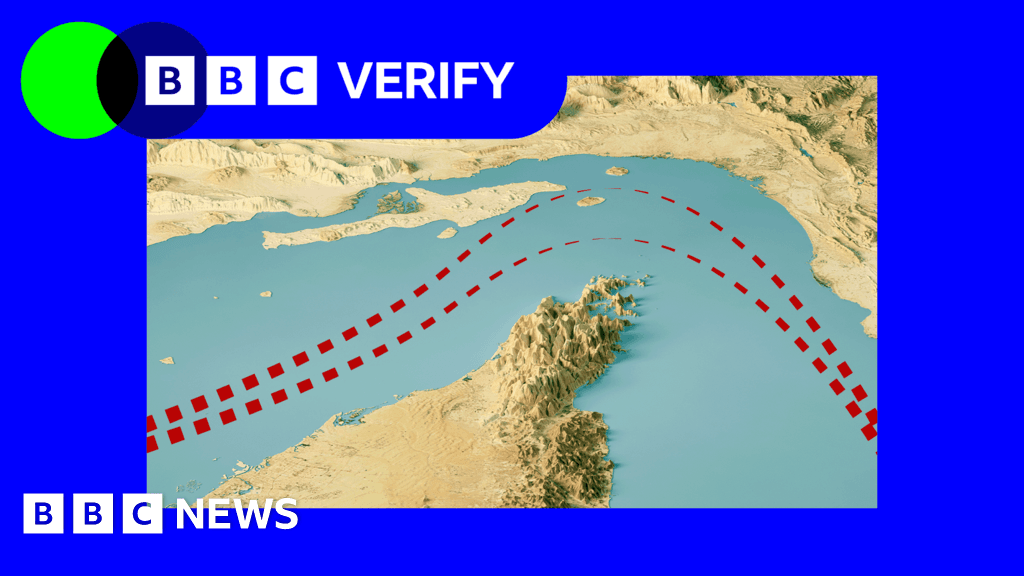
BBC Verify's analysis of the paths taken by the ships shows them taking a northern route through the strait close to Iran's coastline, within its territorial waters.
The US military blockade aims to restrict all maritime traffic entering and exiting Iranian ports, impacting Iran's shipping capabilities.
The container ship Paya Lebar was the first vessel to cross the Strait of Hormuz after the US imposed the blockade.
Before the blockade, four vessels, including tankers carrying oil, gas, or chemicals, crossed the Strait of Hormuz.
The US blockade does not impede vessels transiting the Strait of Hormuz to or from other countries, allowing continued maritime traffic.
California man shot by ICE agents faces assault charges after incident

Eric Swalwell resigns amid fifth sexual misconduct allegation

England's 1-0 win over Spain highlights Lauren James' potential.

Former UCLA gynecologist James Heaps pleads guilty to 13 sexual abuse charges and sentenced to 11 years.

Wes Streeting unveils new women's health strategy to combat medical misogyny

Atletico Madrid edges out Barcelona to reach Champions League semifinals!
See every story in News — including breaking news and analysis.
Prior to the conflict, vessels usually took a more southerly route through the middle of the waterway.
Another uncertainty is the possibility of sea mines, says Thomas Kazakos, secretary general of the International Chamber of Shipping.
"We need to make sure that we have clear confirmation that the safety of navigation for the ships and the seafarers are being agreed," he told BBC Verify.
Iran's Islamic Revolutionary Guard Corps (IRGC) Navy published what it states are the permitted routes to be followed when passing through the strait "to avoid possible collision with sea mines".
It has marked a region in the middle of the channel as a "dangerous area" to be avoided.
Centcom has previously announced that two destroyers - the USS Frank E Petersen and USS Michael Murphy - are in the area as part of a mission to clear "sea mines previously laid by Iran's Islamic Revolutionary Guards Corps".
Additional reporting by Joshua Cheetham
13 April: This piece is being updated to reflect the latest number of vessels crossing the strait since the ceasefire.