TL;DR
Ukrainian civilians in Oleshky are trapped due to mined roads and lack of supplies. The humanitarian crisis worsens as fresh food and medicine deliveries remain scarce.
"The road is mined. So, we're stuck here," says Ludmilla, over the phone from the rooftop of a fire-damaged house in southern Ukraine. "People are trying their best to survive."
Her frontline home city of Oleshky has, according to multiple accounts, been largely cut off from fresh supplies of food or medicine for months.
Ludmilla describes being trapped there, and watching it decaying before her eyes.
Ukraine's commissioner for human rights has warned of a "humanitarian crisis."
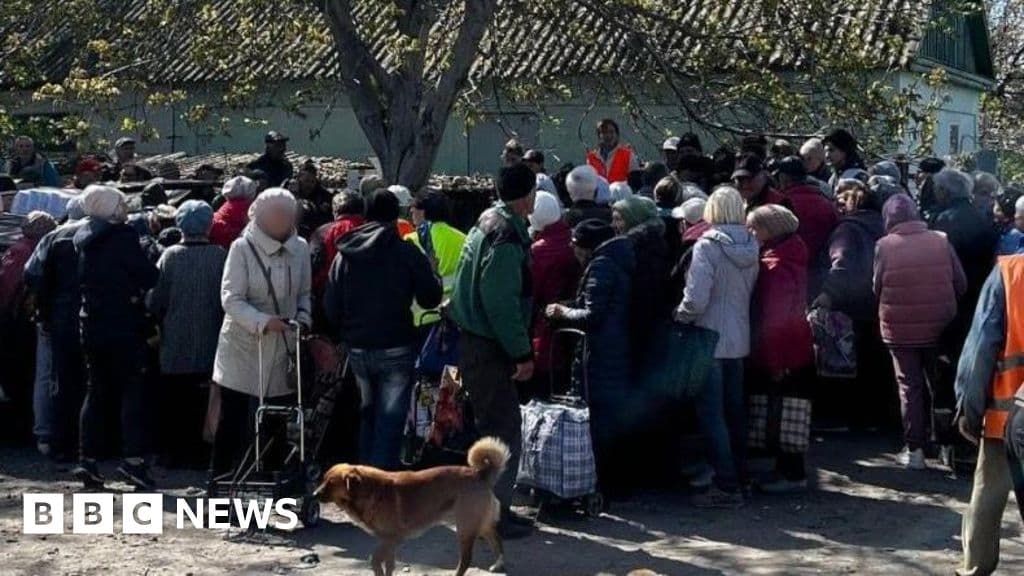
Some recent deliveries do seem to have gone through, organised by volunteers or aid groups. Photos seen by the BBC show a crowd of people, many of them elderly, apparently fetching fresh supplies in a city square.
A relief even if prices were high, says Ludmilla, as people have had to forage for food in the abandoned homes of neighbours. Ludmilla is not her real name. Her name and the names of other residents who have spoken to the BBC have been changed to protect their identities.
Pasta and tinned goods, she tells us, have become a key staple for the roughly 2,000 remaining population.
Any attempt to leave Oleshky, say locals, is to gamble with your life along what's been dubbed "The Road of Death" - due to reports of heavy mining.
Oleshky is imprisoned by both geography and war; cut off by a river and wrecked bridges to the north – and dangerous or impassable roads inland.
All the while it is caught in the crossfire of opposing armies.
The city lies on the left or east bank of the Dnipro river and has been under Russian occupation since the Kremlin launched its full-scale invasion.
Ukrainian troops are dug in on the other side of the river, just outside Kherson - the big city they recaptured in November 2022, driving the Russians back across the river.
Residents, volunteers and officials report that, as last winter set in, snowfall made the danger points harder to see amid intensified mining.
The snow is gone but the mines, people fear, are still there.
Despite the dangers, there have been some successful, recent evacuations along the 'Road of Death', south-west along the route of the Dnipro river.
"Leaving Oleshky, everyone prayed to God that we wouldn't hit a mine," says Volodymyr, who's in his 50s.
Terrorised by drones and traumatised by seeing his neighbour's body carted away after she was hit by shelling, he says his family finally took the decision to leave.
"None of us could endure it any longer."
Volodymyr recounts being driven out in an ambulance in an evacuation arranged by volunteers. Even that was horrifying.
"The entire highway from Oleshky to Hola Prystan' is littered with burnt-out cars. Some of them burned with people still inside."
Satellite imagery from November shows at least eight damaged vehicles on a 1km stretch of the road heading out of Oleshky towards Kardashynka, which is on the way to Hola Prystan'.