
Donaldson told police letter to alleged victim was not an apology for sex abuse
Donaldson claims letter to alleged victim was not an apology for sex abuse
BBC News1 min read
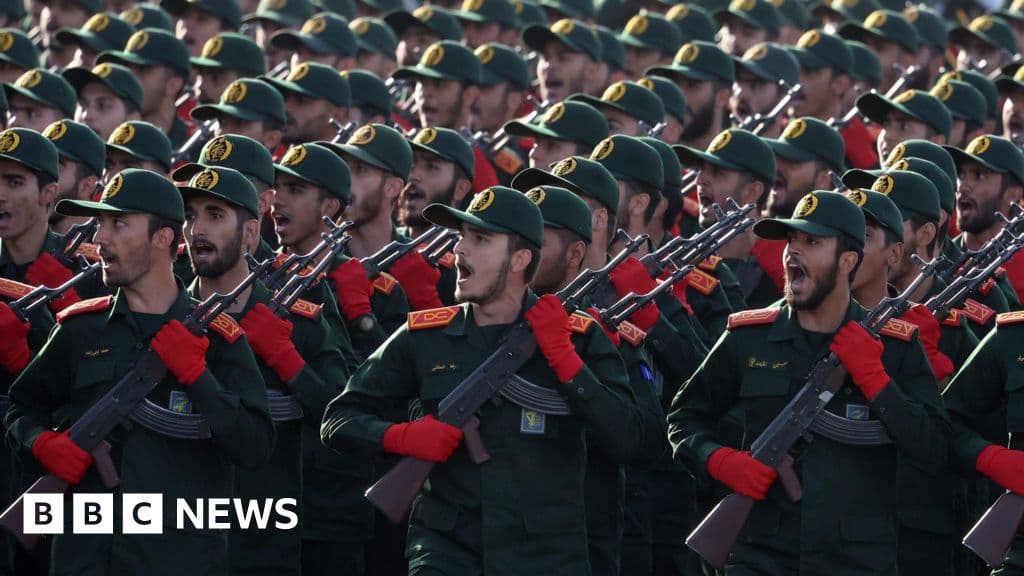
The UK government plans to introduce new anti-terror powers to ban state-backed groups like Iran's IRGC. This legislation will create criminal offences for supporting or promoting these organizations.
Mentioned in this story
Ministers are planning to introduce new anti-terror powers that would enable them to ban state threats such as Iran's Islamic Revolutionary Guards Corps (IRGC) in the next parliamentary session.
The new powers would allow the UK government to label state-backed groups as terrorist organisations.
The legal change is expected to create new criminal offences for people who support or promote groups formally listed as state-supported threats.
The BBC understands the new powers will be included in the government's plans for legislation, which will be set out in the King's Speech on 13 May.
The IRGC was set up to defend Iran's Islamic system and has become a major military, political and economic force in the country.
It is estimated to have tens of thousands of active personnel and has consistently been accused by Western nations of sponsoring terrorism abroad.
Labour MPs have been urging the UK government to ban the IRGC following a series of antisemitic attacks since the war in Iran started.
An Islamist group suspected of having Iranian links - Harakat Ashab al-Yamin al-Islamia - claimed responsibility for a recent attack on Jewish community ambulances in north London, along with other incidents in the UK and Europe.
Other European countries and the EU have already added the IRGC to their lists of proscribed terrorist organisations.
This week, Prime Minister Sir Keir Starmer said the UK must "deal with malign state actors" and suggested his government would bring forward legislation "as quickly as possible".
The Jewish Chronicle newspaper also quoted Sir Keir as saying he was "very worried" about the increasing use of proxies by the Iranian government.
"In relation to malign state actors more generally, we do need legislation in order to take necessary measures and that is legislation we're bringing forward as soon as we can," Sir Keir said, in a video posted by the newspaper.
"We're going into a new session in a few weeks' time and we're going to bring that legislation forward."
The previous Conservative government did not proscribe the IRGC, despite suggesting it would do so in 2023.
Maintaining diplomatic relations with Iran has been cited as a reason for not proscribing the IRGC in the past.
The UK government plans to introduce powers that would allow them to label state-backed groups, such as the IRGC, as terrorist organizations.
The new anti-terror legislation is expected to be included in the King's Speech on 13 May.
Supporting or promoting groups that are formally listed as state-supported threats will create new criminal offences under the proposed legislation.
The IRGC is a major military, political, and economic force in Iran, established to defend the country's Islamic system.
Donaldson claims letter to alleged victim was not an apology for sex abuse

Trump faced boos from Knicks fans at the NBA Finals, marking a historic visit.
American snapping turtle with a powerful bite discovered in Welsh woods
Annabel Rook, a champion for vulnerable women, was tragically murdered by her partner.

Israel and Iran halt attacks after missile exchanges, but tensions remain high.

Zelenskyy expresses concerns over Trump's focus away from Ukraine and Putin's tactics.
See every story in News — including breaking news and analysis.
Conservative shadow foreign secretary Priti Patel said: "Labour promised action on IRGC proscription but, despite reviews and rising threats, they have failed to deliver.
"Our allies from Europe to Canada and the Gulf have already acted, and the UK is lagging behind."
Labour had promised to proscribe the IRGC as a terrorist organisation before the general election in 2024.
But once in power, the Labour government stepped back from doing so while ministers reviewed options for dealing with state-linked organisations.
The government already has powers to proscribe organisations under the Terrorism Act 2000.
Other groups like the Iran-backed Hezbollah have been banned under that law.
But last year, the government's independent reviewer of terror legislation, Jonathan Hall KC, said new powers were needed to tackle state-sponsored organisations.
In a report, Hall recommended a law change that would give the government powers "equivalent to proscription under the Terrorism Act 2000".
"By way of example, this strong power would be available for use against the Islamic Revolutionary Guard Corps," Hall said.
Yvette Cooper, when she was home secretary last year, said the government had accepted Hall's recommendations.
In May last year, Cooper said the government would "draw up new powers modelled on counter terrorism powers in a series of areas to tackle these state threats".
She added: "And crucially I can tell the House we will create a new power of proscription to cover state threats – a power that is stronger than current national security act powers in allowing us to restrict the activity and operations of foreign state backed organisations in the UK."