TL;DR
At least four Iranian vessels have reportedly crossed a US blockade in the Gulf of Oman, according to ship-tracking data. The US blockade, initiated by President Trump, will remain in effect despite Iran's claims about the Strait of Hormuz being open during the ceasefire.
At least four vessels tracked from Iranian ports appear to have crossed a US blockade line in the Gulf of Oman, BBC Verify analysis of ship-tracking data suggests.
President Donald Trump said the US blockade of Iranian ports, which began on Monday, will stay in place after Iran's foreign minister said on Thursday that the Strait of Hormuz will be open for the duration of the ceasefire.
In a statement on X, Abbas Araghchi said the strait "is declared completely open for the remaining period of ceasefire", which is due to expire on 22 April.
"Thank you!", Trump wrote on Truth Social, adding in a second post: "The naval blockade will remain in full force and effect as it pertains to Iran, only, until such time as our transaction with Iran is 100% complete."
The US has said ships coming from and going to other countries will be able to pass its blockade.
Access to the Strait of Hormuz has become a focal point of the US-Israel war with Iran after Tehran effectively choked off one of the world's most important shipping lanes.
The disruption to shipping since the conflict began six weeks ago has sent shock waves across the global economy, destabilising energy prices and exposing just how reliant international supply chains are on the channel that connects the Gulf with the Indian Ocean.
An average of 138 ships passed through the strait each day before the conflict started on 28 February, according to the Joint Maritime Information Centre.
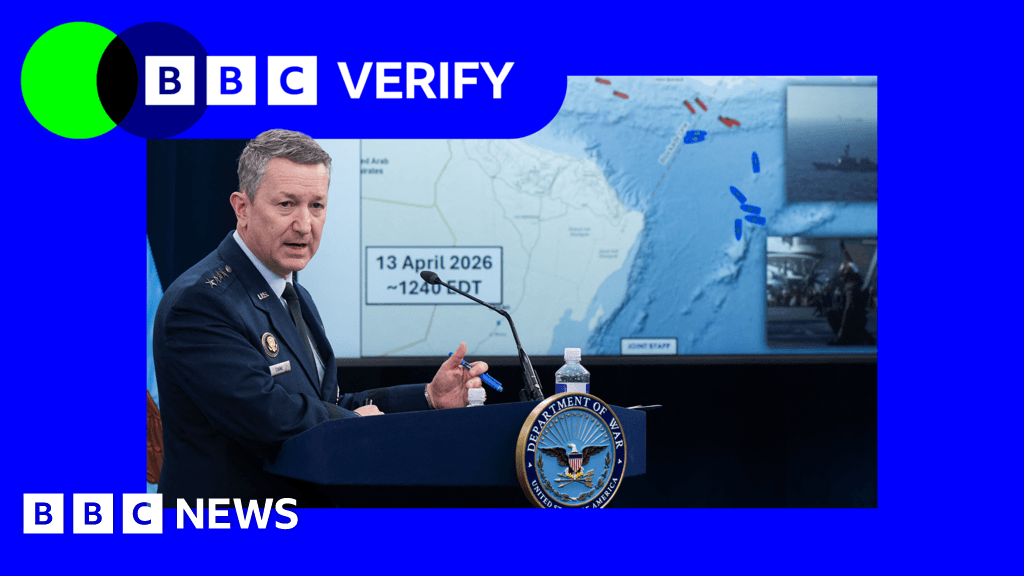
At a Pentagon news conference on Thursday, America's most senior military officer Gen Dan Caine presented a map which showed a "blockade line" stretching from the eastern tip of Oman to Iran's border with Pakistan.
Caine told reporters the blockade "applies to all ships, regardless of nationality, heading into or from Iranian ports".
The US Navy has also said it will intercept ships it suspects of carrying "contraband" including oil, petroleum products, weapons, munitions and nuclear material linked to Iran.
But ship-tracking data suggests at least four vessels tracked from Iranian ports have crossed the US blockade line since the blockade came into force.
Three of the four vessels - Shabdis, Tava 4 and Azargoun - are under US sanctions and are broadcasting locations off the coast of India.
The cargo vessel Ashkan3 25278 - which is not subject to US sanctions - is broadcasting its location at the port of Karachi in Pakistan.
Ship-tracking relies on vessels transmitting location data accurately. However, some ships may be turning their trackers off or broadcasting a false position, a practice known as "spoofing".
Experts have told BBC Verify this is common for sanctioned vessels linked to Iran.
When BBC Verify asked the US military's Central Command (Centcom) about these four vessels it said it had "nothing to add" to what Caine said at Thursday's briefing. The general had told reporters the US had not had to board any ships.