The Papers: US-Iran deal and England's World Cup win
US-Iran deal faces backlash as critics call it a 'sellout'
BBC News1 min read
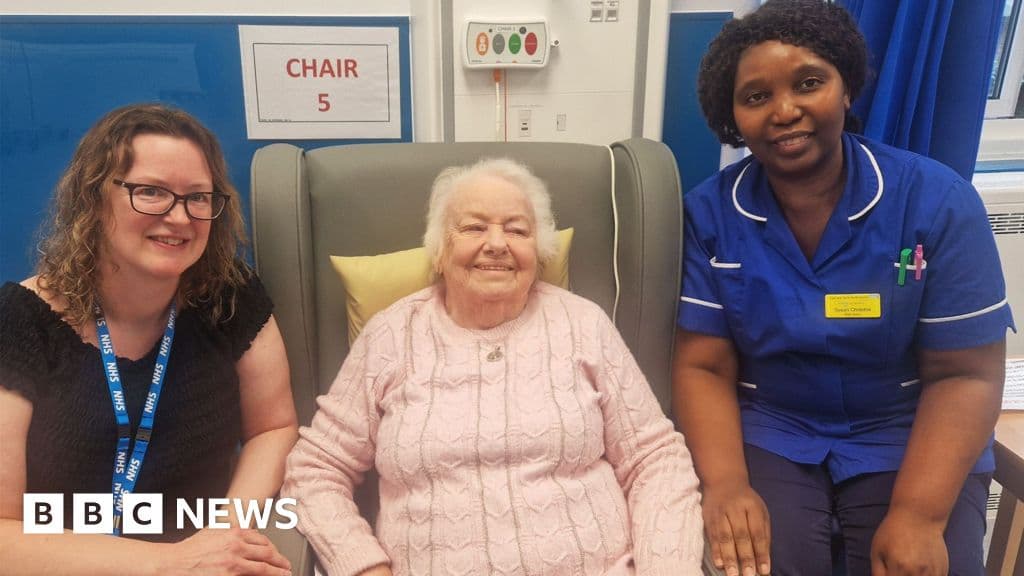
A new injectable form of Keytruda could significantly reduce hospital time for NHS cancer patients. The injection will replace the lengthy intravenous infusion, cutting administration time from over an hour to just a few minutes.
Mentioned in this story
A new injectable form of a key cancer drug could see thousands of NHS patients across the UK spending far less time in hospital.
Keytruda, which is already used to treat multiple cancers, is a type of immunotherapy that helps the body's own immune system attack cancer cells.
Since 2015, NHS patients have received the world's best-selling drug through a drip – or intravenous infusion – which can take more than an hour to administer in hospital.
NHS England says the new injection should cut that procedure to just a couple of minutes, saving patients and staff valuable time.
Shirley Xerxes from St Albans in Hertfordshire was one of the first to receive the jab at the Mount Vernon Cancer Centre near Watford.
The 86-year-old said she was in the chair "for a matter of minutes instead of an hour or more".
"It's made such a difference and gives me more time to live my life, including spending more time gardening."
About 14,000 cancer patients in England start on a course of Keytruda, also known as pembrolizumab, each year, with most of those likely to be moved over to the injectable version.
The drug can currently be used to treat 14 different types of cancer in the UK, including lung, head and neck, cervicaland breast.
In its new form, the treatment will be given every three weeks as a one-minute injection or every six weeks as a two-minute injection, depending on an individual's cancer diagnosis.
It is the third immunotherapy drug of its type that can be given via a jab on the NHS after a new form of another treatment, Opdivo or nivolumab, was introduced in some hospitals last year.
Cancer can hide from the body's own immune system by producing proteins that send a "stop signal" telling our immune cells not to attack.
Some scientists describe this as the disease hiding behind an "invisibility cloak".
Immunotherapy works by blocking the signal allowing those cancer cells to be more easily recognised and destroyed.
That discovery won two scientists - James Allison and Tasuku Honjo - the Nobel Prize for medicine in 2018.
Keytruda was one of the earliest immunotherapy drugs to be approved, first for skin cancer and later for other forms of the disease.
By most measures it is now the biggest-selling prescription medicine in the world, with global sales of $30bn (£22bn) in 2025.
Until now, hospital pharmacy teams have had to prepare a bag of the drug under sterile conditions which is then given as an infusion into the vein through a cannula.
NHS England's national clinical director for cancer, Prof Peter Johnson, said that switching to a standard, speedy injection would save time and benefit patients.
The new Keytruda injection allows patients to receive treatment in just a couple of minutes, reducing their overall time spent in the hospital.
Keytruda is an immunotherapy drug that helps the immune system attack cancer cells and is used to treat multiple types of cancer.
The new injection was first administered at the Mount Vernon Cancer Centre near Watford, with Shirley Xerxes being one of the first patients to receive it.
NHS patients have been receiving Keytruda through intravenous infusion since 2015.
US-Iran deal faces backlash as critics call it a 'sellout'

Brexit has led to a 12% drop in UK exports to the EU, with rejoining the customs union only partially addressing the issue. Research indicates that leaving the single market has had a more significant impact on trade than customs barriers.

Despite falling crime rates, Western Europeans feel crime is rising, a new poll reveals.

NHS patients are facing unprecedented drug shortages, including essential medications.

Oil prices fall and stocks rally after US-Iran peace deal.

Heartbreaking loss: Sydney mother shares pain after children killed by car
See every story in News — including breaking news and analysis.
"Managing cancer treatment and regular hospital trips can be really exhausting," he said.
"If we can do this in a much shorter period of time, it frees up space in our chemotherapy units and means we can start thinking about giving treatment in the community and away from hospitals."
NHS England said it could not reveal the cost to the health service - its deal with the US drug company Merck Sharp & Dohme (MSD) is confidential
But it's understood it will pay around the same price for both versions of the drug.
Keytruda is already one of the most financially successful medicines of all time with estimated sales of $180bn since its launch over a decade ago.
The patents protecting the original drug are due to expire in 2028 in the US and 2031 in Europe, meaning that rival companies could soon copy it and produce cheaper generic versions.
In the US, critics including Democratic Senator Elizabeth Warren, have accused MSD of introducing the new injectable form, which is covered by different patents, partly to shield it from competition.
MSD says the jab offers "meaningful benefits" for hospitals by reducing the time spent administering the drug, freeing up time for other clinical tasks and potentially reducing the pressure on NHS resources.