
Motorway traffic drones are coming to UK roads, but will they drive us to distraction?
UK roads are set to see low-flying traffic drones by 2027, but will they distract drivers?
The Guardian World1 min read
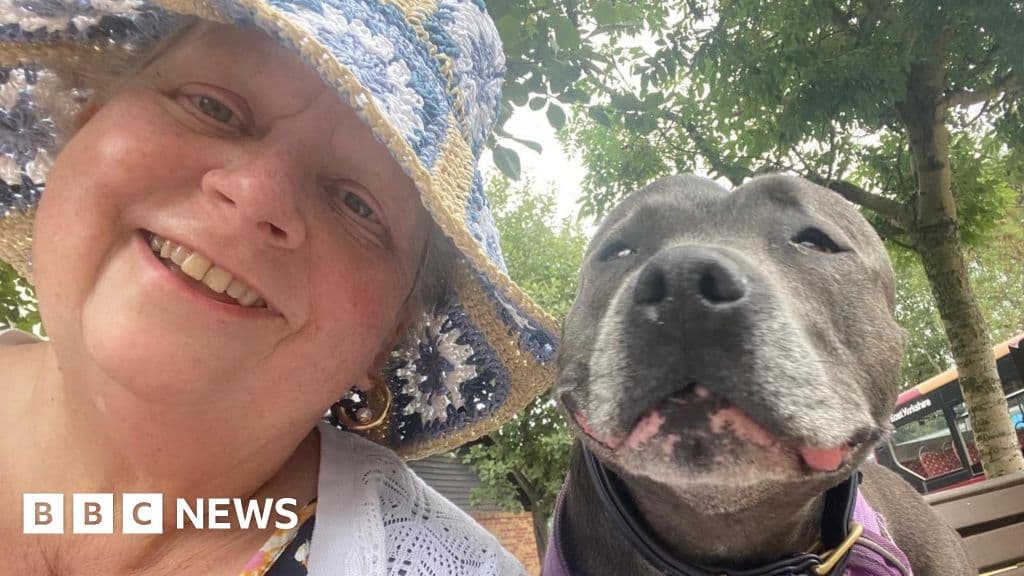
Lesley Goodburn credits her dog Gertie with helping her detect lobular breast cancer by noticing an unusual ridge in her breast. Goodburn, now cancer-free, aims to raise awareness about this often-overlooked condition.
Mentioned in this story
Lesley Goodburn has spent more than a decade encouraging people to pay attention to the warning signs of cancer, since the death of her husband.
But when it came to her own diagnosis, she said it was her dog, Gertie, who spotted something she had missed.
Goodburn was diagnosed with lobular breast cancer two years ago, after her pet bashed into her chest.
The impact led to her noticing an unusual ridge in her breast - a symptom she later learned was linked to the disease, which accounts for about 15% of breast cancer diagnoses, according to researchers.
Now free of cancer, Goodburn, from Kidsgrove, Staffordshire, wanted to raise awareness of the condition, which she said was often overlooked because it did not usually present as a lump.
"I'd never even heard of it," she told BBC Radio Stoke.
"The surprise was that it wasn't a lump, it was nothing that I'd felt. If the dog hadn't bashed my chest, maybe no-one would ever have known it was there.
"Lobular breast cancer is in the lobules, which is the bit that produces the milk. Quite often it doesn't form a lump - often it's a ridge."
Unlike many other breast cancers, she said symptoms could include itching, tingling, pulling sensations, dimpling or changes to the skin rather than a distinct lump.
"It isn't always picked up on mammograms," she said.
"People can go and have a mammogram, get the all clear and then, a few months later, get diagnosed with lobular breast cancer."
Goodburn had chemotherapy, surgery and radiotherapy following her diagnosis, before being told she was in remission.
She had no doubt about the role her pet played.
"Without a shadow of a doubt, Gertie saved my life," she said.
"Without that bash, I would never have realised there was a ridge there. I would never have gone to the doctors."
According to Lobular Breast Cancer UK, about 8,400 people are diagnosed with the condition each year.
As Goodburn said, by growing in straight lines or single cells, it is much harder to see on imagining tests, such as mammograms, a spokesperson says
There are no specific treatments for lobular breast cancer but they added that did not mean they were not effective and did not work.
Goodburn is well known for her fundraising efforts following the death of her husband, Seth, from pancreatic cancer in 2014, 33 days after he was diagnosed.
Over the past 12 years she has travelled to places including the Great Wall of China, Chile and the South Pole while raising awareness and tens of thousands of pounds for charity, including Pancreatic Cancer UK.
Lesley Goodburn's dog Gertie bumped into her chest, prompting her to notice an unusual ridge that led to her breast cancer diagnosis.
Lobular breast cancer accounts for about 15% of breast cancer diagnoses and often does not present as a lump, making it frequently overlooked.
People should be aware of unusual changes in breast tissue, such as ridges or thickening, as lobular breast cancer may not form a distinct lump.
UK roads are set to see low-flying traffic drones by 2027, but will they distract drivers?

Teams qualified for the World Cup 2026 knockout stage revealed!

Survivor reports 90% of passengers injured in Bedford train crash

How Lanchester Wines Uses a Flooded Mine to Cut Heating Costs

Carlitos Ricardo Parias, shot by ICE, reveals DHS oversight issues.

Israeli airstrikes kill at least 11 in Lebanon just after ceasefire with Hezbollah.
See every story in News — including breaking news and analysis.
She has now joined Lobular Breast Cancer UK to support their drive to get others to seek medical advice if something did not feel right.
"If you feel like something's wrong, go and get it checked out," she said.
"Be brave. It might make the difference between being here in five years' time and not."
Follow BBC Stoke & Staffordshire on BBC Sounds, Facebook, X and Instagram.