
The GCC should insure itself against the next Strait of Hormuz crisis
GCC member states face uneven impacts from US-Israel war on Iran; unity is crucial for future crises.
Al Jazeera English1 min read

Marco Rubio announced significant progress in US-Iran talks aimed at ending the US-Israeli war on Iran. He indicated a potential agreement could address concerns over the Strait of Hormuz and Iranian nuclear weapons.
Mentioned in this story
United States Secretary of State Marco Rubio says “significant progress” has been made in talks to end the US-Israeli war on Iran, hours after President Donald Trump claimed that a memorandum of understanding to end the fighting was “largely negotiated”.
Rubio, who is on his first official visit to India, said on Sunday that the emerging deal would address Trump’s concerns about the Strait of Hormuz, which Iran has largely blocked since the US and Israel launched their war on February 28.
“Some progress has been made, significant progress, although not final progress has been made,” Rubio told reporters in New Delhi.
“I do think perhaps there is the possibility that in the next few hours the world will get some good news,” he said.
The agreement would also start a “process that can ultimately leave us where the president wants us to be, and that is a world that no longer has to fear or worry about an Iranian nuclear weapon”, Rubio added.
Iran’s semiofficial Tasnim News Agency, which is close to the Islamic Revolutionary Guard Corps (IRGC), said that under a potential memorandum of understanding, the number of vessels transiting the Strait of Hormuz would return to pre-war levels within weeks.
“If the agreement is reached, the Strait of Hormuz will not fully return to its pre-war status; instead, the number of ships allowed to pass would be restored to pre-war levels within 30 days,” Tasnim reported.
The US naval blockade on Iranian ports must be completely lifted within 30 days, according to the potential memorandum of understanding, Tasnim said, adding that part of Iran’s frozen funds must be released in the first phase of the agreement.
The potential deal also includes an end to the war on all fronts, including in Lebanon, Tasnim reported.
The measures on the Strait of Hormuz would take effect over a 30-day period while negotiations over Iran’s nuclear programme would continue over a 60-day period after the potential agreement is signed, Tasnim said.
After the initial 30-day period, “the parties will have 30 days to agree on the nuclear issue. These 30 days can be extended by mutual agreement,” Al Jazeera’s Ali Hashem said. “During [the initial 30-day period], passage will be facilitated through the strait. According to Iran, management of the Strait of Hormuz will be an Iranian-Omani issue and is being negotiated with Muscat.”
Iran emphasised that any potential agreement with the US is conditional on the release of at least part of Iran’s frozen funds, which must be released in the first phase of negotiations, Tasnim reported.
“In addition to many other elements of the Agreement, the Strait of Hormuz will be opened,” Trump said on his Truth Social platform. Such a development would lift pressure on global energy prices after the crucial passageway for oil shipments has been virtually shut down since the war began with .
Marco Rubio stated that significant progress has been made in negotiations to end the US-Israeli war on Iran, although a final agreement has not yet been reached.
Trump's concerns focus on Iran's blockade of the Strait of Hormuz, which is crucial for global oil shipping and trade.
Rubio suggested that there could be good news regarding the agreement in the next few hours, indicating a swift resolution may be possible.
The emerging agreement is intended to initiate a process that would alleviate fears about Iran developing nuclear weapons, as stated by Rubio.
GCC member states face uneven impacts from US-Israel war on Iran; unity is crucial for future crises.

Cape Verde makes its World Cup debut in 2026, celebrating 50 years of independence!

Former prosecutor Weissmann urges reforms to combat election lies

Nationwide pressured to resolve governance issues as AGM nears
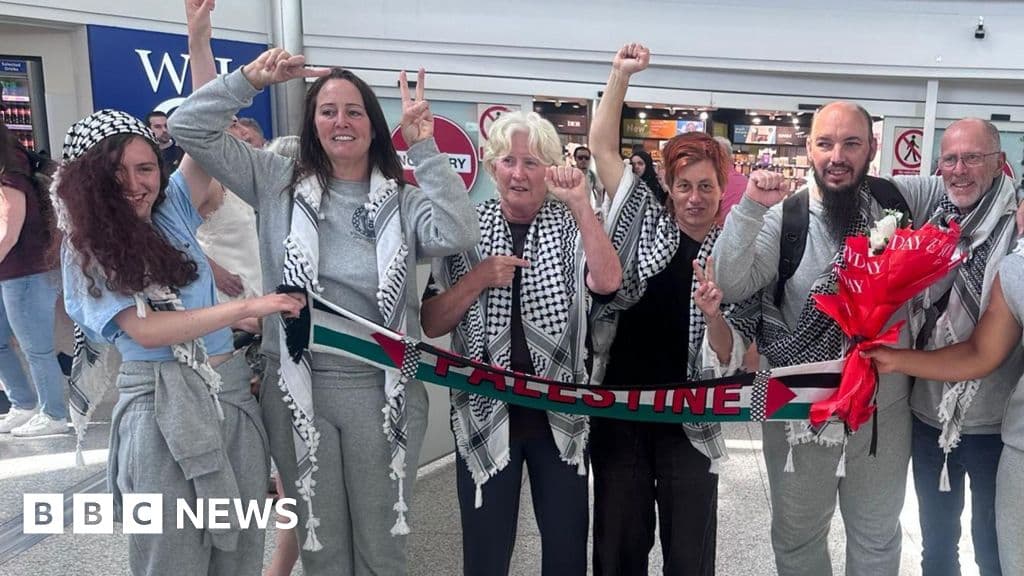
Seven UK activists return home after being detained by Israel during Gaza aid flotilla.

Trump reveals a potential Iran deal to reopen the Strait of Hormuz, but faces skepticism.
See every story in News — including breaking news and analysis.
Al Jazeera’s Resul Serdar Atas, reporting from Tehran, said: “The talks are still in a delicate situation, particularly regarding the Strait of Hormuz. Once that is resolved, the second phase will focus on the nuclear negotiations. That issue has been ongoing for decades with a lot of back and forth, but the parties have not been able to agree on and stick to a deal.”
Al Jazeera’s correspondent Kimberly Halkett said from Washington, DC: “President Trump wants it to appear that he got what he wanted out of this deal, given the unpopularity of the war with the American public and his dropping approval ratings.”