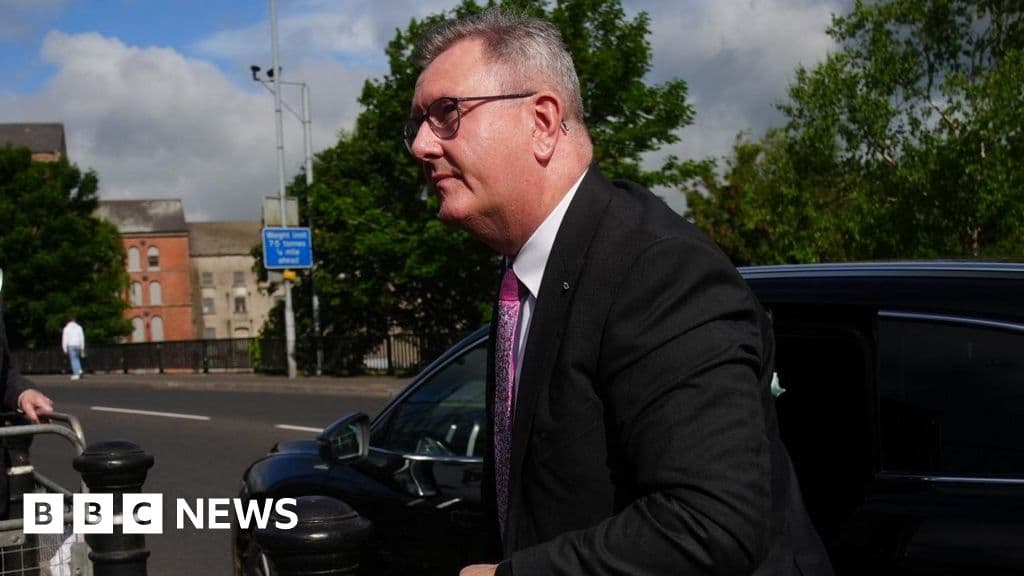
Donaldson sex abuse accusers 'not sufficiently reliable' for a guilty verdict, jury told
Jury told Donaldson's accusers are 'not sufficiently reliable' for a guilty verdict.
BBC News1 min read

Bunia is facing a new Ebola outbreak, causing fear among residents and affecting public-facing workers. Schools have implemented strict measures to prevent the virus's spread as health ministries confirm the outbreak.
Mentioned in this story
Justin Keno watches more than 400 pupils stream through the Nelson Mandela school’s gate each morning, and wonders which of them might be carrying Ebola.
The institution’s principal has done everything he can to prevent the spread of the virus: installing hand-washing basins at the entrance, providing alcohol-based hand rub for parents, making pupils bring packed lunches instead of eating in the canteen, and banning food sellers from outside the gates.
But he knows the virus moves in ways he cannot control. “Children come from everywhere, including neighbourhoods declared epicentres,” he said in his office in Bunia. “We cannot know which child comes from a confined area. If one is infected, it could reach many children very fast.”
Nearly six years after the last Ebola outbreak in Ituri in the Democratic Republic of the Congo was declared over, residents of the province’s capital, Bunia, have for the past month found themselves reliving their fears as another epidemic takes hold.
The health ministries of the DRC and neighbouring Uganda announced outbreaks of Ebola on 15 May, but the virus is thought to have been circulating undetected for weeks before then.
The epidemic, which the World Health Organization has declared a public health emergency of international concern, is caused by the rare Bundibugyo virus, which has no vaccine or approved treatment.

Healthcare workers disinfect themselves after preparing the body of an Ebola victim at Citadelle clinic in Bunia, Congo, on Friday 12 June. Photograph: Moses Sawasawa/AP
Responders are racing to contain the virus, which has caused 136 deaths from 676 confirmed cases in the DRC as of 10 June, according to a government report. In Uganda, it had caused two deaths from 19 confirmed cases as of 6 June, .
Schools in Bunia are installing hand-washing basins, providing alcohol-based hand rub, requiring packed lunches, and banning food sellers from outside.
The current Ebola outbreak in Bunia was announced on May 15 by the health ministries of the DRC and Uganda.
The Ebola virus is believed to have been circulating undetected for weeks before the official announcement on May 15.
The Ebola outbreak has led to increased fears and potential income loss for public-facing workers as safety measures are enforced and community interactions are limited.
Jury told Donaldson's accusers are 'not sufficiently reliable' for a guilty verdict.

Donald Trump has halted the confirmation process for Jay Clayton as the US intelligence chief, allowing Bill Pulte to remain in the role temporarily. This decision follows bipartisan criticism of Pulte's qualifications and delays in renewing the Foreign Intelligence Surveillance Act.

Trump backs G7 statement on Iran deal as criticism mounts domestically

Trump calls for delay in Jay Clayton's nomination as intel chief

Trump to address G7 press conference amid Iran deal discussions

Zidane Iqbal makes history as Pakistan's first World Cup player!
See every story in News — including breaking news and analysis.
The DRC report also noted that the outbreak in the country had spread to three new health zones – all in North Kivu and Ituri provinces.

The Ituri provincial public health laboratory on Monday 15 June, where Ebola test results are reviewed. Photograph: Moses Sawasawa/AP
The previous Ebola outbreak in Ituri lasted from July 2018 to June 2020, and also affected neighbouring North Kivu province. Overall, it involved 3,470 cases and 2,287 deaths, making it the largest in the country and second-largest globally.
Modelling by the Centers for Disease Control and Prevention in the US shows that the current outbreak could affect more people than the largest on record, which occurred in west Africa from 2014 to 2016 and infected more than 28,000 people, killing more than 11,000.
First identified in 1976 in what is now the DRC, Ebola is a highly contagious and often fatal viral disease that affects humans and non-human primates. It spreads through body fluids or contaminated materials and causes organ damage, blood vessel impairment and sometimes severe internal and external bleeding.

Two girls sit at the isolation centre in Bunia on Monday. Photograph: Moses Sawasawa/AP
People living Bunia said the economic toll of the virus was beginning to bite.
Sylvie Guilaine was forced to close her used-clothes business because of the fear of contracting the disease in the high-contact operation. “Someone comes, touches a shirt, tries it on, throws it away. Another picks it up,” she said. “That can contaminate. I stopped completely.”
She’s now a bricklayer’s assistant, and she soaks her work clothes in bleach before entering her house, delaying greeting her children. “They can cry but will have to wait until I have washed,” she said at Bunia general hospital, where she and colleagues were constructing a new Ebola treatment centre. “[Ebola] does not want dirt. It wants cleanliness. But it kills entire families – five, six, seven people. That is what I fear,” she said.

A nightclub in Bunia on Sunday. Photograph: Moses Sawasawa/AP
Yves Buakya, a motorcycle taxi rider, has seen his earnings plunge since the outbreak started. He explained: “Before, two passengers could share the bike. Now they refuse. Some prefer to walk rather than take a moto [a motorcycle taxi]. I spend hours waiting [for passengers].”
Buakya says Ebola is real but he also suspects that some organisations are profiting from it. To protect himself, he prays every morning and drinks traditional remedies made from guava leaves. He has a message for fellow residents: “Respect the measures. Wash your hands. Avoid unnecessary contact. Even if you think Ebola is politicised, protect your life.”
Richard Ngongo, an airline travel agent, is counting losses as the outbreak affects movement in the province, a business centre and migratory hub that borders Uganda and South Sudan.
“Flights are blocked. My cash registers are empty. We were waiting for the high season, for holiday travellers. Now nothing,” he said from his office. At the workplace, he has a sanitiser gel and a non-contact infrared thermometer for customers, who he said complied without resistance. He said no health team had ever come to sanitise him at work and urged more effort: “The message must be spread in churches, in communities, everywhere.”
Georgette Kalume, who runs a secondhand clothes shop, said members of her Jehovah’s Witness congregation had stopped going door to door to preach to people, and were now using WhatsApp. She decried the fact that she had never received an Ebola awareness visit. “Not the government, not humanitarians,” she said.
As the outbreak continues, medics in eastern DRC are struggling with shortages of basic equipment to protect themselves and prevent the spread of the virus, partly due to aid cuts, logistical challenges and the large size of the outbreak.
Last week, the International Rescue Committee warned that basic protective equipment was likely to run out within days due to border closures with Uganda and Rwanda, where many supplies are sourced, and insecurity along transport routes.
Africa CDC said that, as of 4 June, only a quarter of the critical supplies needed for the next three months had arrived in the DRC and Uganda. Thirty-four healthcare workers so far have been infected with the virus, and seven have died from it.

Nyamurongo cemetery in the Ndibakodu neighbourhood, Bunia, one of the burial sites receiving a large number of people who have died from Ebola since the beginning of the outbreak. Photograph: Jospin Mwisha/AFP/Getty Images
At Elikya hospital, Dr Yazid Yassine said the isolation ward was full, despite the number of beds increasing from six to more than 18. He is relentless, despite the deaths of other Ebola responders in the line of duty: “A soldier does not fear the battlefield. Better to die there than at home.”
At ISIG University, academic secretary Maki Mugeni Sagesse has managed to prevent infections on the campus. He has installed chlorinated basins and does awareness sessions before lectures. He has lost five people close to him to Ebola in the past month alone.
He praises the government’s efforts in setting up treatment sites and doing public awareness announcements, but said more must be done. “Go to ordinary people. Use megaphones in neighbourhoods. Use local languages. Train neighbourhood chiefs to sanitise 10 houses each,” he said.
Dr Charles Kachindi, who works at CME Nyankunde hospital, told of a grim situation at the facility, saying it currently had 10 confirmed cases and 15 people had died. Testing, he said, was not as helpful as it might be as results for samples took up to three days to arrive – and sometimes not all of them came back. He appreciates the government’s efforts in trying to control the spread but warns: “We are not yet on a plateau.”
Despite the growing danger of the virus, information gaps mean that some Bunia residents are not convinced that it is real. Yassine has watched patients arrive too late after believing rumours that the outbreak is fake and visiting traditional healers. “Disinformation has been rife,” he said. “People say Ebola was created by health workers to get funding. Some say it is poisoning.”
People have become hostile, he said. “When we go into the community, people watch our movements. In this period, you cannot buy a motorcycle. They will say: ‘That is Ebola money,’” he said, smiling.

The Ebola virus disease treatment centre at the Bunia general reference hospital. Photograph: Gradel Muyisa Mumbere/Reuters
Yassine said he had received death threats. “A man told me: ‘My family member died in your care. One day we cross paths, you will follow the same path.’”
For Ngongo, the airline operator, the reality is beyond question. “I have never read in any manual that an epidemic can be invented. When you see doctors dying, do you think they would accept to die for a lie?”