
A powerful US surveillance law is set to expire – what happens now?
Key FISA provision set to expire as Trump faces backlash over DNI appointment
The Guardian World1 min read

Lebanon's environment minister has accused Israel of committing 'ecocide' during its military actions from 2023 to 2024, severely damaging the country's natural resources. A report details the ecological disruption and loss of essential ecosystem services in southern Lebanon.
Mentioned in this story
Lebanon’s minister for the environment has accused Israel’s military of committing “an act of ecocide” in the foreword to a report detailing the harm done to the country’s natural resources during the invasion of 2023 to 2024.
Israeli military aggression “reshaped both the physical and ecological landscape” of southern Lebanon, according to the report, which does not consider the impacts of Israel’s latest barrage of attacks this spring.
Published amid a patchy ceasefire, as refugees from Israel’s latest invasion return to shattered homes and communities, the 106-page report outlines how southern Lebanon has suffered profound ecological disruption and the loss of essential ecosystem services.
In her foreword, Tamara el Zein said: “The scale and intentionality of the damage to forests, agricultural lands, marine ecosystems, water resources, and atmospheric quality constitute what must be recognised as an act of ecocide, with consequences that extend far beyond immediate destruction.
“The environmental damage we face is not simply ecological – it is a matter of public health, food security, livelihoods, social fabric, and national resilience.”
According to the report, attacks by Israeli forces:
Israel’s critics argue that it is currently repeating “the Gaza playbook” in southern Lebanon by , and , , and .
Lebanon accuses Israel's military of causing extensive damage to forests, agricultural lands, marine ecosystems, and water resources during its invasion.
The damage affects public health, food security, livelihoods, and the social fabric of communities in southern Lebanon.
The military actions by Israel occurred during the invasion from 2023 to 2024.
The report was authored by Lebanon's minister for the environment, Tamara el Zein.
Key FISA provision set to expire as Trump faces backlash over DNI appointment

Watford legend Kenny Jackett passes away at 64
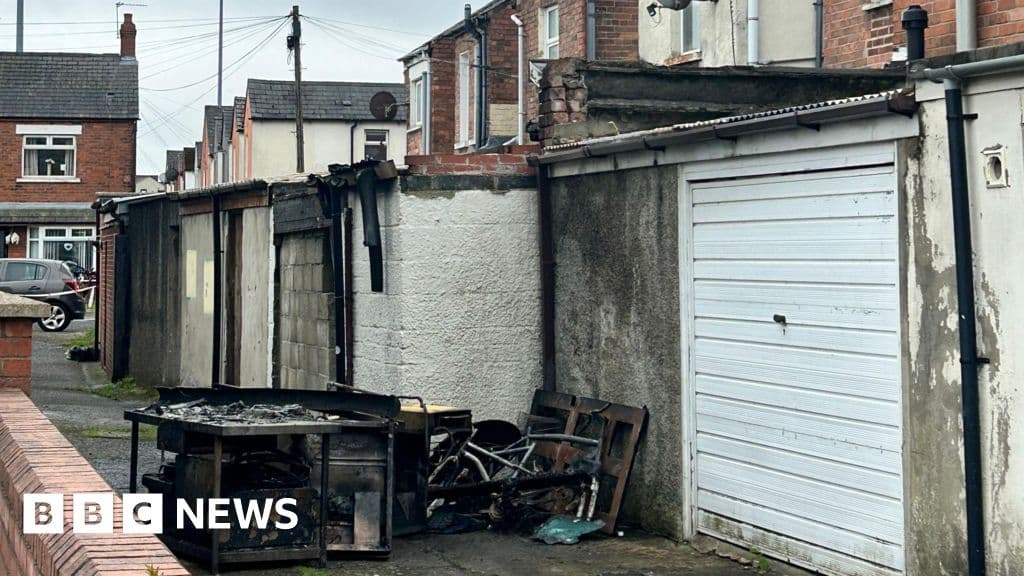
Nineteen people arrested, including a teen, after violence in Northern Ireland and an arson attack.

David Hockney, the iconic British artist known for his diverse work, has passed away at 88.

David Hockney, the revolutionary British artist, has passed away at 88.

Exploring the Historical Roots of Torture Against Palestinians
See every story in News — including breaking news and analysis.
Within months of beginning its war on Gaza in 2023, Israel’s forces had destroyed about 38-48% of tree cover and farmland, with olive groves and farms reduced to packed earth and groundwater contaminated by munitions and toxins, and air polluted by smoke and particulate matter.
According to the new report, prepared by Lebanon’s National Council for Scientific Research (CNRS-L) and covering the period between October 2023 and December 2024, southern Lebanon was similarly treated by the Israeli military.

An IDF tank on the border between Israel and Lebanon in November 2024. Photograph: Jim Hollander/UPI/Rex/Shutterstock
“The environmental footprint of the war is evident in the destruction of forests and woodlands, many of which served as biodiversity hotspots and carbon sinks, and in the burning of agricultural lands, including high-value orchards and staple crop fields, undermining both livelihoods and national food security,” the report states.
In total, it estimates the monetary cost to the country amounts to an estimated $25bn ($18bn), comprising $6.8bn in physical damages, $7.2bn in economic losses ands $11bn in recovery and reconstruction needs.
“Lebanon cannot carry this burden alone,” El Zein said. “We call for international solidarity and support to share the responsibility of environmental recovery. The scale of the damage and the costs of restoration demand collective action and long-term partnerships.”
Doug Weir, the director of the Conflict and Environment Observatory, which studies the environmental impact of war, said: “The report’s focus on building back better, and on strengthening national environmental monitoring capacities, are welcome recognition of two critical priorities for any conflict-affected state.
“Sadly, elements of the report’s findings are already out of date due to the devastation wrought by Israel since the study period, particularly in the area it is illegally occupying south of the Litani River,” he added.
A spokesperson for the Israel Defense Forces said: “The IDF is aware of the potential environmental impacts of its operations in the region. The IDF operates to protect the citizens of Israel and to ensure the security and safety of the surrounding areas. All IDF actions are carried out with precautions taken to minimise harm to civilians and the environment.”