Is VAR being used differently at the World Cup vs the Premier League?
TL;DR
VAR interventions have been more frequent at the 2026 World Cup compared to the Premier League, despite a calmer perception. The emotional intensity of football may influence how fans view these decisions.
Key points
- VAR interventions are more frequent at the 2026 World Cup.
- The perception of VAR is calmer at the World Cup compared to the Premier League.
- Emotional intensity affects how fans view VAR decisions.
- Games at the World Cup occur rapidly, influencing perceptions.
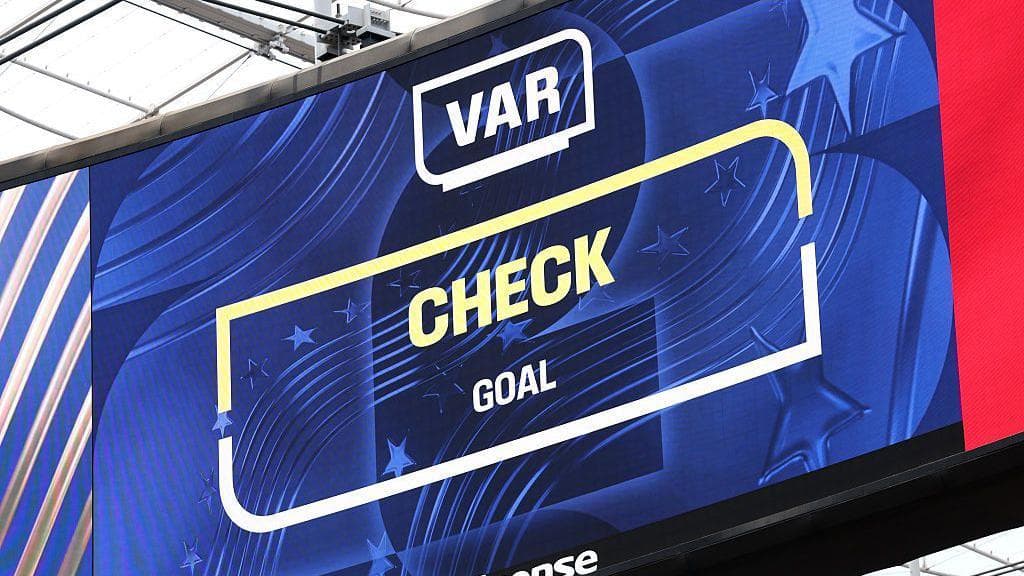
Complaining about the video assistant referee has become a sport all of its own in the Premier League.
It has felt very different at the 2026 World Cup, where VAR has largely been pretty low key.
So it may come as a surprise that there have been more regular VAR interventions than in the Premier League last season.
Perception can be just as powerful as the facts, especially in the emotionally charged world of football.
Games come thick and fast at a World Cup. No sooner has one incident happened, another match comes along to wash over it.
In the Premier League, where supporters have a vested interest in every game, controversy does not fade away quite so quickly.
So why does it feel so different at the World Cup?
Is the World Cup being refereed like a Premier League game?
VAR at the World Cup has not been without its controversies.
Think of the red card for South Africa's Themba Zwane for violent conduct in the opening game.
Or the referee rejecting a penalty review after France's Kylian Mbappe appeared to be tripped by Senegal's Sadio Mane.
But for the most part, there have not been too many talking points.
It is often the way at major tournaments, as players take fewer risks compared to a 38-game league season.
On average, there is one key match incident (red card, penalty claim etc) in a World Cup fixture. In the Premier League, it is three. That instantly creates the scope for more controversy at league level.
We should expect refereeing to be the gold standard at the World Cup, too.
After all, Fifa scoured the globe to select the creme de la creme, the 51 top referees and 30 best video match officials.
Whisper it, but Pierluigi Collina, Fifa's head of referees, wants his officials to approach the tournament a bit like a Premier League game.
Collina's ethos is that football is a contact sport, and not all contact is a foul. He wants to see free-flowing games at a higher tempo.
You could pick that wording right out of the Premier League handbook.
The stats back this up, too. Referees are blowing for far fewer fouls.
The 2018 World Cup saw 27 fouls per game, while in Qatar four years ago it was 25.
For this World Cup it is down to 21.7. In the Premier League last season it was 21.6.
Collina has also reduced the number of cautions per game, with 2.4 well below any other competition or recent World Cup.
If you change the way a game is being refereed, you must adapt video review too.
VARs getting involved less in the World Cup
Collina's desire to have a higher threshold for challenges on the field has a direct link to VAR.
The Italian wants consistency of decision-making. If you let more tackles go on the field, you must have fewer VAR interventions. Both bars must move in unison.
Take the penalty appeals for Scotland's John McGinn and Scott McTominay against Morocco.
Claims for a spot-kick undeniably, but too soft for Collina's threshold.
Against public perception, the Premier League has the lowest rate for VAR interventions in Europe at 0.29 per game.
The high bar we hear about so much in England has made its way to the World Cup.
In Qatar we saw 0.41 interventions per game, for this World Cup it is down to 0.33 - much closer to the Premier League interpretation.
Compare that to the Champions League, which saw 0.47 interventions per match last season - almost one every other game.
Then there are the subjective reviews, when a referee must go to the monitor.
The World Cup (six reviews) and the Premier League (57) both trend the same at 0.15 subjective interventions per game.
In the Champions League, it is more than double at 0.36 monitor visits per game.
All the stats should point to other competitions having more intrusive video review.
Why does VAR feel so much better at the World Cup?
Lies, damned lies and statistics.
How can the World Cup possibly have more VAR interventions than the Premier League when it feels like the opposite is true?
There are a few reasons behind it.
First and foremost, speed. Delay feeds doubt.
Collina has a clear philosophy - he wants his VARs to make quick and decisive decisions. Errors should jump out, and video officials should not over-analyse.
This has led to much shorter reviews on those subjective decisions like penalties and red cards.
In the Premier League, there can be a tendency to procrastinate, to over-think by dwelling on replays. That can lead to long VAR reviews, including with its own version of semi-automated offside technology.
Howard Webb, the Premier League's head of referees, has a similar ethos to Collina.
But getting the same results across 380 games is more challenging.
Fifa's enhanced semi-automated offside technology has helped too.
The assistant referee gets an audio alert when a player is 10cm or more offside, so the delayed flag has largely been eradicated.
It has removed many frustrating passages of play and cut the need for a VAR review on some disallowed goals.
It has not been without a few issues, but the benefits of cutting delays have been obvious.
One indirect reason should not be underestimated.
At a World Cup, the in-game match pictures are delivered by the tournament organiser, and the broadcaster provides the commentary.
Fifa, and Uefa, both have very clear policies. The incident might be replayed once, twice at most, while the VAR is looking at a possible red card or penalty.
The viewer is only shown the VAR's screen if the referee is at the pitchside monitor.
Now compare this to the Premier League, where Sky Sports' and TNT Sports' first responsibility is to analyse an incident, show it from every possible angle.
Slow it down, speed it up, throw it to the pundit. Has there been a mistake or not?
The commentators have a live feed from the VAR hub to both watch and listen to. They can pull back the curtain and switch to this at any time.
It creates a completely different perspective on each potential incident.
Tournament organisers want to present less controversy, rights holders want to showcase it.
The Premier League must get frustrated that fans still believe VAR is worse in England even though the numbers are aligned with the World Cup.
Two key lessons are clear.
While accuracy is most important, speed is the greatest asset for the success of video review.
And how it is portrayed can make a huge difference too.
Q&A
How does VAR usage at the 2026 World Cup compare to the Premier League?
VAR interventions have occurred more regularly at the 2026 World Cup than in the Premier League last season.
Why do fans perceive VAR differently at the World Cup than in the Premier League?
Perception can be influenced by the emotional intensity of football and the fast-paced nature of World Cup matches.
What factors contribute to the perception of VAR in football?
Factors include the frequency of interventions, the emotional context of matches, and the rapid succession of games during tournaments.
Is VAR controversy more prevalent in the Premier League than at the World Cup?
Yes, complaining about VAR has become common in the Premier League, while it has been relatively low key at the World Cup.