
Taylor Swift makes tearful 21-minute speech as she joins Songwriters Hall of Fame
Taylor Swift makes emotional speech as she joins Songwriters Hall of Fame
BBC News1 min read
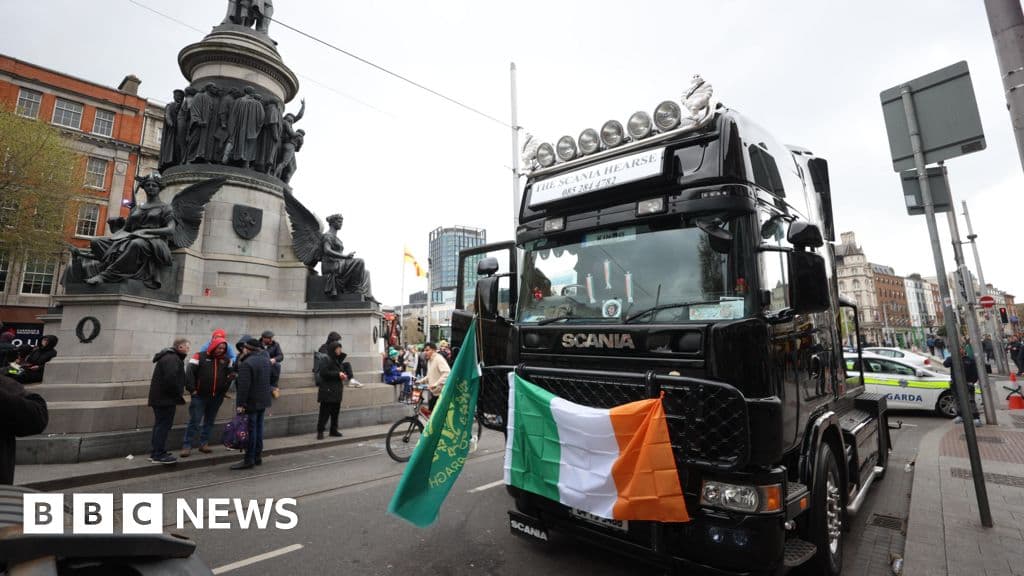
The Irish government has announced additional fuel supports for workers and businesses following recent nationwide protests. This package targets hauliers, farmers, and fishers, building on previous cuts to excise duty on diesel and petrol.
Mentioned in this story
The Irish government has announced further fuel supports for some workers and businesses, after nationwide protests in recent weeks.
Irish government ministers are insisting the package of supports was being worked on by the government before the protests, which saw many major motorways, as well as the main street in the nation's capital, brought to effective standstill.
The Irish government has in recent months cut excise duty on diesel and petrol but the latest package of measures is aimed at hauliers, farmers, agricultural contractors and fishers.
Before nationwide protests kicked off, excise duty had already been cut on petrol and diesel - but in recent weeks since the protests, there have been further cuts to diesel and petrol and a package of supports for farmers, hauliers and coach drivers has been promised.
The details of this package were laid out by Irish government ministers on Wednesday at Government buildings in Dublin.
The Road Transporters Supports Scheme is worth €120m (£104m) and is for hauliers and bus and coach operators.
This scheme will be backdated to March and will apply from when average national diesel prices exceeded €1.90 per litre (£1.65) which is being benchmarked at the point at which fuel costs become unsustainable for commercial transport operators.
Payments will be graduated and based on the number of vehicles an operator has on their license.
Operators who own up to and including five vehicles will receive €1,350 per vehicle; operators who own six to 20 will receive €790 and operators with over 21 vehicles will receive €300.
Applications will open in May for the scheme.
A second scheme announced today called the Fuel Support Scheme is aimed at farmers, agricultural contractors and fishers, costing €100m (£87m).
This will also be backdated to cover March to the end of July and will support those who are impacted by hikes to green diesel, used mostly by farmers and agricultural contractors.
They will receive a support rate which is equivalent to around 20 euro cents a litre or €200 per 1,000 litres of marked gas oil (also known as green diesel) based on verified usage in 2025.
The Irish government is also launching a communications campaign with advice on how households and businesses can manage their energy costs.
In total, the Irish government has spent €755m (£654m) on fuel supports in recent months, including today's announcement as well as previous excise duty cuts.
Annual planned increases to carbon tax have also been delayed.
Irish transport minister Darragh O'Brien said the package is "timebound and targeted".
"We will retain the ability to respond further should we need to, but we have to manage the finances in a sustainable way," he said.
Irish agriculture minister Martin Heydon said the Irish government are "responding in real time" to challenges.
The Irish government announced a package of fuel supports aimed at hauliers, farmers, agricultural contractors, and fishers.
These supports were introduced in response to nationwide protests and are intended to alleviate the financial burden on specific sectors affected by rising fuel costs.
Before the protests, the Irish government had already cut excise duty on diesel and petrol to address fuel price concerns.
Taylor Swift makes emotional speech as she joins Songwriters Hall of Fame

Nigeria's president announces military has killed over 13,000 terrorists in a year.

Oil prices plummet after Trump claims he's close to a US-Iran peace deal.

As Brexit's 10-year mark nears, key figures remain silent on its success.

Children with autism receive unapproved stem cell treatments, supported by RFK Jr.
UK government targets 60% of children walking or cycling to school by 2035 with £4.5bn investment.
See every story in News — including breaking news and analysis.