News
Trump hints Iran talks could resume this week as US maritime blockade continues
Trump suggests Iran talks could restart this week as US blockade continues.
BBC News1 min read

The IMF has reduced its global growth forecast to 3.1% due to rising energy and food costs amid US-Iran tensions. This marks a decline from the previous forecast of 3.3% and a slowdown from last year's 3.4% growth.
The International Monetary Fund (IMF) has lowered its global economic growth forecast as tensions between the United States and Iran have driven up energy and food costs globally.
The IMF said on Tuesday that it expected the global economy to grow by 3.1 percent this year, a slowdown from its earlier forecast of 3.3 percent, which it had released before the US and Israel began their war on Iran on February 28.
Since then Iran has retaliated by closing the Strait of Hormuz, a critical chokepoint for oil and gas supplies, and has attacked energy infrastructure in the region, driving up oil prices and squeezing oil and gas supplies, developments that have hit countries most reliant on these imports especially hard.
The new report also marks a slowdown from last year, in which the economy expanded by 3.4 percent. Some regions and countries will be hit harder than others, the IMF said.
Iran’s outlook, for instance, saw one of the largest country-level revisions, with an initial small amount of growth forecast in 2026 cut by 7.2 points, resulting in a forecast contraction of 6.1 percent.
The IMF also cut GDP growth forecasts for Saudi Arabia from 4.5 percent to 3.1 percent.
“The current hostilities in the Middle East pose immediate policy trade-offs: between fighting inflation and preserving growth and between supporting those affected by the rising cost of living and rebuilding fiscal buffers,” the IMF said in its World Economic Outlook report.
“It will be highly uneven across countries, hitting countries in the conflict region, commodity-importing low-income countries, and emerging market economies hardest,” Chief Economist Pierre-Olivier Gourinchas said in a release.
For the Middle East and North Africa, the 2026 growth forecast was cut by 2.8 points to 1.1 percent. The IMF slashed its 2026 forecast for the Middle East and Central Asia by 2 percentage points to 1.9 percent.
Meanwhile, in the eurozone, growth is now seen slowing to 1.1 percent this year from 1.4 percent in 2025 and below the 1.3 percent predicted in January.
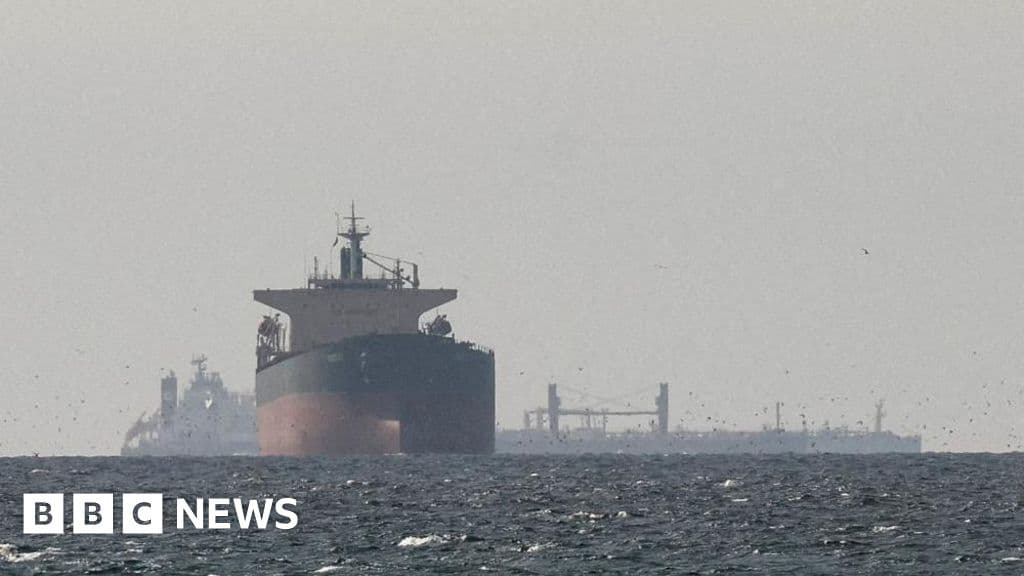
The lower forecasts were released as the costs of oil, gas and fertilisers surge alongside a slowdown in traffic in the Strait of Hormuz, through which roughly 20 percent of the world’s oil and liquefied natural gas supplies travel.
“It is just another confirmation of what we knew, which is that the war in the Middle East is changing the growth trajectory in the immediate term and, if it expands, possibly in the longer term as well,” Aleksandar Tomic, associate dean for strategy, innovation and technology at Boston College, told Al Jazeera.
The IMF said it anticipates higher global inflation at 4.4 percent, up 0.6 percentage points from its January forecast.
The IMF has lowered its global growth forecast to 3.1% for this year.
The blockade has driven up oil prices and squeezed supplies, impacting countries reliant on these imports.
The previous growth forecast was 3.3% before the US and Israel began their war on Iran.
Iran's economy is now forecasted to contract by 6.1%, a revision down by 7.2 points from an initial growth forecast.
Trump suggests Iran talks could restart this week as US blockade continues.

Boy thrown from Tate Modern's 10th floor sees health decline post-surgery

California man shot by ICE agents faces assault charges after incident

Eric Swalwell resigns amid fifth sexual misconduct allegation

England's 1-0 win over Spain highlights Lauren James' potential.

Former UCLA gynecologist James Heaps pleads guilty to 13 sexual abuse charges and sentenced to 11 years.
See every story in News — including breaking news and analysis.
The fund is monitoring the effect of a stronger US dollar on inflation in developing economies because it is a typical transmission channel for tighter financial conditions in emerging markets, Gourinchas said.
The IMF shaved its US growth outlook for this year to 2.3 percent, down just a tenth of a percentage point from January.
Experts argued that continued strains in the Strait of Hormuz could worsen inflationary pressures in the months to come.
“For every $10 sustained increase in gas prices [per barrel], we should expect a decrease in GDP growth of about 0.4 percent. Meaning, a sustained $60 increase above the average price would put the US firmly in recession territory,” Babak Hafezi, professor of international business at American University, told Al Jazeera.
Petrol prices have continued to rise in the US with the average price for a gallon (3.78 litres) at $4.11, up from $2.98 on February 28 when the US and Israel attacked Iran, according to the American Automobile Association, which tracks daily petrol prices.
But pressures on oil prices could ease. Oil prices dropped on Tuesday on hopes that Iran would resume talks with the US to end the war.
Brent crude futures dropped to $95.02 per barrel, down 4.37 percent on the day. West Texas intermediate crude fell by $7.27 or 7.32 percent to $91.84. They are, however, still at levels much higher than before the Iran war.