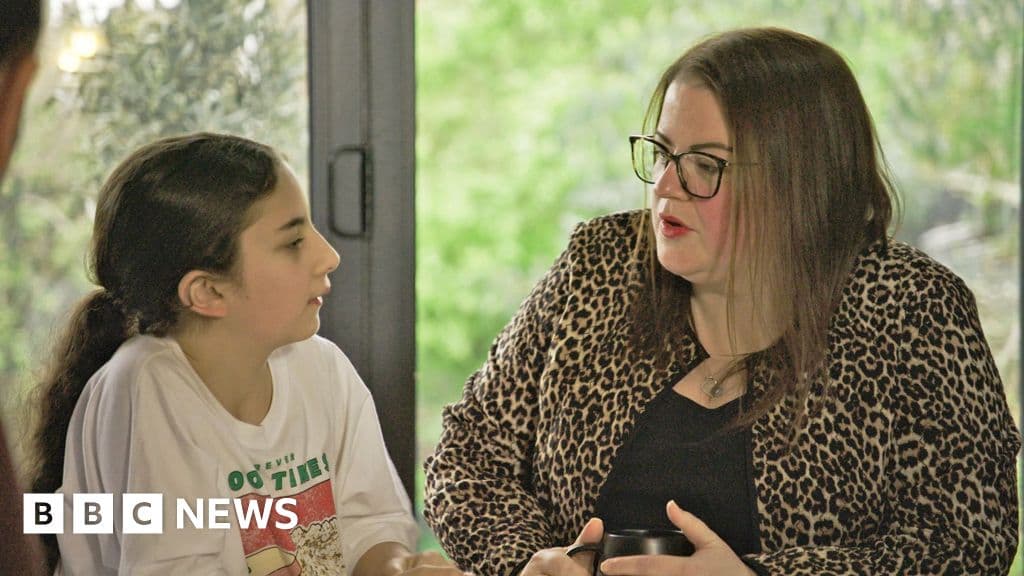
UK families are struggling with rising costs due to the US-Israel war with Iran, particularly affecting transportation for medical care. Fuel prices have surged, forcing families to make financial sacrifices.
Key points
UK families face financial strain from rising fuel prices
Increased costs affect transportation for medical care
Families are cutting back on other expenses
The war is impacting daily life 3,000 miles away
Before the US-Israel war with Iran, Naomi did not think twice about filling up the family van for her young daughter's regular hospital trips. But not any more.
Fuel prices have surged since the war began, driving up the cost of taking 10-year-old Riziah - who was born with complex medical conditions - to hospital for vital care more than 30 miles away in Liverpool.
What was once a routine expense, is now forcing the family to cut back elsewhere just to cope.
"I don't want the children to see how worried we are," she says.
BBC Panorama has spoken to families feeling the sudden financial hit of a war 3,000 miles away, as the cost of daily life rises.
Naomi lives in Chorley, Lancashire, with her husband, daughter and teenage son.
Rising fuel costs have now become a growing financial pressure on families like Naomi's, who have no choice but to travel.
"We've just filled up the van and it's cost us just short of £130. How is that doable? To just carry on filling up your van each time," Naomi says.
The family is spending about £30 extra a week on diesel since the war started on 28 February, she says.
In real terms, the cost of filling a typical family car with petrol has gone up by about £14. A tank of diesel is about £27 more expensive.
But it is not just travel costs. Naomi is also worried about added pressure later this year, when her home energy bills are likely to rise again - after significant hikes in recent years.
Riziah's condition means she relies on medical devices that use extra electricity on top of the family's normal consumption. The house also needs to be kept warm all year round for her health.
Millions of household energy bills in England, Wales and Scotland are protected by a price cap which sets a limit on the cost of each unit of gas and electricity. The cap dropped at the start of this month, but it is expected to increase in the next quarter, starting in July.
Watch Panorama - Iran War: The Cost at Home - on BBC One at 20:00 on Monday 27 April (23:10 in Scotland) or lateron iPlayer
Cornwall Insight, an energy consultancy, predicts the cap will increase to £1,843 a year for a typical household - up by more than 12%, or roughly £200.
Q&A
How has the Iran war affected UK family finances?
The Iran war has led to increased fuel prices, significantly impacting UK families' transportation costs for essential activities like medical care.
What specific challenges are families facing due to rising fuel prices?
Families are forced to cut back on other expenses to manage the higher costs of fuel for necessary trips, such as hospital visits.
What are the implications of rising living costs for families in the UK?
Rising living costs are causing financial strain, leading families to worry about their ability to afford essential services and care.
What is the distance families are traveling for medical care in the UK?
Families are traveling more than 30 miles to hospitals for vital medical care, which has become increasingly expensive due to fuel price hikes.
How this cosmic map of magnetic fields could help illuminate one of the universe’s most mysterious forces
A global team led by Australia's CSIRO has created the largest cosmic map of magnetic fields, measuring light from nearly 4 million galaxies. This map aims to help scientists understand the origins and evolution of magnetic fields in the universe.
Widow of gambling addict takes Betfair to court in possible landmark UK case
The widow of a gambling addict is suing Betfair for negligence after her husband took his life, allegedly due to his gambling debts. This case could set a precedent for the UK's gambling industry regarding operators' duty of care to customers with gambling problems.
See every story in News — including breaking news and analysis.
One of the reasons diesel and energy costs are being affected so much is because of the closure of the Strait of Hormuz - the narrow waterway which separates Iran from Oman.
The strait is deep enough for the world's biggest tankers carrying crude oil, and when everything is running normally, a fifth of the world's oil is transported through it from Middle East oilfields.
But early in the war, Iran began to threaten shipping in the strait in retaliation for US and Israeli strikes. That effectively shut it, severely restricting the supply of oil and gas around the world.
There is currently a ceasefire, but a stand off between Iran and the US means the strait remains closed to most traffic.
Although the UK gets very little of its gas from the region, the squeeze on supply has pushed up the international price of both oil and gas - and the higher wholesale gas prices faced by energy suppliers ultimately feed through to gas and electricity bills in UK homes.
Increased fuel and energy prices are expected to be joined by rising food costs later this year, as the disruption to shipping routes and the flow of fuel around the world spreads through to the wider economy.
Many households already have little capacity in their monthly budgets to take on more financial pressure - but things are likely to get tighter, says Mohamed El-Erian, economist and professor at the Wharton School of the University of Pennsylvania.
He is concerned the war could continue to affect families struggling to make ends meet.
"This is what worries me most. What's happening now hits those that are most vulnerable, the lower income households that are already under significant pressure, and as a result, they are hardest hit."
Businesses are also facing higher transport and energy costs. Most are currently absorbing the costs themselves, but further increases - for example, in food production and transportation - are likely to be passed on to consumers over time.
At the same time, while potentially good news for savers, borrowers may be disappointed about the outlook for interest rates.
The Bank of England uses rates to keep inflation in check and had been expected to cut them this year. It may now not be able to do so, as inflationary pressures linked to the Iran war are felt across the economy.
UK inflation, as measured by the consumer prices index (CPI), rose to 3.3% in the year to March - up from 3% in the 12 months to February - after the Iran war caused the largest jump in petrol and diesel prices in more than three years.
At the start of the year, the Bank of England predicted inflation would dip below its 2% target in April, but it is still much lower than the double-digit rates seen in 2022, early on in the war in Ukraine.
Mortgage interest rates are already rising "pretty sharply" as markets react to expected increases to interest rates in the next few months, says leading economist, Michael Saunders.
"That means the households looking to re-fix their mortgage face substantially higher costs than they would have expected previously," he adds.
One of those affected by a more volatile mortgage market is Iona, who lives with her teenage daughter in Mansfield, Nottinghamshire.
She bought her house on a five-year fixed-rate mortgage which expires in September.
Iona was always going to face a rise in mortgage payments when her fixed rate ended. But then the war in Iran started.
She currently pays £720 a month for her three-bedroom house, but that will now go up to £1,020 - an increase of £300.
"I was gobsmacked. I always expected it would increase anyway but it was a massive shock."
Iona has accepted a deal on another five-year fixed rate, which she says was a gamble but she did it because she was concerned about the rates increasing even further.
She says her increased monthly outgoings means she is already looking at ways she can save on the food shop, while cutting out little luxuries with her daughter like going to music shows and eating out.
For Iona, the consequences of the war in Iran feels closer to home than she ever imagined.
"I didn't think what was happening thousands of miles away would have a direct impact on my life and my family's life."