
Musk’s Grok accused of violating Canadian privacy laws on deepfakes
Musk's Grok faces accusations of violating Canadian privacy laws with deepfake images.
Al Jazeera English1 min read

John Healey's resignation as Defence Secretary highlights Keir Starmer's struggles with national security amid global conflicts. The Labour Party faces criticism over military spending and the government's perceived failures in ensuring safety.
Mentioned in this story
As Labour MPs set out the case for change in the tea rooms and bars of Westminster, there is usually one caveat. They believed the prime minister was an asset when it came to national security and had performed beyond expectations on the world stage.
Now that reputation too lies in tatters, after the resignation of John Healey with one of the most quietly damning letters that many can remember. Not a departure over ambition – though Healey certainly has it – but on principle. It is a rare thing to see a loyalist cabinet minister accuse the prime minister and a chancellor of making the country “less safe”.
All of Keir Starmer’s rhetoric has always suggested he understood the severity of the moment: just months ago in Munich, he pledged that Britain would “rise to this moment … spend more, deliver more, and coordinate more.”
But the row is the perfect encapsulation of the government’s problems. Some of it is not of its own making. This is the most dangerous world any government has faced in decades, with global conflicts in the Middle East and Ukraine, threats from China and Russia and buffeted by the whims of an increasingly irrational White House.
The government inherits a hollowed-out armed forces and a withering industrial base. It has an opposition who for many years saw welfare increase and defence cut – and now loudly demand the government do the opposite.
But it also has a chancellor who is boxed in by the party’s own pledges on tax. It has cabinet ministers who refuse to countenance cuts to schools, energy infrastructure and hospitals. It has Labour MPs who – with honourable exception – are far more interested in schools and hospitals than frigates.
And at the centre, a prime minister who seems not to lead but prevaricates, who lacks the authority to force his cabinet to accept unpopular cuts and eventually attempts to bounce his defence secretary into a plan at the 11th hour.
The most damning sentence of Healey’s resignation letter was where he described the chancellor as “unwilling” and the prime minister as “unable”.
But where in reality can these billions be found? There is no plan for difficult welfare improvements that could command support from MPs.
There is no narrative to convince the British public that those difficult economic decisions will be worth it to fund billions more into keeping the country safer but – let’s be honest – that will have likely no material impact on improving the day-to-day lives of citizens. Many of those billions go towards buying arms, equipment and technology from abroad.
And then there is the chaos of it all – departments only asked to countenance spending cuts in the last few weeks. Healey himself only saw the full sums on Monday morning, where the cash was billions less than he expected. The Australian defence minister is en route to the UK, along with 20 reporters, to do a joint press conference with Healey – it has now been cancelled.
John Healey resigned due to concerns over national security, accusing the Prime Minister and Chancellor of making the country less safe.
The UK government is facing challenges from conflicts in the Middle East and Ukraine, as well as threats from China and Russia.
Healey's resignation has tarnished Starmer's reputation, particularly regarding his ability to manage national security effectively.
The Labour Party is criticized for previously advocating for welfare increases while supporting cuts to defense spending, now demanding a reversal.
Musk's Grok faces accusations of violating Canadian privacy laws with deepfake images.

Trump urges Republicans to pass a $350 billion bill, causing division over voting restrictions.
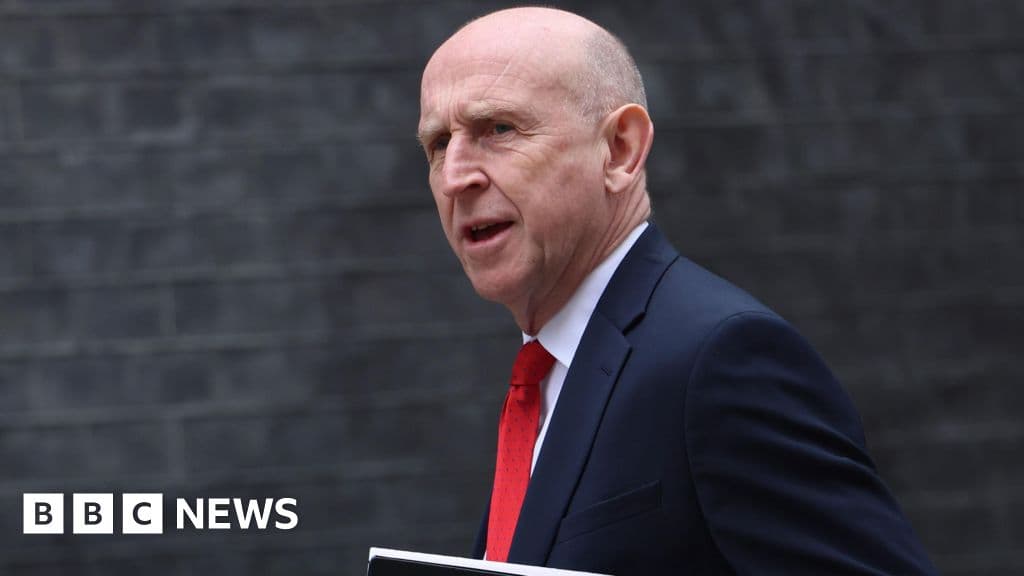
John Healey quits as defence secretary amid military funding row

The Israeli government has allocated $51 million for construction plans of 69 illegal settlements in the West Bank, with a potential $338 million funding proposal postponed for further review. This could lead to one of the largest expansions of settlements in decades.

NHS inquiry finds children at risk from gender care failures at Brighton GP clinic.

Toronto police officer shot and killed while investigating US consulate attack
See every story in News — including breaking news and analysis.
All the different sides have a case for feeling aggrieved. Healey and the defence chiefs who believe the centre is unwilling to make the hard decisions necessary in these dangerous times. And the Treasury, which looks at the mess of defence procurement and waste in the department and grows irritated by the louder calls for more and more billions from retired military types who will not bear the brunt of the backlash for the cuts to fund them.
It seems trite – when so much is at stake – to then return to the question of Starmer’s future as prime minister. But it is the shadow that looms over the story because Healey’s frustrations in the letter suggest much about the dysfunction in government.
They are the same frustrations about – as one MP put it – “a continued drift into incrementalism and managerialism” that have led so many MPs to turn their hopes towards Makerfield where in a week’s time they hope to see Andy Burnham return to Westminster.
But Burnham, should he make it from Wigan to the heart of SW1, will face these same exact choices that have driven Healey from government. He too will have to choose whether to further change the fiscal rules, rip up tax pledges, cut spending, cull infrastructure projects and justify all this to an angry public and restive MPs.