'Extraordinary' heat health alerts to come into force as record May heat possible

TL;DR
Heat health alerts are now in effect across parts of the UK as temperatures rise, with highs expected to reach 33C on bank holiday Monday. Many areas will experience a heatwave with high UV levels forecasted.
Key points
- Heat health alerts are in effect across parts of the UK.
- Temperatures may reach 33C on bank holiday Monday.
- Many areas will experience high temperatures in the high 20s and low 30s.
- High UV levels are expected during the heatwave.
As temperatures continue to rise as we go into the bank holiday weekend, heat health alerts come into force today across parts of the United Kingdom.
Many areas will enter into the official heatwave thresholds across the next few days, with temperatures widely in the high 20s and low 30s into next week.
Bank holiday Monday could see the hottest May day on record as temperatures are forecast to approach 33C in south-east England.
With lots of sunshine in the forecast, UV levels are also expected to be high for many.
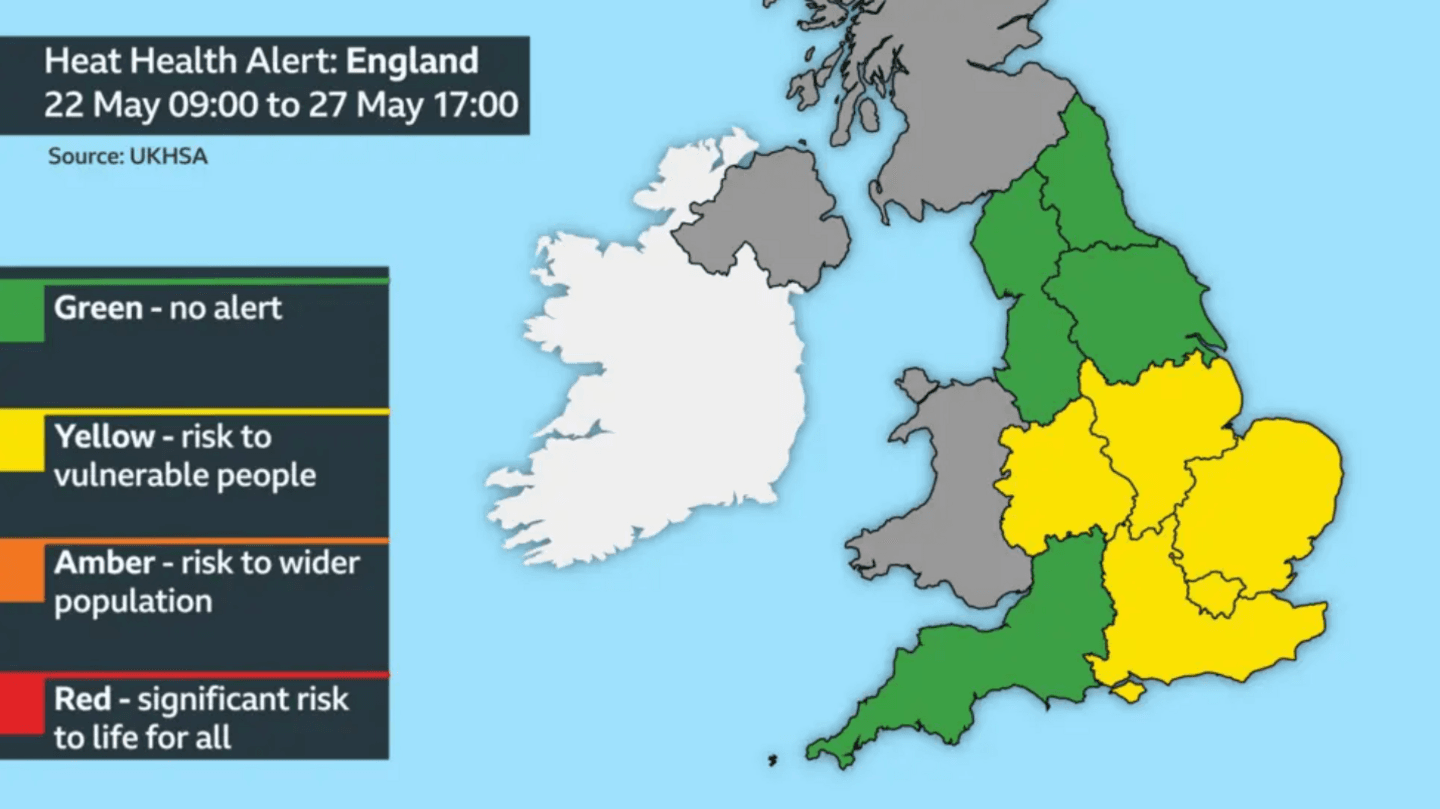
Image caption,
Heat health alerts are usually only issued between 1 June and 1 September but authorities have chosen to issue an "extraordinary" alert for this period of warm weather
The UK Health Security Agency (UKHSA) normally issue heat-health alerts during the core season of 1 June to 30 September.
But, as the temperature significantly rises, they have issued "extraordinary" alerts for the Midlands, eastern and south-east England.
Valid from 09:00 BST on Friday to 17:00 on Wednesday, the yellow alerts suggest some minor impacts to health and social services.
Dr Anya Gopfert, consultant in public health at UKHSA, told the BBC: "This first heat-health alert of the summer season is an important reminder that sustained periods of warm weather can pose a real risk to the most vulnerable."
The purpose of the alerts is to help ensure that health and social care services are prepared for hotter weather and the harms that extended periods of heat can have on health are reduced.
A yellow alert is - for most people - unlikely to be a major problem but there are some simple steps people can take to keep them safe according to Gopfert such as staying hydrated, avoiding the sun during the hottest part of the day, and keeping your home cool.
How hot is it likely to get?
For many parts of England and Wales, the temperature will rise into the mid- to high-20s over the weekend.
Locally in the south Midlands and south-east England, it could hit 30C by Sunday, which would be relatively rare for May.
There is also increasing confidence that the maximum temperature could reach 33C on bank holiday Monday.
This would exceed the current highest recorded May temperature of 32.8C, set in 1944.
This also happened to be on the Late May Bank Holiday.
We're also expecting many parts of England to go into an official heatwave, during which the temperature exceeds 26-28C - depending on exact location - for three consecutive days.
While it won't be as hot in Scotland and Northern Ireland, with no heatwave expected, it will still feel warm over the coming days.
Cloudier skies are likely to keep temperatures at around the low 20s at best.
Elsewhere, there'll be a lot of sunshine - though there is a risk of a heavy shower or even thunderstorm in south-east England on Saturday afternoon.
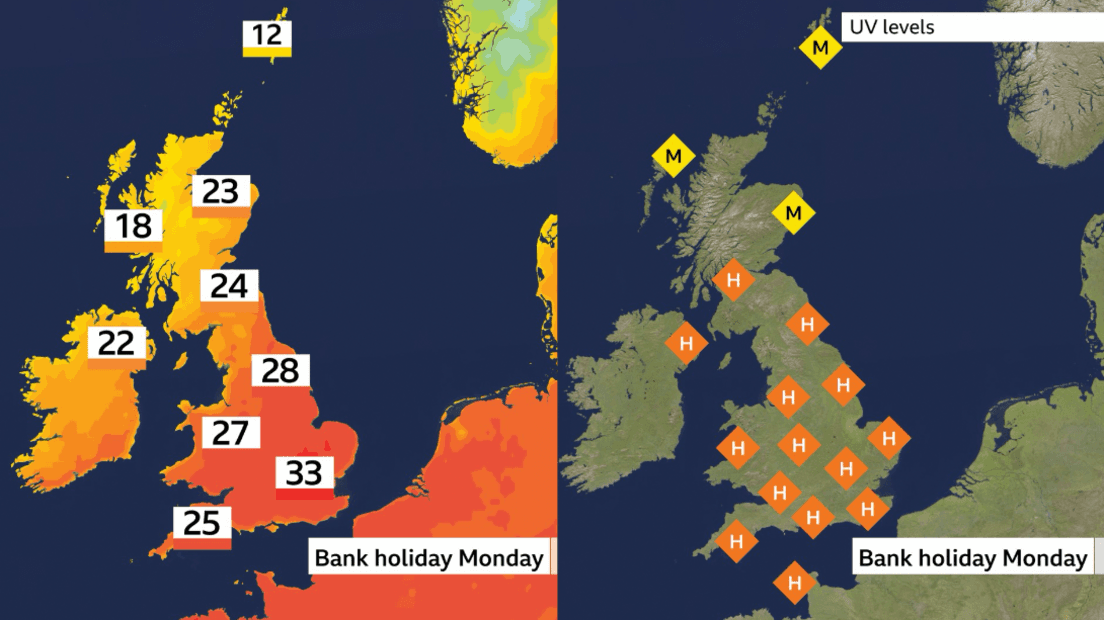
Image caption,
Temperatures and UV levels are set to rise significantly into the Bank holiday Monday
Unusually high UV levels
As the sunshine becomes more widespread across the UK, especially England and Wales over the weekend, UV levels will also rise to "high" for many.
High UV corresponds to an index of 6 or 7 on a scale from 0 to 11+.
During summer in the UK, that UV index would typically be around 5-6 with a maximum of 8 only in exceptional circumstances.
On Sunday and Monday, the index is expected to peak at 7 across much of England and Wales.
While reaching 7 in late May isn't unheard of, it is rare and means that the time taken to get sunburn is significantly reduced.
The cloudier skies in Scotland and Northern Ireland will mean that UV levels will be more like 4-6 or in the "medium" to occasional "high" level.
People are being reminded to stay safe in the sun by covering up, using sunscreen and seeking shade.
Additional reporting by Michelle Roberts
Q&A
What areas in the UK are under heat health alerts?
Heat health alerts are in effect across various parts of the United Kingdom, particularly in the west and east Midlands, East Anglia, and south-east England.
What temperatures are expected during the heatwave in May?
Temperatures are forecast to be in the high 20s and low 30s, with bank holiday Monday potentially reaching 33C in south-east England.
What is the significance of the heat health alerts?
The heat health alerts indicate a risk to vulnerable people due to high temperatures and are issued to help mitigate health risks during extreme heat.
How will UV levels be affected by the rising temperatures?
With the expected sunshine during the heatwave, UV levels are anticipated to be high, posing additional health risks.