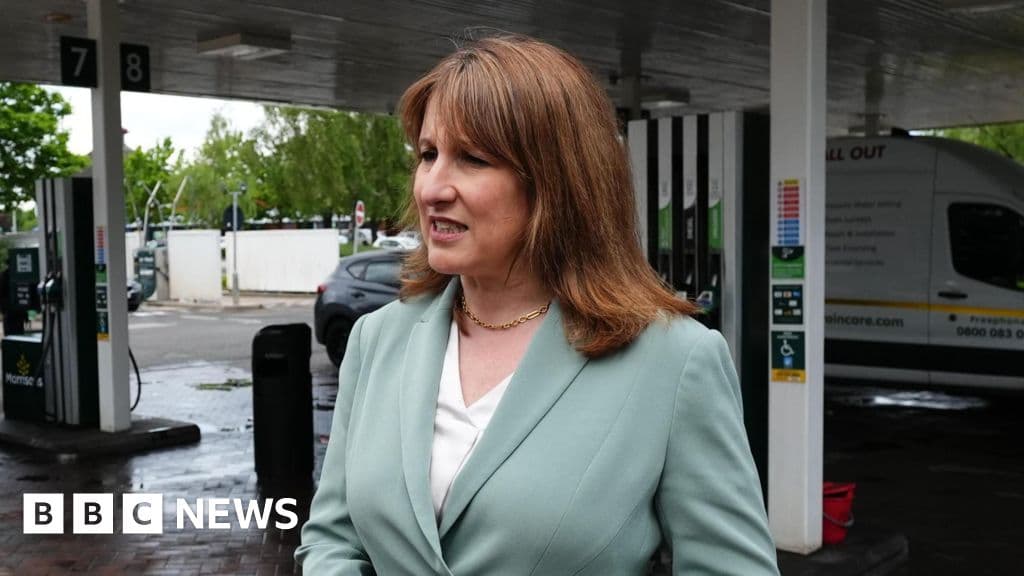
Chris Mason: Reeves' summer savings drive won't stretch to energy bills
UK's 'Great British Summer Savings' won't help with energy costs, says Reeves.
BBC News1 min read

Czech President Petr Pavel warns that Russia will remain Europe's primary security threat for decades. This statement was made during the GLOBSEC Forum 2026 in Prague, attended by over 2,000 officials and experts.
Mentioned in this story
From
in Prague
Dobré ráno, or good morning from Prague.
Over 2,000 state officials, foreign policy and security experts from Europe and beyond are meeting in the Czech capital for the GLOBSEC Forum 2026. And there is no shortage of issues to cover.

Boats cruise the Vltava river during the Navalis celebrations, with Prague Castle in the background, in Prague, Czech Republic. Photograph: Martin Divíšek/EPA
From the latest drone incidents in the Baltics to broader security situation in Ukraine and Europe – and this part of Europe in particular – to broader global questions on energy, geopolitics, AI, and the state of the transatlantic alliance, there will be plenty of things to cover.
We will hear from the Czech president, Petr Pavel, the European Commission’s vice-president, Henna Virkunen, and the former Nato secretary general, Anders Fogh Rasmussen, among others just as Nato’s foreign ministers gather in Sweden for their ministerial meeting today and tomorrow.
Last night, Pavel warned that Russia will continue to be Europe’s main security threat for decades, as the continent wakes up from being overreliant on US protection and needs to radically bolster its own defence as a new global order of competing superpowers takes shape.
Czech President Petr Pavel stated that Russia will be Europe's main security threat for decades.
The GLOBSEC Forum 2026 is being held in Prague, Czech Republic.
Over 2,000 state officials, foreign policy, and security experts are attending the GLOBSEC Forum 2026.
The GLOBSEC Forum 2026 covers various pressing issues related to security and foreign policy.
UK's 'Great British Summer Savings' won't help with energy costs, says Reeves.

Over one billion people are affected by mental health conditions, with urgent discussions at the WHO assembly in Geneva.

Iran is reviewing the US response to end the war, keeping diplomatic options open.

Capitol police officers file lawsuit to block payouts from $1.776 billion fund for January 6 rioters.

Former federal prosecutor indicted for sending sealed Trump probe report to her personal email.

Netanyahu scolds Ben-Gvir for mocking detained flotilla activists
See every story in News — including breaking news and analysis.
I will bring you all the key lines here.
Elsewhere, I will bring you the latest on Ukraine, the said drone incidents in the Baltics, and all other relevant news from across the continent.
It’s Thursday, 21 May 2026, it’s Jakub Krupa here, and this is Europe Live.
Good morning.
Pavel says that Europe “has already made significant progress in defence spending,” but warns that “credible defence is not built on spending levels alone.”
“We need to work hard to strengthen our strategic enablers and close critical gaps in areas such as strategic airlift, air and missile defence, intelligence, logistics, or military mobility. There is no time to lose.”
Pavel begins by saying that his repeated warnings that Europe needs to focus on its political will, industrial capacity and technological capacity “remain fully valid; if anything, it has become even more urgent today.”
He says it is clear that Europe “must assume greater responsibility for our own defence, not because we are told so by Washington, but because it is in our own strategic and vital interest.”
He says that as “debates about the future scale of America’s conventional military presence in Europe are becoming more pronounced, Europe must be prepared for this reality.”
“This doesn’t mean that Europe should turn away from the United States – just the opposite. Nato remains the foundation of our collective defence, and the transatlantic bond remains essential for our own security – but we must be honest [that] many assumptions supporting the old security architecture are no longer valid.”
The Globsec Forum in Prague is now under way.
Czechia’s Pavel is on stage for his opening address.
I will bring you the key lines.
in Prague
Dobré ráno, or good morning from Prague.
Over 2,000 state officials, foreign policy and security experts from Europe and beyond are meeting in the Czech capital for the GLOBSEC Forum 2026. And there is no shortage of issues to cover.
Boats cruise the Vltava river during the Navalis celebrations, with Prague Castle in the background, in Prague, Czech Republic. Photograph: Martin Divíšek/EPA
From the latest drone incidents in the Baltics to broader security situation in Ukraine and Europe – and this part of Europe in particular – to broader global questions on energy, geopolitics, AI, and the state of the transatlantic alliance, there will be plenty of things to cover.
We will hear from the Czech president, Petr Pavel, the European Commission’s vice-president, Henna Virkunen, and the former Nato secretary general, Anders Fogh Rasmussen, among others just as Nato’s foreign ministers gather in Sweden for their ministerial meeting today and tomorrow.
Last night, Pavel warned that Russia will continue to be Europe’s main security threat for decades, as the continent wakes up from being overreliant on US protection and needs to radically bolster its own defence as a new global order of competing superpowers takes shape.
I will bring you all the key lines here.
Elsewhere, I will bring you the latest on Ukraine, the said drone incidents in the Baltics, and all other relevant news from across the continent.
It’s Thursday, 21 May 2026, it’s Jakub Krupa here, and this is Europe Live.
Good morning.
Explore more on these topics