
Dua Lipa and Callum Turner wedding divides Palermo: ‘I could understand if it was for the pope’
Dua Lipa and Callum Turner celebrate their wedding in Palermo, drawing mixed reactions from locals.
The Guardian World1 min read
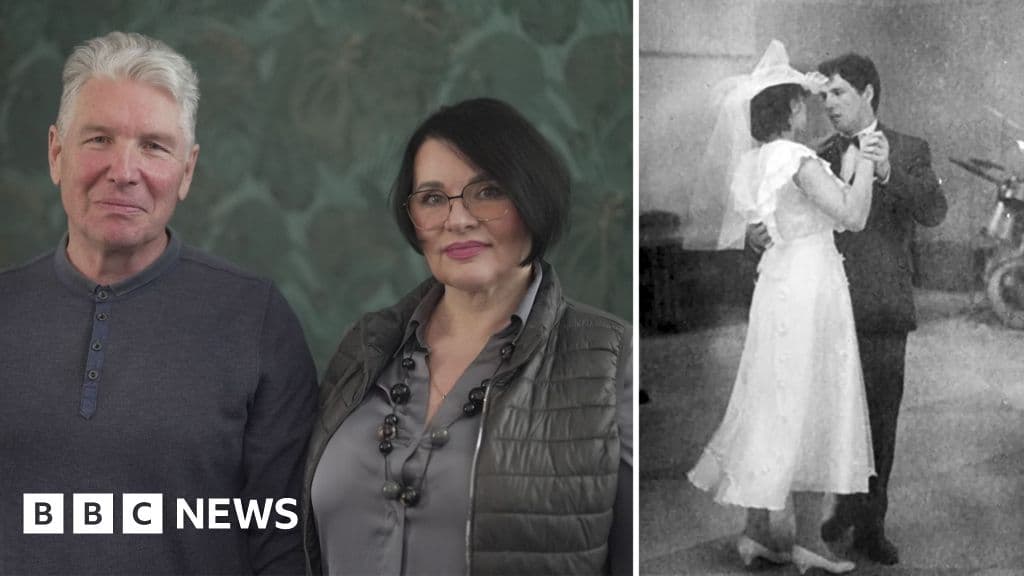
Iryna Stetsenko and Serhiy Lobanov married just as the Chernobyl disaster began. They were unaware of the nuclear accident occurring nearby as they celebrated their wedding in Pripyat.
Mentioned in this story
It was just after midnight. Iryna Stetsenko had finished doing her nails for her wedding, opened the balcony door and was battling her nerves to get to sleep.
In a nearby apartment packed with guests, her fiancé Serhiy Lobanov was asleep on a mattress in the kitchen.
Then a "rumble" disturbed the quiet, says Iryna. "It was as if a lot of planes were flying overhead, everything was humming and the glass in the windows shook."
Serhiy says he "felt a shake, as if some kind of wave passed", wondered if it was a mild earthquake, and fell back to sleep.
The 19-year-old trainee teacher and power plant engineer, who was 25, were looking forward to married life in the newly built Soviet city of Pripyat. They had no idea that the world's worst ever nuclear accident was unfolding less than 2.5 miles (4km) away.
Reactor number four at the Chernobyl power plant – in what is now northern Ukraine - had exploded, spewing out radioactive material that would spread across swathes of Europe.
Forty years later, the highly radioactive remains of the plant are in a warzone. The couple now live in Berlin, having uprooted their lives a second time - this time to escape conflict, not a nuclear disaster.
But on the morning of 26 April 1986, Serhiy remembers waking around 6am, full of excitement, to find his wedding day had dawned gloriously sunny.
He had errands to do - bed linen to take to a friend's apartment where he and Iryna planned to sleep that night, and flowers to buy.
He says he saw soldiers in gas masks outside, and men washing the street with a foamy solution. Some men he knew from his work at the nuclear plant told him they had been called in urgently because "something happened", but they did not know what.
As he looked out from the friend's high-rise apartment, he spotted smoke rising from reactor four.
It would later become clear that firefighters and power plant workers had spent the night risking lethal doses of radiation to tackle a huge toxic blaze.
"I felt a bit anxious," he says. Drawing on his training, he took some fabric, wet it and put it across the apartment entrance as a precaution to catch radioactive dust, he adds.
He then rushed to the market. Unusually for a Saturday morning, it was deserted, so he picked five tulips for the bouquet.
Iryna, who was staying with her mother in the family's apartment, says the phone kept ringing overnight. Her mother sounded "alarmed", she says, by neighbours calling to say "something terrible" had happened. But there was little detail.
Information was strictly controlled in the Soviet Union. They turned on the radio, but there was no mention of any incident.
In the morning, her mother rang the authorities: "They told her not to panic, all planned events in the city should go ahead."
Officially, everything carried on as usual. Children were sent to school.
Their wedding took place just as the Chernobyl nuclear disaster was unfolding less than 2.5 miles away.
Iryna described the sound as a rumble like many planes flying overhead, while Serhiy initially thought it was a mild earthquake.
They got married in the newly built Soviet city of Pripyat, Ukraine.
Iryna was a trainee teacher and Serhiy was a power plant engineer.
Dua Lipa and Callum Turner celebrate their wedding in Palermo, drawing mixed reactions from locals.

New analysis reveals half of California's waterways are tainted with PFAS pesticides linked to health risks.

Senate passes a $70 billion immigration enforcement bill after 18 hours of debate.

Hamas refuses to surrender arms, stating only police will carry weapons in Gaza.

A 21-year-old man has been charged with attempted murder after a staff member was shot with a crossbow at the University of Surrey. The suspect, Almunthir Daqamah, is a former student and is due in court on Friday.

UN warns US-Iran war is pushing millions into hunger crisis
See every story in News — including breaking news and analysis.
Later in the day, the bride, groom and guests drove in a line of cars to the Palace of Culture, known for hosting both ceremonial events and popular discos.
They made their vows standing on a cloth embroidered with their names, then moved with their guests to a nearby café.
But the wedding banquet felt "sad", not celebratory, says Serhiy. "Everyone understood that something had happened, but no one knew the details".
For their first dance, they had practised a traditional waltz. But with the growing realisation that a tragedy was unfolding, "from the first steps we went out of rhythm", recalls Iryna. "We just hugged each other and moved in the hug."
Then - exhausted but finally man and wife - they returned to the friend's apartment.
But, Serhiy says, in the early hours of Sunday morning, another friend knocked on the door, telling them to rush to an evacuation train, due to leave at 5am.
The only extra clothing Iryna had with her was a flimsy dress for the second day of the celebrations, so she put her wedding dress back on to hurry back to her mother's apartment to change. Also, her shoes had given her blisters. "I was in a wedding dress and I was running barefoot through the puddles," says Iryna.
It was still dark as they saw the glow of the collapsed reactor from the train. It was "as if you were looking into the eye of a volcano," says Serhiy.
The official announcement, when it came, described the evacuation as "temporary".
"We left for three days, but ended up going for our entire lives," he adds.
The Soviet Union was heavily criticised for its slowness in revealing the scale of the disaster. It was only two days after the explosion – after radiation was detected in Sweden – that it acknowledged an accident had happened. It was more than two weeks before Soviet leader Mikhail Gorbachev spoke about it publicly.
A safety test had gone badly wrong. An estimate cited by the International Atomic Energy Agency (IAEA) and World Health Organization suggests the explosions released 400 times more radioactive material than the bomb at Hiroshima.
Nikolai Solovyov was working as a lead engineer in the turbine hall at the time.
"It was like an earthquake beneath us," he recalls. "We saw the roof collapsing… A blast of air came towards us and brought all this black dust… And the siren started."
He says he and colleagues raced towards the site thinking a generator had exploded – unable to imagine it could be the reactor itself.
One checked their monitors and said radiation levels were "off the charts", Nikolai remembers.
He says they found another colleague standing on one of the turbines, apparently unhurt but vomiting - a sign of radiation sickness. "He was one of the first to die," he says.
The official death toll from the incident is 31 people - two were killed by the explosion itself, while 28 died from Acute Radiation Sickness, and one from cardiac arrest, in the weeks afterwards.
The wider impact of the disaster is contested and difficult to determine. No comprehensive long-term medical study was set up at the time.
In 2005, a study by several UN agencies concluded 4,000 people could die as a result of the accident. Other estimates suggest the number could be tens of thousands.
An operation was launched to stop the exposed reactor pouring out radiation.
Helicopter flights dropped sand and other materials on it. The authorities brought in hundreds of thousands of people from all over the Soviet Union to contain the disaster.
Extreme radiation levels caused machines to break down, so some work had to be done by hand.
Jaan Krinal and Rein Klaar were deployed from Estonia, then part of the Soviet Union, and were part of a group sent to clear debris from the roof of reactor three.
"You wore lead plates - one in front, one on your back, and one between your legs. It was heavy, 20kg or more," says Jaan.
"On your head: a standard Soviet construction helmet - goggles, gloves and a dosimeter [to measure radiation] in your pocket," he says.
Rein recalls being sent to work in bursts of a single minute to limit their exposure. "Nobody could tell what was what… There was no time to think," he says.
As the clean-up began, Iryna and Serhiy were staying with her grandmother, about 300km away in the Poltava region, east of Kyiv.
A few days after they arrived, doctors monitoring the evacuees for radiation gave them unexpected news - Iryna was three months pregnant.
She remembers weeping as she discovered doctors were warning that radiation exposure may have affected unborn babies, and advising women who had been exposed to have abortions: "I was scared to have a baby, and scared to have an abortion."
But a sympathetic female doctor encouraged her to proceed with the pregnancy, and Iryna gave birth to a healthy girl, Katya. Decades on, she has become a mother herself and Serhiy and Iryna now have a 15-year-old granddaughter.
The couple feel the nuclear accident has affected their health, though this has not been confirmed by doctors.
Iryna has had to have both knees replaced, and believes radiation may have weakened her bones. They think radiation may be a factor in a heart attack Serhiy had in 2016, a week after visiting his old home town, Pripyat.
Jaan, who leads an organisation for Estonian former liquidators, says some have had health problems, but they have not seen "cancers everywhere" as they initially feared. He says in 1991, 51 Estonian liquidators died, including 17 who took their own lives.
Nikolai, the turbine engineer, was married with two sons at the time of the accident. He returned to work at the plant and retired recently. His younger son joined Ukraine's military in the wake of Russia's full-scale invasion in 2022, but has been missing in action since September 2023.
The nuclear plant itself needs constant monitoring and maintenance.
A concrete sarcophagus over reactor four was completed in just seven months after the accident. But it became unstable and, in 2016, a new £1.3bn ($1.8bn) metal shield was rolled over the top to contain leaks.
Radiation in much of the "exclusion zone" around the plant is now at levels low enough to be safe to visit for limited periods, but no one is allowed to live there legally. There are still hotspots with dangerously high levels of radiation, both in and near the destroyed reactor, and in places such as the "Red Forest", which was heavily contaminated.
The buildings of Pripyat – once considered a beacon of youthful optimism and Soviet technology – now stand crumbling and abandoned, including the Palace of Culture where Serhiy and Iryna made their vows.
Inside the new dome, the chimney of reactor four is a haunting ruin, coated with a crude grey concrete shell, under the shiny metal dome tall enough to house the Statue of Liberty.
In 2022, Russian forces rolled into the power plant complex in tanks, taking staff hostage for five weeks, laying mines and digging trenches.
And last year, a drone smashed a hole in the new shield. Ukraine accused Russia of targeting the power plant – which the Kremlin denied. Radiation levels did not increase but the IAEA says the shield has lost its "primary safety function".
Serhiy and Iryna moved to Germany in 2022 after their daughter's flat in Kyiv was hit by a missile. Their marriage, begun amid uncertainty and tragedy, remains a comfort.
"I think we really had to go through some difficulties in life, in order to understand that we… really can't be one without the other."
"After 40 years, I can say with certainty that we are like a thread with a needle," says Iryna. "We do everything together."
Additional reporting by Paul Harris and Ellie Jacobs