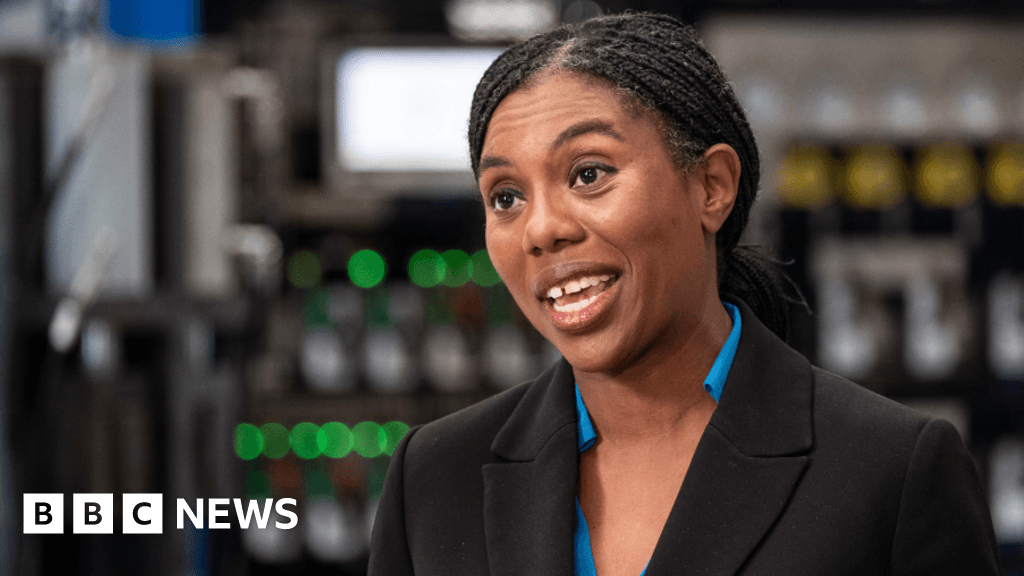
Legal equality duty for public services should be scrapped, says Badenoch
Kemi Badenoch proposes to eliminate the Public Sector Equality Duty, citing divisive agendas.
BBC News1 min read

California and New York have weakened their climate policies, with California scaling back its cap-and-invest program and New York delaying carbon regulation. These changes come as red states increase their clean energy efforts amid rising energy prices.
Mentioned in this story
Democratic-led states are eroding their climate policies, as red states are scaling up their clean energy deployment.
California on Friday scaled back its cap-and-invest program, offering more than $3bn in free pollution allowances to polluting companies. Earlier the same week, New York weakened its groundbreaking climate law, delaying a plan to regulate carbon from 2024 until 2028 and reducing emissions-slashing targets. Rhode Island’s governor, meanwhile, is attempting to roll back aggressive clean-energy programs.
The moves come as Donald Trump’s administration withdraws clean energy incentives and energy savings programs, and as energy prices spike across the country amid trade disruptions stemming from the US-Israeli war on Iran.
Proponents have said the changes are necessary to suppress electricity costs, but climate advocates say that view is short-sighted and misguided.
“Using affordability as a cudgel to weaken climate policy is a major error that will not solve either crisis, ultimately amplifying both,” said Johanna Bozuwa, executive director of the Climate and Community Institute, a left-leaning thinktank.
“Extreme weather and fossil-fuel dependency directly inflate costs – for food, energy, transportation, housing, and health – across the economy for working people.”
Polls show most Americans are concerned about the climate crisis. An annual poll from Gallup, published in April, shows that 44% of American adults say they worry “a great deal” about global warming – one of the highest levels of concern since 1989, when the poll was first conducted, behind only 2020 and 2017.
About 65% of registered voters in the US also think global heating is driving up the cost of living, according to a report published in December by Yale University and George Mason University.

Wind turbines in Lyford, Texas, by US Route 77. Photograph: NurPhoto/Getty Images
“The polling shows that climate must remain on the political agenda,” said Bozuwa. “Good climate policies provide immediate relief for families while also driving larger structural green transformation.”
In contrast to many Democratic-led jurisdictions, red states have tended to dominate renewable energy deployment in recent years. In terms of growth of utility-scale renewables, states that voted for Donald Trump in the 2024 presidential election made up eight of the top 10 in the year to March, according to Energy Information Administration data. Indiana tops the list of states with the most clean energy capacity growth in that timeframe, followed by Kentucky and Utah.
California scaled back its cap-and-invest program, providing over $3 billion in free pollution allowances to companies.
New York delayed its plan to regulate carbon emissions from 2024 to 2028 and reduced its emissions targets.
Proponents argue the changes are necessary to lower electricity costs, while climate advocates believe they are misguided and detrimental.
Red states are ramping up their clean energy deployment despite the weakening of climate policies in Democratic-led states.
Kemi Badenoch proposes to eliminate the Public Sector Equality Duty, citing divisive agendas.

OpenAI confidentially files for an IPO in the US, aiming for a valuation of up to $1 trillion.

Armed bandits abduct villagers during peace negotiations in Nigeria

UN human rights leader demands U.S. lift sanctions on Cuba now

Somali referee Omar Artan denied US entry, missing World Cup 2026.

Iran and Israel halt attacks but threaten retaliation if ceasefire is breached.
See every story in News — including breaking news and analysis.
More broadly, though, it is Texas that has emerged as the country’s leading clean energy superpower, despite its strong ties to the oil and gas industry and unsuccessful attempts within the Republican-led legislature to curb the growth of wind and solar.
Texas leads the country in wind energy production, followed by fellow red states Iowa, Oklahoma and Kansas, and in March overtook California in utility-scale solar, too. The state is the “energy capital of the world”, Greg Abbott, Texas’s governor, has boasted.
The oil and gas sector remains strong in Texas amid the boom in renewables. Like many red states, Texas has made it easier to build energy infrastructure in general, both dirty and clean, than their Democratic counterparts.
Still, the ramping up from red states comes as Trump has attacked efforts to boost renewable energy nationally, slashing tax incentives for wind and solar developers, attempting to halt offshore wind projects, and deriding clean power as “stupid” and a “scam”.
Meanwhile, the states scaling back their emissions-cutting policies have long called themselves climate leaders. When Governor Gavin Newsom of California extended his state’s cap-and-invest program last year, he said: “We’re doubling down on our best tool to combat Trump’s assaults on clean air … by making polluters pay for projects that support our most impacted communities.”
The scheme requires polluting companies to buy permits covering their planet-warming pollution while decreasing the number of permits over time. But the changes made on Friday reduce costs for in-state refineries, while also creating a new incentive for companies that invest in cleaner technology, allowing some polluters to reduce the amount they owe by demonstrating they are spending on emissions-cutting projects.
The changes could end up giving more money to the fossil fuel producers and distributors who have been increasing consumers’ energy prices amid the Iran war, said Bahram Fazeli, Policy Director with Communities for a Better Environment, a grassroots organization in California.
“There’s no reason to think that giving them more free allowances will actually help motivate them to lower gas prices more,” he said. “This is the time that we can see who are the real climate leaders who have the courage and imagination to fight for working families and the health of vulnerable frontline communities.”
New York advocates are also skeptical about whether the weakening of the 2019 Climate Leadership and Community Protection Act – which the state touted as among the strongest climate laws the country – will deliver long-term benefits. The state legislature last week reached a deal with Governor Kathy Hochul to remove a 2030 mandate to cut planet-warming pollution by 40% from 1990 levels, instead including language to aim for a 60% by 2040 if it is “feasible and cost effective” to do so.
Last month, Hochul told reporters the state’s climate goals were untenable to “without driving energy costs higher.” Climate advocates are pushing back.
“We have an alternative to fossil fuels that is not just aspirational, but it is operational and it is going to make it possible for us to be able to address climate change while also incentivizing the local economy,” said Elizabeth Yeampierre, executive director of UpRose, a community-based environmental justice organization in New York City. “In a community like ours, where we’re looking for green re-industrialization that generates good-paying jobs, these changes won’t help with affordability.”
Other states are also shrinking away from their climate plans. In Rhode Island, long hailed as ahead of the pack on climate policy, Governor Dan McKee has proposed pushing back the state’s requirement for 100% renewable power from 2033 to 2050. And Maryland lawmakers in April greenlit a package of measures aimed at lowering consumer energy costs, including a provision that would shrink the state’s emissions-reduction targets through 2035 and cut the amount utilities are required to spend boosting energy efficiency.
Proponents say the measures, which Maryland’s governor, Wes Moore, is expected to sign into law, will save ratepayers about $150 a year on their utility bills, but clean energy advocates say those savings will be short-lived.
“Even though you might see bill savings initially, that’s going to come at the cost of locked-in, higher energy costs in the future, as the grid has to procure more energy that would otherwise have been saved,” Anna Johnson, a senior policy manager State at American Council for an Energy-Efficient Economy, told Baltimore’s NPR affiliate WYPR; she estimates that the moves could ultimately increase households’ electricity costs by $592m.
The climate crisis itself also costs for working people, said Mar Zepeda Salazar, legislative director of the national environmental justice coalition Climate Justice Alliance.
“You can lower costs on paper by weakening protections, but the bill still comes due,” she said. “It just shows up in emergency rooms, insurance premiums, utility bills, lost wages, and disaster recovery – that families pay, not industry.”