Australia's right-wing One Nation party scores historic parliamentary win
TL;DR
Australia's One Nation party has won its first lower-house seat in Farrer, New South Wales, with David Farley securing over 57% of the vote. This victory signals a shift away from traditional political parties in Australia.
Key points
- One Nation party won its first lower-house seat in Australia
- David Farley received over 57% of the vote in Farrer
- The election was triggered by Sussan Ley's resignation
- Voters are moving away from traditional political parties
- This was the first federal test of One Nation's support
Mentioned in this story
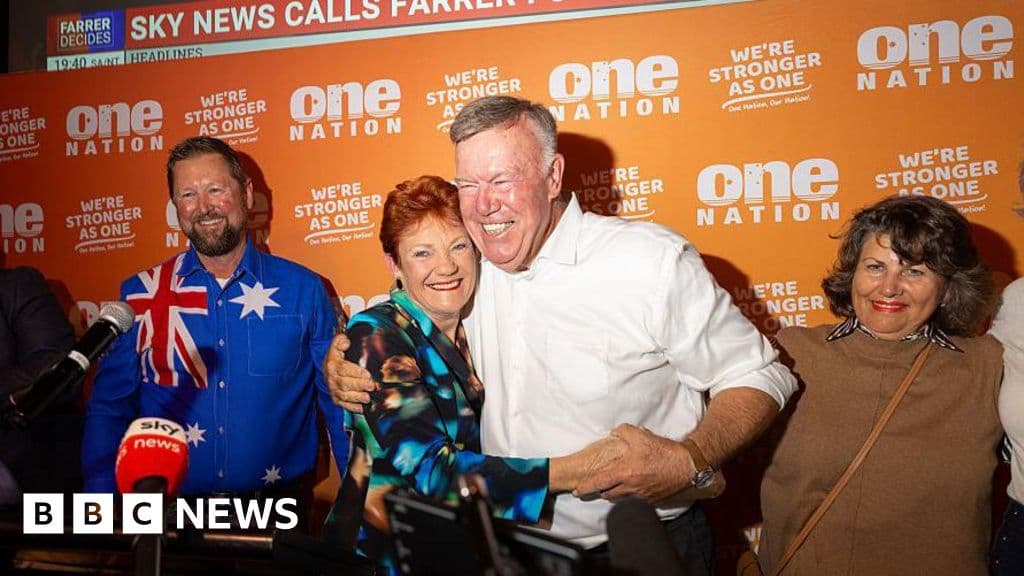
Australia's One Nation party has won its first-ever lower-house seat in what is being seen as an important test for the right-wing populist party.
With almost all the votes counted, One Nation candidate David Farley won over 57% of the tally in Farrer, a vast regional constituency in New South Wales, with independent candidate Michelle Milthorpe on almost 43%.
The contest was triggered by the resignation of Sussan Ley, who quit when she was ousted as leader of the opposition conservative Liberal Party.
While the result will not affect the Labor government's large majority, it is a clear sign that voters are moving away from traditional political parties in Australia.
Saturday's poll was the first federal test of One Nation's support after the party recorded the second-highest number of votes out of any political party in the South Australian state election in March.
As news of the party's victory emerged, One Nation leader Pauline Hanson told supporters this was not just a win for Farrer, but a win for Australia, and said the party was "coming after those other seats".
Farley - whose background is in agribusiness - told supporters One Nation had "reached the end of its beginning, we're going through the ceiling".
"What are we doing tonight? We're like a mason, with a chisel, and a hammer and we're re-carving the letters into the Australian democracy."
Australia has a preferential voting system where voters rank candidates from their most to least preferred. The final tally is calculated as a challenge between two candidates after preferences are distributed to ensure that the winner is supported by a majority.
One Nation had never won a federal lower house contest before Saturday's poll. In the late 1990s Hanson initially held her seat as an independent before losing her re-election bid. She has since returned to the parliament as a senator.
During the campaign, Farley said he had "lost a bit of faith" in the major parties. "They say one thing to your face and then go and do something else in parliament," he said.
Farrer spans 127,000 sq km (49,000 sq miles), an area larger than South Korea, and takes in the regional centres of Albury, Griffith and Deniliquin. The seat has always been held by either the Liberal or National parties.
The by-election also marked tests for the new leaders of the Liberal and National parties, respectively Angus Taylor, who ousted Ley in February, and Matt Canavan, who replaced David Littleproud in March.
The Liberal-National coalition suffered its worst ever defeat in last year's federal election, and the two parties have struggled with infighting and poor polling since then.
Q&A
What does One Nation's victory in Farrer mean for Australian politics?
One Nation's victory indicates a growing support for right-wing populism in Australia and suggests voters are moving away from traditional parties.
Who is David Farley and what role did he play in the election?
David Farley is the One Nation candidate who won the historic lower-house seat in Farrer, achieving over 57% of the vote.
What triggered the election in Farrer for One Nation's historic win?
The election was triggered by the resignation of Sussan Ley, who stepped down after being ousted as leader of the opposition Liberal Party.