
Bowen: Trump and Netanyahu wanted to reshape the Middle East - now they risk a permacrisis
Trump and Netanyahu's plans for the Middle East risk a permacrisis amid rising tensions with Iran.
BBC News1 min read
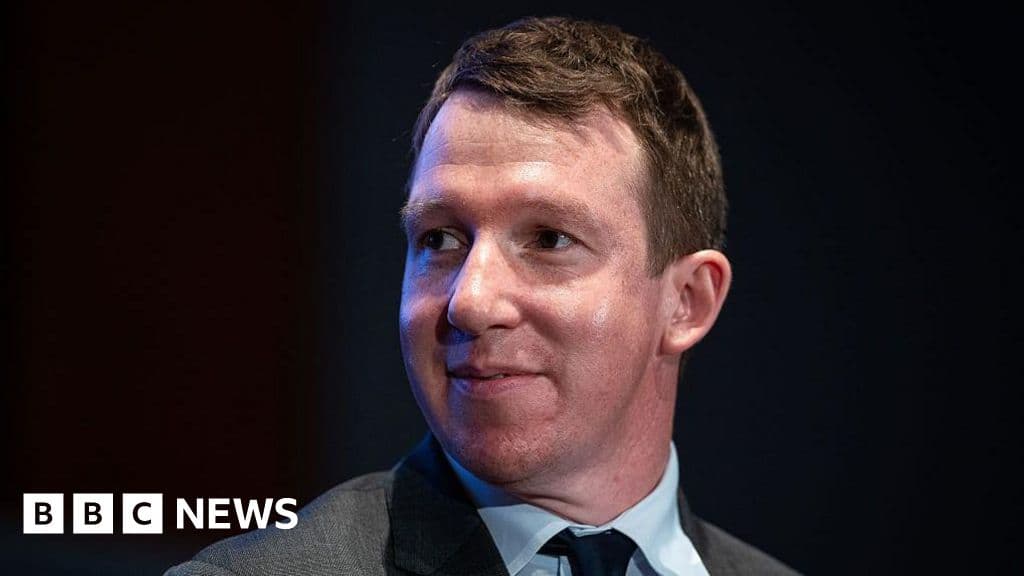
Anthropic co-founder Jack Clark warns that AI is advancing rapidly and may soon develop independently of human oversight. He advocates for regulatory measures to ensure control over AI systems.
Mentioned in this story
Anthropic co-founder Jack Clark has called for the ability to slow progression of artificial intelligence (AI), warning the technology is nearing a point where it could develop without human input.
"You want the option to be able to take your foot off the gas and put your foot on the brake", Clark told BBC Newsnight. "Right now, it's like the AI industry has a gas pedal, but it doesn't have a brake pedal."
He stressed people, through government policy, need to keep control of AI systems, which will only get more powerful and have broader impacts on society.
"The world needs to do some thinking and we need to eventually develop some new regulations that allow us to be confident in these systems," he said.
Already, Anthropic's popular chatbot Claude is operating on code of which 80% the system wrote itself. Getting to 100% is possible within two years, Clark said, and "would have huge implications".
Clark did not outline how a "brake pedal" for AI research and development could be created, but drew a parallel between AI and the oil boom and barons of the turn of the last century.
"Society's response was to come up with a sensible policy and regulatory framework that gave people confidence in oil and the benefits that oil could provide to the world, and meant that you didn't have to worry about the personalities of the people leading the companies", Clark said. "That's clearly where we end up here."
Yet, Anthropic this week welcomed an executive order on AI from US President Donald Trump that was relatively hands-off in its directives toward the companies.
It did not require AI companies to submit to safety testing by the government, something that remains a voluntary effort.
Major AI companies pursuing advances in the technology, including Anthropic, OpenAI and Google, have also not said they will pause their own research.
Anthropic has grown so quickly since its founding five years ago that it is preparing to debut on the public stock market.
It is poised to be one of the first public listings by a newer AI firm and one of the most valuable stock listings in history, as Anthropic's valuation is estimated by private investors to be nearly $1tn (£745bn).
Clark said Anthropic's motivation for publicly discussing the growing capability of AI technology is not to further burnish its reputation with paying customers.
Jack Clark emphasized the necessity for regulations that allow humans to maintain control over AI systems as they become more powerful.
Currently, 80% of Anthropic's chatbot Claude operates on code that the system wrote itself.
If AI develops independently, it could lead to significant societal impacts and challenges in ensuring safety and control.
Clark suggests that the AI industry needs mechanisms to slow down its progression, similar to having a brake pedal in a vehicle.
Trump and Netanyahu's plans for the Middle East risk a permacrisis amid rising tensions with Iran.

Protests erupt in Kenya against U.S. Ebola quarantine center for Americans

NASA announces crew for Artemis III lunar mission set for next year

Two men sentenced for violence during protest over Henry Nowak's death

Belfast's Sudanese community is on high alert following a violent attack linked to an asylum seeker charged with attempted murder.

A train passenger is the first to be sentenced under the new UK harassment law for inappropriate behavior.
See every story in News — including breaking news and analysis.
He simply wants to "tell the world what we're seeing inside these companies with this unusual technology".
Since its founding by chief executive Dario Amodei, Clark and a handful of other executives, Anthropic has positioned itself as outspoken about potential risks stemming from AI.
It even engaged in a public dispute with the US Department of Defense over concerns that its AI tools would be used in mass surveillance of Americans and autonomous warfare.
"I am worried for my kids if we as a society don't have a serious conversation about what the implications of AI's continued advances mean," Clark told Newsnight. "There are potentially great benefits. There are also risks."
Clark added that one of the risks is a disruption to the economy, with fears that AI technology like "agents" - essentially individual AI bots that conduct routine tasks somewhat autonomously could take over certain jobs.
Major tech companies have conducted mass layoffs over the last year, often citing the growing ability of AI tools to do the work of hundreds or even thousands of software engineers.
Clark said people who are more creative and have more, better ideas may actually have an advantage over AI technology.
"There are open questions about whether AI systems can be truly creative… there is not really evidence for that yet", he added. "At Anthropic, we're now limited more by the ability to generate good ideas than the ability to do the engineering to turn those ideas into reality."
Nevertheless, Clark suggested a young person who may be feeling that an economy built on AI does not have a place for them should "develop a hobby" and pursue a liberal arts education.
"People that are creative and can think broadly, people that read a lot, people that have interests are the ones most benefited by this," Clark said. "Indulge in curiosity and it pays back in how you can use this technology."