
Nineteen now arrested over disorder with house targeted in arson
Nineteen people arrested, including a teen, after violence in Northern Ireland and an arson attack.
BBC News1 min read

Kimberlé Williams Crenshaw, a legal scholar and coiner of the term 'critical race theory,' defends its importance in addressing social inequalities. She emphasizes the need for courage to challenge unfair conditions.
Mentioned in this story

Kimberlé Williams Crenshaw is a professor of law at UCLA and Columbia Law School and the founder of the African American Policy Forum. Carl Timpone
Carl Timpone
Growing up in Canton, Ohio, legal scholar Kimberlé Williams Crenshaw was encouraged to call out conditions that were unfair or inexplicable. It was a form of "talking back" that continued into her career, she says.
"We're not living in a world in which we are all standing on equal footing," Crenshaw says. "And we have to muster the courage ... [and] the righteous indignation to talk back against these expectations."
Crenshaw is responsible for naming two of the most contested ideas in American politics: intersectionality and critical race theory.
The idea of intersectionality came to Crenshaw in the late 1980s when she was studying the 1976 Supreme Court case DeGraffenreid v. General Motors.A Black woman had sued the car maker for discrimination and a federal court told her she could sue either as a Black person or as a woman, but not both at once.
"I thought, 'How can these very smart people not get that if you're protected against race discrimination, you're protected against all of it?'" Crenshaw says. "In the same way that traffic going north and south sometimes overlaps with traffic going east to west, discrimination on the basis of race sometimes overlaps with discrimination on on the bases of gender. ... That's where intersectionality came from."

Kimberlé Williams Crenshaw is a professor of law at UCLA and Columbia Law School, and she is credited with coining the term 'critical race theory.'
Crenshaw refers to 'talking back' as the act of challenging unfair conditions and expectations in society, a practice she was encouraged to adopt from a young age.
Crenshaw argues that critical race theory is essential for understanding and addressing systemic inequalities that prevent equal footing in society.
The African American Policy Forum is an organization founded by Crenshaw that focuses on issues of social justice and equity, particularly in relation to race and gender.
Nineteen people arrested, including a teen, after violence in Northern Ireland and an arson attack.
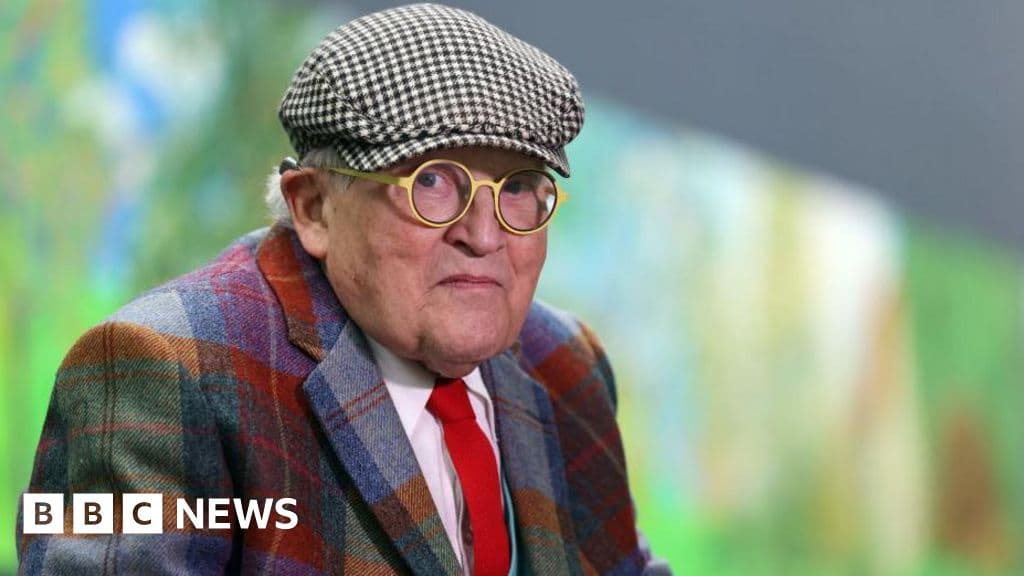
David Hockney, the iconic British artist known for his diverse work, has passed away at 88.

Exploring the Historical Roots of Torture Against Palestinians

USA faces Paraguay in World Cup 2026 opener at SoFi Stadium!

Israel's new buffer zone in Lebanon could be an attempt to seize gas reserves.

China detains American researcher accused of spying amid Myanmar tensions
See every story in News — including breaking news and analysis.
A few years later, with 30 other scholars of color, Crenshaw helped name a second idea, critical race theory, which argues that race is not incidental to American law, but built into it.
"If you are learning about the way that the Constitution embedded enslavement in it, despite the fact that slavery as a word never appears — that's critical race theory," Crenshaw explains. "If you talk about the Montgomery bus boycott and you talk about segregation as an anti-Black policy and practice, that is critical race theory."
In 2020, President Trump attacked critical race theory as "toxic propaganda." More than 20 states now restrict how it can be taught. Crenshaw's new memoir, Backtalker, explains how she came to those words and what it's been like to watch the courts, legislators and the media weaponize and redefine them.

Simon & Schuster
On the importance of dinner conversation growing up
The first thing to recognize is my parents are both educators, my mom and my dad. And that didn't stop when they left the schoolhouse. They came home with the same kind of commitment to prepare their children for a world that we were trying to create, that we were hoping for. So part of that preparation is to speak when you're spoken to, to have something to say, to have some thoughts about what you're seeing in the world, and to be able to defend what it is that you are talking about.
So that started from a very early age, and my friends ... used to tease me when I had to stop playing a little bit before we were called in for dinner because I had to think about what am I going to talk about at the dinner table tonight?
On what she remembers of Martin Luther King Jr.'s assassination
It's like the wind had been taken out of us, the spirit had been taken out of us. There was such a feeling of an upward trajectory. We were clearly aware that we were in the middle of a fight over equality. I was born at a time where some of the basic things that we take for granted now were not yet legal, including the Voting Rights Act. But there was still some sense that we are arriving somewhere. And this was just like, not just air out of the balloon; it sort of exploded our sense of possibility. … What I remember the most is the feeling, like we cannot let them turn us around. We cannot let them take our dreams away from us by just killing our leader. We know that's what they're trying to do, and we just won't stand for it.
On the recent Supreme Court decision that struck a blow to the 1965 Voting Rights Act
People actually died for these laws. They were beaten. Some of them damaged for life because it was more important, to insist on the promises that were made to us as a people, to us, as a democracy, than it was to hide their light or just to fold into a status quo that was unlivable. ...
I watched this stuff unfolding on television. I watched the Selma marchers being beaten. I watched children my age being tortured, frankly, by dogs, their bodies being tossed into the air by water hoses simply because they were demanding to be given the same access, being treated the same way as any other American. Having been able to enjoy the fruits of that labor and the fruits of that sacrifice through the creation of the Voting Rights Act, which is called the crown jewel of the civil rights movement — seeing it systemically dismantled, piece by piece by piece, to see that history basically be unwritten right now, being erased right now, seeing us being pushed back right now, it makes me want to weep. But we don't have time for that. This is a time to talk back against that erasure.
On the importance of holding onto grief and loss
Growing up and knowing about lynching, knowing about how successful you can be as a Black business owner, and because of that success you could lose your life. Or growing up knowing about Tulsa, how a community could survive and thrive and because of that success, you stand to lose everything. One has to hold on to that sense of loss in order to be appropriately cautious and aware that no matter the fact that you can have a Black family in the White House, you can also, in 10 years or 20 years later, find yourself struggling to actually have the right to vote. I think that sense of I'm never going to forget how quickly things can turn. [That's] what being woke is all about.
On what she's thinking about in observation of America's 250th this summer
I remember when I was at Girls & Boys Nation, and this is a program in which 300 17-year-olds are brought to Washington, D.C., to learn leadership and to become patriots of our country. I remember they took us to President Washington's plantation, and they tell us what happened there. And what stands out is what is unsaid, the life stories of the people who were owned by our president, who worked those plantations, who served these presidents. And sometimes that service was material, sometimes that service was, in the case of Jefferson, sexual. And this is all unwritten in the celebratory history that we want to tell. ... If there is a mother [of] this country, it's Black women, because it's through our bodies that the wealth of the nation was able to launch the United States as the global power it actually became.
When Thurgood Marshall was thinking about how he would engage the bicentennial ... he gave a speech that was later published, and in it he basically said when he thinks about celebrating the country we've become, when he think about the rights that we take for granted, when he thinks about the legacy that we should be celebrating, it's not what happened in 1776. It's what happened in 1866. It's what happened at the end of the Civil War. It's the remaking of the Republic in a vision that truly celebrates the idea of citizenship that everyone has access to. ... So I think there is a way of celebrating America. It celebrates those who fought for the true America. It celebrates those judges and lawyers and other actors who made good on a promise that we could be better. It is in that frame of mind that I'm going to celebrate their legacy this summer.
Thea Chaloner and Susan Nyakundi produced and edited this interview for broadcast. Bridget Bentz, Molly Seavy-Nesper and Meghan Sullivan adapted it for the web.

